
Council moves forward with implementing animal microchipping program
Pet registration discussed but not acted upon
After quickly passing the consent agenda and the only resolution on the regular agenda, the Marshalltown city council spent over 40 minutes of Monday night’s meeting considering updates to the animal ordinance and agreed to move forward with a microchipping requirement while not pursuing a pet registration program at the present time.
Capt. Kiel Stevenson of the Marshalltown Police Department (MPD) addressed the council with a rundown of the changes that arose out of five meetings of the Animal Ordinance Review Committee — comprised of Animal Rescue League of Marshalltown Executive Director Austin Gillis, Jodi Gillis, Karla Gould, City Clerk Alicia Hunter, Dr. Grant Jacobson, Wendy Reisinger, Jim Shaw, Marshalltown Police Department (MPD) Capt. Kiel Stevenson, City Councilor Gary Thompson and City Administrator Carol Webb — last year. According to Stevenson, the proposed changes include expanding some of the definitions in the code for clarity, added animal care standards to simplify neglect investigations and a microchipping requirement to quickly reunite lost pets with their owners. It also authorizes the use of Trap Neuter Return (TNR) programs within the city, though the city itself is not involved or directly funding any such program.
A ban on dog breeding operations and household limits for dogs remain intact, and Stevenson noted a new section being added to the code regarding “irresponsible pet owners” who violate the ordinance multiple times in a 12-month period. Such owners can be prohibited from owning pets in the community for 24 months and be required to apply for reinstatement.
“What we find. The ARL could probably speak to this too, but the major problems tend to be a small number of people. It’s like my job. It’s the small number of people that ruin it for everybody else, and what we get here is a handful of people that create issue after issue for us. So this allows us another recourse to deal with that,” Stevenson said.
Other proposals include stronger penalties for animal at-large violations and working with veterinarian Dr. Grant Jacobsen and Marshall County Public Health to clear up the rabies definition in the code. As Stevenson opened up the floor for questions, Thompson, who was the council representative on the committee, said he learned a lot through the process and hoped it would make life easier for both the police department and residents.
In response to questions from Councilor Sue Cahill, Jacobsen said microchipping on average costs about $35, and Stevenson added that the ARL is working on a voucher program to cover the cost for those who qualify. Councilor Mark Mitchell asked about what microchips specifically do, and Stevenson replied that they are registered with a company that provides information on the owner of the pet.
ARL Executive Director Austin Gillis then came forward and thanked the city council and MPD for listening to concerns that were raised during the ordinance review process, noting that it’s always difficult to pass laws or bills that satisfy everyone.
“But what we can do is take our combined experiences and try to find out that best pathway to a joint effort that we can,” he said. “No bill’s gonna be perfect. We don’t know what we don’t know. We can iron the wrinkles as we come across them, but I do think this is a very good step in the right direction.”
The next public commenter, Layne Pieri, offered a series of suggestions related to the proposed changes including seeking clarity on what would garner the irresponsible owner designation, to which Stevenson replied that there should be language to address unique circumstances like a pet sitter making a mistake. Thompson joked that Pieri must have been listening in on the committee meetings as many of those issues were discussed, and he felt that the changes provide “a lot of leeway” to understand specific situations.
Jacobsen then came to the podium and expressed a desire to create “workable definitions” while specifically addressing the issue of feral cats, and Councilor Jeff Schneider then motioned to bring back the changes in ordinance form as presented. It passed by a unanimous 7-0 vote.
From there, the council moved on to considering a pet registration program as Webb explained that it was not recommended by the committee members, who instead favored the microchipping requirement. The city administrator said most of Iowa’s peer cities require pet licensing with annual fees between $5 and $15 per altered animal and a higher fee between $10 and $50 for unaltered pets.
Schneider expressed his support for such a program and felt it could help backfill some of the cost of the city’s contract for services with the ARL, and Councilor Greg Nichols asked how much extra workload it would add for city staff. Councilor Mark Mitchell wondered if veterinarians could perform the work when they vaccinate animals, and Thompson said he had “backed off” the registration idea because he didn’t feel it needed to be done at the same time as the microchipping requirement.
Webb and Gillis said the current contract amount between the city and the ARL is about $86,000 a year, and Nichols asked Stevenson about the concrete differences between microchipping and licensing/registration, which the captain called “a more complete package” mandating that the owner prove vaccination. Webb felt requiring both might be overly burdensome.
During the public comment period, Danielle Lekin shared her support for a registration system over microchipping, and Thompson suggested that a microchipping fee could be assessed to generate some revenue. Jacobsen provided further details on the microchipping system and opined that it was his preference.
Councilor Melisa Fonseca sought clarification on the registration fees and who could perform microchipping, and Mayor Mike Ladehoff said the ARL and veterinarians could do so. Schneider motioned to proceed with the “Muscatine model” for a pet registration program, but it died for lack of a second.
Ultimately, the council opted to take no formal action on the pet registration program but left the door open to reopen the conversation at a later date.
In other business, the council:
• Approved the consent agenda as listed.
• Set the standalone public hearing on the property tax rate for FY27 for March 23 at 5 p.m.
• Honored Nathan White (20 years) and Jacob Patterson (five years) for their service to the Marshalltown Fire Department.
——
Contact Robert Maharry at 641-753-6611 ext. 255 or
rmaharry@timesrepublican.com.
-
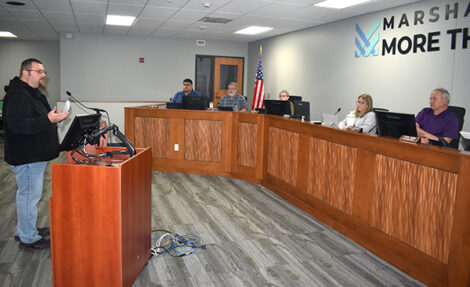
- T-R PHOTO BY ROBERT MAHARRY Animal Rescue League of Marshalltown Executive Director Austin Gillis, left, addresses members of the Marshalltown city council, City Clerk Alicia Hunter, Mayor Mike Ladehoff and City Administrator Carol Webb during Monday night’s meeting. The council moved forward with a series of changes to the city’s animal ordinance including a micro-chipping requirement.
-
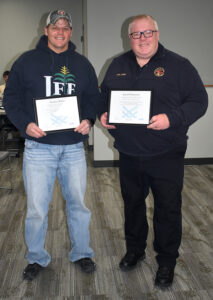
- Captain Nathan White, left, was honored for 20 years of service to the Marshalltown Fire Department during Monday night’s city council meeting. Also pictured is Fire Chief Christopher Cross, right.
Todays News
Sanchez Vasquez placed on probation for election misconduct
Jorge Oscar Sanchez Vasquez was granted a deferred adjudication last Friday by a Marshall County District Court ...
Judge: City’s arrest of critic is ‘quintessential viewpoint discrimination’
Council moves forward with implementing animal microchipping program
Tama County Supervisors no longer interested in old STC Middle School
TOLEDO - In stark contrast to last week’s meeting, only about seven people showed up for last Monday’s Tama ...
Haverhill farmer inducted into Iowa Hereford Breeders Association Hall of Fame
MCSD celebrates Public Schools Week, Feb. 23–27
The Marshalltown Community School District will celebrate Public Schools Week from Feb. 23-27, recognizing the ...