Council OKs revised contract with Arts + Culture Alliance, hears report from executive director
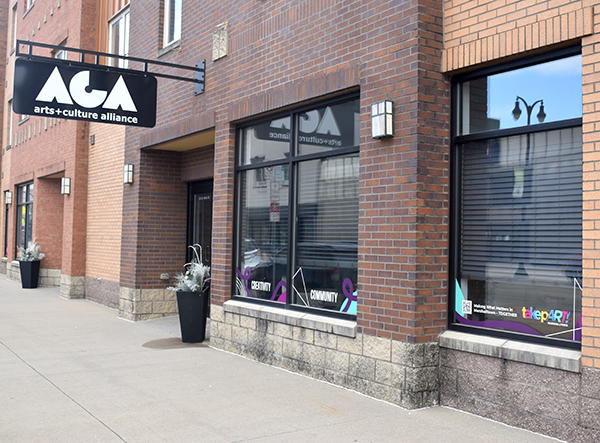
T-R PHOTO BY ROBERT MAHARRY During Monday night’s meeting, the Marshalltown city council voted 4-3 to reduce the city’s contract with the Arts + Culture Alliance (ACA) for creative placemaking and the implementation of the Arts and Culture Master Plan by 20 percent from $130,000 to $104,000 for Fiscal Year 2027 before ACA Executive Director Amber Danielson shared a report about the organization’s first year inside its new headquarters at 126 W. Main St., pictured.
Fresh off of a discussion and eventual approval of a contract for the Flock public safety camera system after it was pulled from the consent agenda, the Marshalltown city council revisited another topic of frequent conversation over the last few years — its contract with the Arts + Culture Alliance (ACA) for services related to creative placemaking efforts and the Arts and Culture Master Plan — during Monday night’s regular meeting.
During a special meeting on Jan. 19, ACA Executive Director Amber Danielson came to the council with a proposal to reduce the annual contract payment by 20 percent from the current annual figure of $130,000, which is funded out of council-designated Local Option Sales Tax (LOST) revenues, to $104,000 for the upcoming fiscal year due to budget constraints, and on Monday night, the item was pulled from the consent agenda for further consideration.
After a motion from Councilor Sue Cahill and a second from Councilor Jeff Schneider to approve the amended agreement, Councilor Gary Thompson explained that he was the one who asked to pull the item from the consent agenda.
“No matter what anybody thinks, the nonprofits are not city businesses, city entities, so the Flock cameras, that is a city entity, that’s the police department. So what I would like to do, and this is not a motion… I’m leaning towards postponing this until the Feb. 23 meeting when we get ready to set the public hearing on everything because the end result is, as a group, we are moving $1,033,223, if I wrote down what Carol (Webb) told me today, we’re moving that from LOST into balanc(ing) the general fund,” he said. “Personally, I’m not comfortable with having to take $1 million from LOST, our slush fund, as people refer to it, the council-designated freedom, not the 75 percent that’s property tax relief, the other 25 percent. It only pulls in $1 million a year, so this is moving the whole year’s worth out of it in that year. It’s as if we don’t have any extra funds for anything else.”
His question for the other councilors was whether they wanted to explore further cuts to LOST expenditures and would explore postponing the vote before making a decision. Cahill replied by asking what additional information would be available by then, and Thompson said Councilor Greg Nichols was researching expenditures related to a specific department while he was also looking at other efficiencies and potential spending cuts in hopes of keeping the overall levy rate at $16 per $1,000 of valuation as opposed to $16.25 due to the increase in the transit levy.
“The department heads have done their due diligence. We just need to be the body on the outside looking in and saying ‘Is this critical to the mission of the city?’ So that’s where I’m at with that,” Thompson said.
He then motioned to postpone the vote until the Feb. 23 meeting, and it failed by a 4-3 tally with Thompson, Mark Mitchell and Greg Nichols in favor of the amendment and Councilors Cahill, Jeff Schneider, Marco Yepez-Gomez and Melisa Fonseca opposed. From there, the original motion to accept the reduction to $104,000 annually passed by a 4-3 vote with Cahill, Schneider, Yepez-Gomez and Fonseca in favor and Thompson, Mitchell and Nichols opposed.
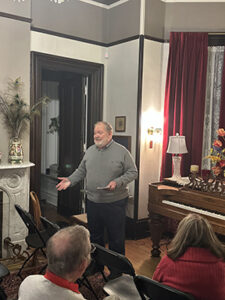
Once the vote had been taken, Danielson stepped to the podium to provide a quarterly update on the work of her organization, which is headquartered at 126 W. Main St. She noted that “a lot” of ACA activities are not funded by city dollars.
“I did just kind of want to set the tone for what we’re focused on in partnership with the city and others in our community, and that really is community development through the lens of ‘How do we continue to make our community unique and distinct and make the people that live here proud to be a part of Marshalltown?’ And we’re doing that through attraction, retention and engaging the people in our community,” she said.
Since the ACA officially moved downtown about a year ago, Danielson said they have hosted eight public events — most of them standing room only — resulting in the sale of over 70 pieces of artwork and at least 2,600 guests visiting the space.
“This really has been what we’re considering an incubator space, and so this is an opportunity for us to kind of test out new concepts, new ideas,” she said. “We hosted events celebrating spoken word poetry, art sales and exhibits, live music, and save the date for March 6. We have another songwriter showcase coming up here in about a month.”
The ACA launched three new grant programs in 2025, hosted bimonthly workshops and invested over $70,000 in 45 different artists in Marshall County.
“Across 10 different events, we had 137 artists participate, and since moving downtown, we’ve seen an 800 percent growth in artist engagement,” Danielson said.
The ACA also invested over $20,000 in nine organizations in 2025, and another round of grants is upcoming this year to continue supporting them. Folklorist Kiran Singh Sirah was selected as the inaugural recipient of the Community Artist Grant and spent two weeks in Marshalltown back in November, hosting 10 total events with over 1,000 participants in all. Soul or System Photography Owner Austin Chadderdon of Marshalltown captured the stories of residents on video, and the highlights will be released as a short film later this year. In conjunction with the Marshalltown Area Chamber of Commerce’s tourism branch, Meet in Marshalltown/Nos Vemos en Marshalltown, the ACA promoted over 20 local festivals in Marshall and Tama counties between May and October as part of “Fiesta Season,” and the initiative will be launched again for 2026 in the next few weeks. They also promote arts and culture events happening each weekend through a weekly email newsletter.
Danielson said the ACA attracted over 1.2 million video views on social media and over 25,000 visitors to the organization’s website, and the first “Selfie Sign” was installed in the 13th Street District just in time for the Harvest Market last fall with six more to come around the community in 2026.
The Linn Creek District projects, buoyed by a $2 million Destination Iowa grant, broke ground in 2025, and Danielson credited City Administrator Carol Webb, Public Works Director Heather Thomas, Parks and Recreation Director Kelsie Stafford and Chamber President/CEO John Hall for their efforts in coordinating the developments with plans to be open by late spring or early summer.
“Weather like today gets us all really excited to see these projects finally come to fruition and really kind of come to life, so we’re hopeful for a nice, long, warm summer season to enjoy these projects,” she said.
The ACA’s long-term goal, she said, is to align with the comprehensive plan the city is in the process of creating while also pursuing “quick wins” like another pedestrian alleyway next to 7 Rayos on East Main Street and proposals for the vacant lot at 101 W. Main St., with over 30 applications including some from international artists received.
Before showing a video to wrap up the presentation, Danielson emphasized that the work of the ACA is happening community-wide, and maps are now available to direct residents and visitors alike to points of interest within Marshalltown from the world’s largest trowel sculpture at MARSHALLTOWN Company to the new Veterans Memorial on the courthouse square.
As she opened the floor up for questions, Thompson sought clarification on which projects and initiatives were utilizing city dollars, and Danielson explained that they go toward creative placemaking efforts like the downtown alleyway and vacant lot she previously mentioned between grant writing and project management (30 percent), actual elements like benches and interactive features (60 percent) and storytelling like video work and drone footage (10 percent). A specific annual contribution to the Marshalltown Community Band is also part of the contract, while the rest is dictated by community engagement and stakeholders. Thompson called the explanation “very helpful” as many residents simply watch council meetings on YouTube and don’t read every attachment in the packet.
“Tonight was really a high level overview of everything we’re doing in the community. Just a portion of the city dollars were in some of those items,” Danielson said. “Thank you for your continued partnership.”
Todays News
UnityPoint awarded grant to hire two specialty providers
Council OKs revised contract with Arts + Culture Alliance, hears report from executive director
Tama County Supervisors, Marshalltown Area Chamber of Commerce formalize contract at signing event Tuesday morning
Marshalltown Water Works deals with multitude of main breaks

Noodle dinner is proven fundraising ‘pasta-bility’