Supervisors set elected official pay with some reductions from Comp Board recommendations
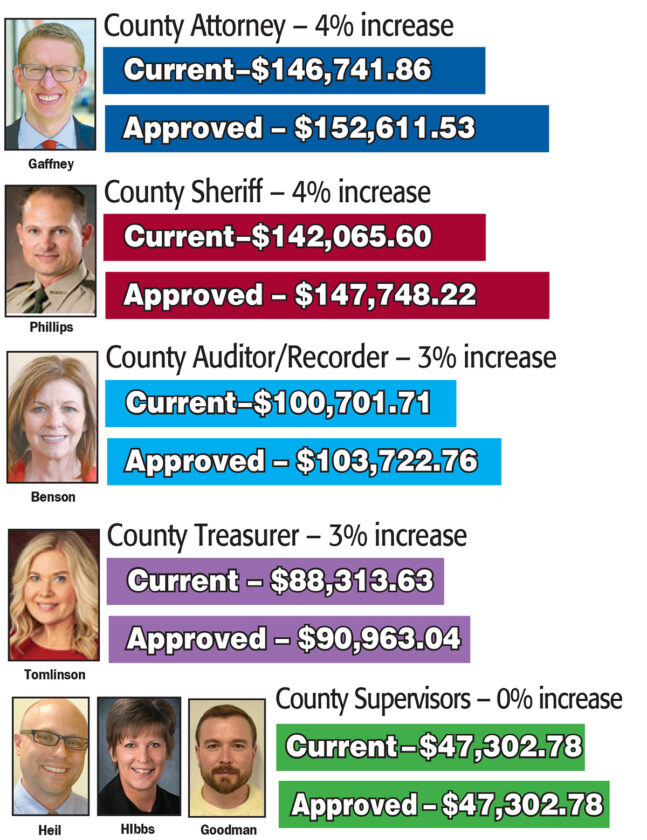
The Marshall County Board of Supervisors performed their annual duty of setting the salaries of elected officials — including themselves — during Wednesday morning’s meeting after the Compensation Board previously met to offer its official recommendations. Per Iowa Code, the Board of Supervisors cannot raise the pay for any official at a rate beyond the Comp Board’s recommendations, but they can reduce the recommendations or approve no raises at all.
Ultimately, after a fairly lengthy discussion that included input from one member of the Comp Board — Mark Eaton of Marshalltown, who represents the Marshall County Sheriff — the supervisors accepted some of the recommendations as presented, reduced others and gave themselves no pay increase for the upcoming fiscal year. Eaton commented that the Comp Board’s meeting went “smoothly” and praised each representative on that board for doing their due diligence in forming their recommendations.
“As always, we are conscious, as representatives, of the burdens that we don’t want to put onto the taxpayers, and we also are conscious that you have trade-offs as supervisors with goals and things like that, but the law surrounding the sheriff’s department says that we need to keep the sheriff commensurate with similar cities and counties,” he said.
Eaton added that he prepares a spreadsheet each year in hopes of keeping sheriff pay in line with 10 similar counties population wise, and the sheriff’s salary in Marshall County has been raised substantially over the last few years due to the passage of Iowa’s “Back the Blue” law. Currently, the pay of Sheriff Joel Phillips ($142,065.60) is slightly lower than that of Marshalltown Police Chief Chris Jones, and Eaton also referenced union negotiations that bump up the salaries of non-union employees, which led him to recommend a four percent increase for the sheriff in order to avoid wage compression as the salaries of other officials like the chief deputy and chief jailer are tied to his salary. The salary of the first assistant county attorney is also tied to the pay of the county attorney.
Board of Supervisors Chairman Jarret Heil was complimentary of the Comp Board for its work and noted that discussing the pay of elected officials — including the supervisors themselves — can be an uncomfortable subject, but it is part of their job to set the rates as required by Iowa law. Eaton also pointed out that in addition to the sheriff, the county attorney and the combined role of auditor/recorder (Marshall is one of just two counties in the state with such an arrangement) are “tough ones” to keep up on and in line with similar counties.
Chief Deputy Ben Veren then stepped forward to offer his perspective on the pay rates and how they are determined across different counties based on various factors, and he felt it was important to keep the four percent recommendation in place to avoid any potential wage compression.
“We are still struggling to recruit and retain. Actually, we’ve done a good job retaining, but recruitment’s still difficult. It’s a very competitive environment right now in law enforcement. Probably a lot of jobs in general are hard to recruit people at this time,” he said. “We’re close enough to the (Des Moines) metro area where we’re not in the metro, but we compete with them because a lot of those metro agencies, you can live here and work in the metro. If you don’t mind that commute, you can go down there and make considerably more money doing essentially the same job. So we’re always struggling to try and compete with that, but we don’t have the tax base or the resources that Polk County does or Story County. So we’re always kind of behind the 8-ball, so I think it’s important to keep our folks up as best we can to be competitive in that job market.”
He went on to explain that when he first took the chief deputy role, he actually took a pay cut in moving from an hourly to salary position and losing overtime but felt it was the right thing to do. Over the last six or seven years, he said they’ve done a good job widening the pay gap to encourage more people to take on such roles.
“It’s not the person, it’s the position, whether it’s the sheriff, the auditor/recorder. All these people will be replaced by someone else down the road. We want people to be willing to take those roles and responsibilities without saying ‘That’s just not worth it.’ And having good leadership in those roles is very important,” Veren said. “Supervisors and those people in those positions make a direct impact on their employees and the public that we all serve, so it’s very important that we do a good job of getting those people in those positions and keeping them there and encouraging people to come to them.”
In the past, some officers have turned down leadership roles because they didn’t make sense financially, and he encouraged the supervisors to accept the recommendation to keep salaries on the right track. New Supervisor Christian Goodman, joking that he was “drinking from the firehose” during his first meeting, thanked Veren for the explanation and initially motioned to accept all of the recommendations as presented before allowing further discussion.
Heil offered a bit more of a breakdown on the county’s overall revenue growth and budget considerations and how they tied into the salary schedule, and Marshall County 911 Communications Director Rhonda Braudis cited the difficult work of law enforcement officers and hoped it would be taken into account.
Auditor/Recorder Nan Benson commented that she was surprised to see County Attorney Jordan Gaffney’s pay rate comparably low compared to similar counties as the Comp Board had recommended a six percent salary increase for his office. All of the recommendations — six percent for Gaffney, five percent for Benson, four percent for Phillips, two percent for the supervisors and 6.5 percent for Treasurer Deann Tomlinson — along with the three other positions tied to the sheriff and the county attorney would have constituted a budget impact of just under $45,000.
Eaton then offered more comparisons of county attorney pay by levy rate, noting that Marshall County’s rate was actually closer to counties with populations of around 10,000 residents, but it is quite low compared to counties with similar populations. He also noted the “additional burden” for law enforcement based on Sen. Charles Grassley’s comments about the presence of three major drug cartels in Marshall County.
Veren spoke of the collaboration between the Marshall County Sheriff’s Office (MCSO) and the county attorney’s office to secure convictions and “finish the job” of ensuring that criminals face justice. Heil felt the supervisors and the Comp Board had made important strides in raising elected official pay to be more commensurate with the population of Marshall County, which ranks 15th in the state out of 99, and he also noted that the Comp Board recommendations had been approved as presented the last three years.
Supervisor Carol Hibbs expressed a desire to strike a reasonable compromise based on the projected budget and suggested four percent for all officials except for the supervisors, who were recommended to receive a two percent bump. Heil then countered with four percent for the sheriff and county attorney, three percent for auditor/recorder and treasurer and two percent for the supervisors before revising it to zero out the board for a total budget impact of $31,524.
After Eaton made one final push encouraging the board to adopt the Comp Board’s recommendations as presented with an emphasis on “people over things” and the relatively small difference of $13,076, a motion to approve the amended salary schedule in line with Heil’s suggestion passed by a unanimous 3-0 vote.
The elected official salaries effective July 1, 2026 will now be set as follows:
• County Attorney — $152,611.53
• County Sheriff — $147,748.22
• County Auditor/Recorder — $103,722.76
• County Treasurer — $90,963.04
• County Board of Supervisors (3) — $47,302.78 each.
——
Contact Robert Maharry
at 641-753-6611 ext. 255 or
rmaharry@timesrepublican.com.
Todays News
GOP Congressional candidate Ryan Rhodes talks immigration, fraud at Legends Friday

Monica Rohde-Fulton set to retire after over three decades at Marshalltown Public Library
Supervisors set elected official pay with some reductions from Comp Board recommendations

Funeral home owner performs impromptu wedding ceremony for local couple
UnityPoint awarded grant to hire two specialty providers