
Council, supervisors agree on EMS direction, but still have ‘long ways to go’
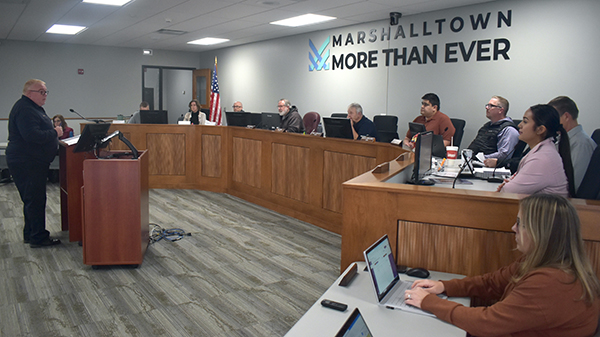
T-R PHOTO BY ROBERT MAHARRY — Marshalltown Fire Chief Christopher Cross, left, addresses a joint session of the Marshalltown City Council and the Marshall County Board of Supervisors regarding the future of EMS services at city hall on Tuesday night.
(Editor’s note: This is the first in a two-part series about a joint meeting between the Marshalltown city council and the Marshall County Board of Supervisors regarding the future of EMS in Marshall County.)
During a meeting that clocked in at about an hour and 45 minutes but resulted in no official action from either governing body, the Marshalltown city council and the Marshall County Board of Supervisors gathered to discuss the future of Emergency Medical Services (EMS) on Tuesday night at city hall in Marshalltown.
By the conclusion, they seemed to have reached a general consensus on pursuing a 28E agreement between the city and county and a countywide ballot initiative to declare EMS an essential service and levy $0.75 per $1,000 of valuation, but it was repeatedly stressed that the parties involved have plenty of work left to do in the near future. Along with the city council, mayor and supervisors, city government and fire/EMS representatives from several of the smaller communities in Marshall County were in attendance along with UnityPoint Health-Marshalltown Interim Executive Director Ron Alston and several Marshalltown firefighters, who were abruptly dispatched on a service call about halfway through the meeting.
Marshalltown Fire Chief Christopher Cross, who has served as the leader of the EMS Task Force, spoke first and then answered a series of questions throughout the evening, explaining that the need for change has primarily arisen from the fact that UPH-Marshalltown, a private nonprofit hospital, loses approximately $1 million a year providing ambulance transport services. Last year, the city council and board of supervisors commissioned a study from Iowa EMS Consultants to assess the situation and present potential courses of action.
Other primary concerns, he said, are limited local control over decisions and transport decisions, risk exposure due to reliance on a third-party provider, declining volunteer participation in the smaller communities and less applications for professional fire departments like Marshalltown. A new system established under a 28E agreement would utilize the MFD as the “operational backbone,” provide countywide Advanced Life Support (ALS) ambulances, support volunteer departments by replacing supplies and transition toward a formal EMS district.
The levy would be paired with a local option income surtax and billing patients for service.
“In conclusion, the EMS study presents a clear finding, and maintaining the status quo is not an acceptable long-term option. And the recommendation of a unified model provides the opportunity to improve patient outcomes, strengthen system reliability, provide local control and accountability to the EMS system and ensure long-term financial stability for providing the service to the public,” Cross said. “The policy direction is critical to determine whether the community should move forward with a voter-approved EMS service model. So that is kind of the 60,000 foot view of the question at hand.”
From there, Cross fielded questions for the better part of an hour and a half, and a number of speakers approached the podium to weigh in on the matter. Councilor Jeff Schneider worried that if the matter is placed on the ballot in November, it will be difficult to get the message out with the other elections and wondered about the possibility of a special election, which County Auditor/Recorder Nan Benson replied would cost the county around $20,000. It should be noted that an essential service measure requires a 60 percent supermajority to pass, and Melbourne City Councilman Josh Fuller told the audience that he believed 21 counties in Iowa have already done so.
“We all agree if we dial 911 in an emergency, we want an ambulance to come pick us up, but to be able to educate the public on what we’re doing here, we need to have time to do that,” Benson said.
Cross estimated that between the levy, the surtax and a conservative collection rate of 60 percent, the new arrangement would generate about $3.8 million annually, and he foresees needing to hire 28 total individuals to staff the operation. He added that the county would serve as the lead taxing authority and the financial driver for staff and capital equipment while the MFD would manage human resources and deliver the service to all county residents.
Other than UPH, Gilman and State Center are the two Marshall County communities with their own ambulance vehicles. Cross and Supervisor Carol Hibbs commented that the goal of the new system was collaboration, not competition.
“There’s a tendency to get territorial and want to turn inward or push away, and I don’t want that. I want one huge EMS silo that is the corporate boundaries of Marshall County. It’s a true system. It’s not Marshalltown vs. the world or State Center doesn’t like Marshalltown because we stole an axe handle from them at some point in time. This is a true collaborative system, and I believe that if we can educate, illuminate and then have a vote, I think people will see that at the end of the process, hopefully,” Cross said.
——
Contact Robert Maharry at 641-753-6611 ext. 255 or rmaharry@timesrepublican.com.
Todays News

Grants awarded at annual Community Foundation ceremony

Council, supervisors agree on EMS direction, but still have ‘long ways to go’
Council OKs street sign changes including new four-way stop at Merle Hibbs/S. 6th St.
School board finalizes 16 of 25 Reimagine Miller contractors

Council OKs contracts for street rehabilitation project, pavement management study
Iowa House sends ‘medical conscience’ bill to governor
The Iowa House approved a bill Monday allowing medical practitioners and health care organizations to refuse to ...