Council, supervisors feel November is ‘too soon’ for EMS essential service vote
(Editor’s note: This is the second in a two-part series about a joint meeting between the Marshalltown city council and the Marshall County Board of Supervisors regarding the future of EMS in Marshall County.)
The final hour plus of Tuesday night’s joint meeting between the Marshalltown city council and the Marshall County Board of Supervisors at city hall in Marshalltown featured commentary from a number of key players with regard to the Emergency Medical Services (EMS) situation as the bodies attempt to navigate a path forward and potentially establish an essential service designation and levy.
Supervisor Carol Hibb explained that changes in reimbursement from Medicare and Medicaid as a result of the Affordable Care Act (ACA) for hospitals around Marshalltown’s size — which only allow hospitals to bill for diagnosis and treatment as opposed to fees for service — have largely led to the current financial predicament with UPH-Marshalltown losing approximately $1 million a year providing transport services.
“When you’re a hospital, you take what you get. Medicare gets to decide how much they pay you, and Medicaid does as well. So you can charge a certain amount, but you only get paid what they say you get paid. And Iowa is one of the lowest Medicare reimbursement states in the country,” Hibbs said.
Mayor Mike Ladehoff also noted that Marshalltown has a substantial population without insurance, but they still deserve ambulance services. Councilor Marco Yepez-Gomez presented a series of questions to Fire Chief Christopher Cross that Yepez-Gomez said were asked to him by members of the public, and Cross did clarify that up front, a new publicly funded system would come with a cost but felt it would improve service in the long term. The final question speculated as to whether the city and county could make EMS an essential service and force UPH to pay for it.
“No,” Cross bluntly responded. “That would be political suicide for all of us.”
Ladehoff told the audience that several hospitals in Iowa have already closed permanently, and he did not want Marshalltown to be added to that list. In response to a question from Councilor Mark Mitchell, Cross said they would likely need to purchase four new ambulance vehicles — three to be housed in Marshalltown and one in State Center — if the new system is implemented along with hiring 28 EMTs and paramedics.
Hibbs noted that UPH would need to keep its vehicles and use them for transport within its own facility and to other facilities.
“They’ll still be part of the system, but their availability will change and their responsibility will change,” Cross said.
Liscomb Mayor Hank Penner, whose community is located on the north edge of Marshall County, asked if the UPH hospital in Grundy Center would potentially be a transport option for patients there as it is a similar distance from the Marshalltown hospital on the far south edge of the city.
“I’m interested in making whatever system exists the best for the patients, and if it means that you can achieve better service from a closer system someplace else, then you should do that. Whatever’s the best for the people, whatever’s the best for the patient,” Cross replied. “I don’t want to be rigid with any of it. We’re setting this system up to help people, and if the end goal is to get the patient off of the X and into definitive care as quickly as humanly possible, then we should foster those behaviors when they present themselves or they exist in the real world. I don’t want to get in the way of anybody doing anything that they want to do. I just want to make sure we set up a good system so that it’s flexible, comprehensive, consistent and reliable. Not that any other system is not, but those are kind of my big four.”
Paramedic Heather Grobe asked about keeping salaries competitive and hiring once the new system is in place, and Cross felt that the Marshalltown Fire Department (MFD) is already a “destination department” and would continue to be under the new arrangement even if specific details on compensation for the new EMTs and paramedics is far from being finalized.
Haverhill Mayor Madaleine Welton worried about funding raises and sustaining the program long-term, and Hibbs stressed the importance of population growth in expanding the tax base and ensuring viability. Cross highlighted the need to forecast and plan and not get “caught in the rain without an umbrella” in managing the budget.
Nicholas Heintz of Cedar Rapids, who served as the ambulance manager and director for UPH-Marshalltown until recently, thanked the community and local leaders for their support and felt many of the questions being asked were the right questions. He worried, however, that the new system could negatively affect the volunteer departments in the smaller towns, and he didn’t feel there is a problem with patient outcomes as it currently stands.
Heintz also took issue with the idea that UPH would suddenly “pull the rug out” and stop providing services abruptly, and he pointed to counties that have passed an EMS levy but have struggled to implement new systems since then. He cited high turnover and burnout rates in the EMS profession.
“There is no career ladder in EMS, and that’s our own fault. As the chief alluded to, (the system) is only 50 years old, but we use that as an excuse way too much. We don’t have the lobbying power, and all of our forefounders only cared about one thing. And that was the patient,” he said.
He noted the low number of professional EMTs currently residing in Marshall County and finding a reliable pool to staff the system. Heintz suggested arranging a three-year contract with UPH in the interim period and paying money from the levy back to the organization.
“Some of you are asking the right questions, but you need to take it a step further. You’re on the right target. You’re doing the right questions and stuff. UnityPoint’s treated me well. I’ve got my opinions and I’ll keep them to myself, but there’s one opinion that you can’t take away that I’ll say. And that’s (that) we’ll put that service against any ambulance service in the state,” Heintz said. “I ask that you don’t take that away.”
Penner credited UPH with keeping him alive but admitted he is always skeptical of tax increases and wondered if the county would make any effort to offset the $0.75, which Hibbs replied hasn’t been discussed yet. Interim Hospital Executive Director Ron Alston stepped forward to the podium about an hour and 20 minutes in and sought to reassure those in attendance that UPH is not “running away” from providing the service and would remain invested in the community going forward.
Laurel Mayor Evan Folk referenced the current countywide reassessment project and asked if a rate lower than $0.75 per $1,000 could be placed on the ballot, and Hibbs said it was too early to determine but commented that the county is not out to take more than needed. Marshalltown City Councilor Melisa Fonseca brought Alston back to the podium and wondered if UPH would be willing to stay onboard as the provider until the new system is in place.
He could not give a firm answer on how long the transition would take but reiterated that the organization remained invested in the community and would support it however possible.
“I think we’ve been at the table, and we’ll continue to be at the table,” Alston said.
As the conversation wound down, the focus shifted to determining a consensus on the path forward and when the essential service designation should be placed on the ballot, with Marshalltown City Councilor Jeff Schneider opining that he didn’t believe the November general election allowed for enough time to properly prepare and educate the public. Supervisor Jarret Heil acknowledged the hesitation many citizens feel about any tax increase in the current climate, and he hoped the parties involved would take the time to ensure sustainability.
“The last thing we want to do is create a new level of government and then say ‘Whoops, we can’t make this work.’ I think that’s the key thing we’ve really got to fine tune in this plan in order to be viable and sustainable,” Heil said. “And I think the legwork that we do, with a little bit more time, allows for that to come to fruition.”
Without any formal action by either governing body, Ladehoff asked for a simple up-down vote from the councilors and supervisors on whether the 28E agreement with the essential service levy was the preferred course of action, and most if not all of them raised their hands to indicate that it was. Both Hibbs and fellow Supervisor Christian Goodman stressed the need to continue moving forward with a sense of urgency as Goodman reiterated that the status quo is not sustainable.
State Center Mayor Craig Pfantz said he was “totally behind” the proposal but highlighted the importance of selling the benefits to each individual community in Marshall County, not just Marshalltown.
“I don’t think any call should be biased toward a community. The people in State Center or Le Grand or anyplace else are just as important as the people in Marshalltown,” Ladehoff replied.
Before the meeting adjourned, Assistant Le Grand EMS Director Tyler Hungerford stood up and took issue with some of the findings in the consultant’s report, specifically noting the mention of a lack of respect and trust between first responding agencies and UPH.
“I don’t see that on our department. We enjoy working with UnityPoint,” he said. “UnityPoint beats us to the scene sometimes, and I don’t get where that’s coming from.”
Hungerford pressed Cross on which agencies were contacted for the study, which he did not recall offhand, and said neither Le Grand nor Green Mountain had any input. He also agreed with the idea of a two or three-year short-term deal with UPH for the time being. Melbourne City Councilman Josh Fuller worried about the impact on smaller communities like his, and Cross reiterated that there are still a host of unknowns that need to be worked out under the new system.
“I would caution everybody to try to expand your mind a little bit. All the presupposed things that you may have or you may think you already know the answers to, I don’t even know the answers to yet,” Cross said. “We’re gonna have to figure it out.”
Ladehoff then wrapped up the meeting and noted that the involved parties still have a long way to go.
“I think, as they pointed out, some counties haven’t figured it out, but Marshall County tends to figure things out. And I think we can do it,” he said.
-
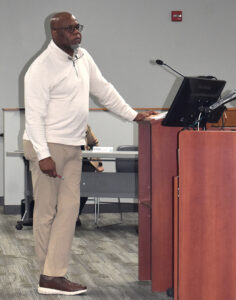
- T-R PHOTOS BY ROBERT MAHARRY — UnityPoint Health-Marshalltown Interim Executive Director of Operations Ron Alston addresses a joint session of the Marshalltown City Council and the Marshall County Board of Supervisors about the future of EMS services in the county during a meeting at city hall in Marshalltown on Tuesday evening.
-

- Liscomb Mayor Hank Penner, standing, was one of several elected officials from the smaller Marshall County communities surrounding Marshalltown who spoke during the EMS joint meeting on Tuesday night.
Todays News

Building a better Marshall County

Chamber, downtown businesses welcome Northwestern Mutual’s Kate Berry
Pesticides have associations with prevalent Marshall County cancers
On Wednesday, the Harkin Institute and Iowa Environmental Council released a study that delves into the cancer ...
Council, supervisors feel November is ‘too soon’ for EMS essential service vote
Supervisors OK additional opioid settlement agreement, E-29 resurfacing contract