Extension office brings Mental Health First Aid certification course
Recognizing there is an issue with an increase of people dealing with mental health issues, a small number of Iowans were able to attend Mental Health First Aid.
Hosted at the Marshall County Extension last week, roughly 20 people learned how to become “the first line of support” for people with mental health needs. Each person introduced themselves and said why they decided to take the class. The reasons varied – work, self-interest, importance to the community, helping clients or their lives were impacted by people who were struggling with mental health crises or had committed suicide.
Leading the class were Iowa State University Extension Health and Human Sciences educators Danielle Day and Malisa Rader. Day told attendees that the class was a public education course and while they would be certified, they would not be licensed counselors afterward.
“This certificate will tell you you are an expert noticer,” she said. “You’re going to practice scenarios, gain tools and skills today to be able to say, ‘I notice when something might not be the same or may have shifted with someone.’ You will be able to say ‘How do I interact with that someone?'”
According to Rader, if 25 people are in a room, 20 percent will have a diagnosable mental disorder in a year. Additionally, she said half of all adults in the United States will experience a challenge during their lifetimes. The common disorders include depressive, substance use, post-traumatic stress, anxiety, bipolar, psychosis and eating. Rader asked what barriers people might encounter which prevent them from seeking help. The lack of providers, finances and transportation; and stigma were the answers participants gave.
Day and Rader added that at numerous times during the class, attendees will not be able to provide diagnoses, but will be able to recognize signs and symptoms and how to respond.
“You’re simply observing those changes in behavior and offering a non-judgmental listening ear,” Day said. “You’re going to respect the person’s privacy, but you are the connector – the vital link between noticing something is going on and getting support as early as possible. Then you’re going to respect and honor that person’s background and experience they bring to the table.”
Some major signs of a challenge are major changes in a person’s thinking, or behavior. The change interferes with a person’s ability to live their life and the interference does not go away quickly.
Rader said “mental health challenge” is an umbrella term, and it was important to note first aiders do not only have to limit themselves to only supporting people with diagnosis.
“We don’t even know if they have a diagnosis. We just need to offer help, right?” she asked. “We want to be able to recognize those early warning signs and symptoms, those worsening signs and symptoms and then the crisis signs and symptoms.”
Day said the class did not cover every single challenge which might occur, but did explain how to react and intervene in the most common. She brought up the story of Kevin Hines, one of only 36 people to survive the fall from the Golden Gate Bridge.
According to Day, Hines walked to the bridge and told himself, “If just one person asks me how I’m doing, I won’t do it.” He did have one person engage with him. She asked him to take her picture. She did not ask how he was doing. He had tears rolling down his eyes, his cheeks. She asked him to take her picture. Think about that. A lot of the time, it just takes one caring person to say, ‘Hey. How are you really doing?'”
Rader spoke about the stigma surrounding mental health, and how it makes it hard for people to talk about what they are struggling with. She asked participants to write on sticky notes three phrases they had heard people use when talking about mental health challenges. Then they were to place the notes in corresponding categories – Stigmatizing, Possibly Stigmatizing or Not Stigmatizing. Most of the answers were considered stigmatizing.
“Most of the words we have around mental health are negative or stigmatizing,” Rader said. “[We’re going to] focus on our language and the terms we use as mental health first aiders to describe mental health challenges. We need to be that catalyst to help change our language.”
One way she said that can be done is using “strength-based language” to focus on the positive aspects of a person’s health and well-being. An example Rader gave is telling someone they had experienced difficult things before and shift the focus on how they got through those hard times.
Another change is using “person first language.” Rather than describing someone as “schizophrenic,” Rader said a first aider should say “a person living with schizophrenia.”
“It helps us recognize the individual first before the condition,” she said. “It’s not the entirety of who they are. Person-first language helps us acknowledge the mental health challenge is not as important as the person’s individuality and their humanity.”
LIFELINE:
The educators brought up a help line people who might be contemplating suicide or are going through a crisis can call or text – 988. Using the same resource, people can chat by going to 988lifeline.org.
——-
Contact Lana Bradstream
at 641-753-6611 ext. 210 or
lbradstream@timesrepublican.com.
-
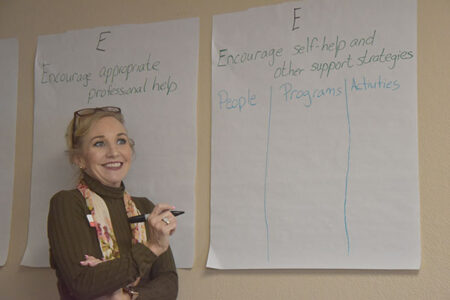
- T-R PHOTOS BY LANA BRADSTREAM — Iowa State University Extension Health and Human Sciences Educator Malisa Rader writes down suggestions from students in her class on ways they can offer support and encourage self help. The class was held at the Marshall County Extension office last week.
-
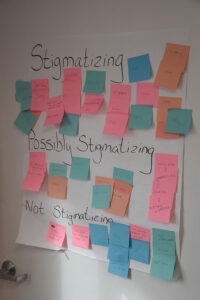
- Attendees of the Mental Health First Aid class wrote down phrases they have commonly heard from people talking about someone dealing with a mental health issue. Most of the phrases fell in the stigmatizing category, highlighting the attitude society tends to have toward mental health.
Todays News

Sammy Kershaw will headline at the 2026 Central Iowa Fair
MNPD investigating vandalism at Powwow Grounds
MESKWAKI SETTLEMENT — The Meskwaki Nation Police Department is investigating a recent incident of vandalism at ...
Extension office brings Mental Health First Aid certification course
Bill outlawing kratom as a Schedule I drug passes Iowa House
Kratom would be outlawed as a Schedule I substance under a bill passed Tuesday by the Iowa House. House File 2133 ...
National American Legion Vice Commander visits IVH Tuesday