Five most prevalent cancers in Marshall County identified during seminar at MPL
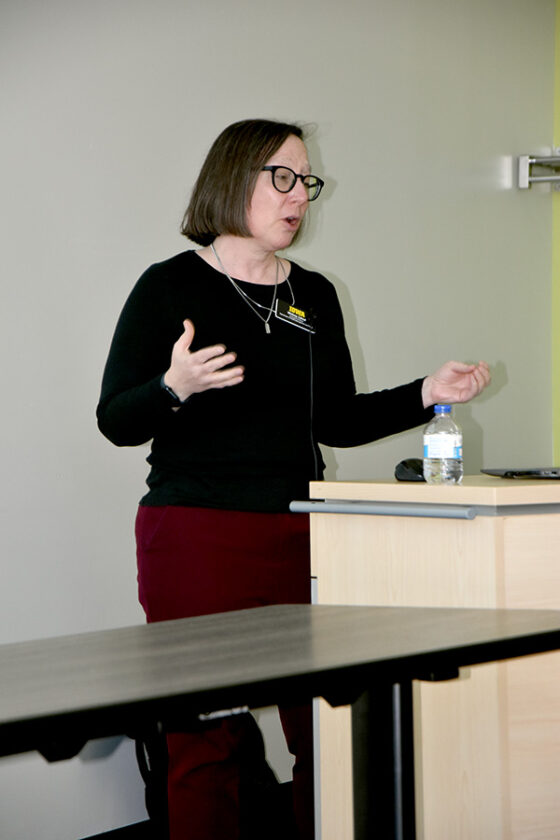
T-R PHOTO BY LANA BRADSTREAM Whitney Zahnd, an associate professor at the University of Iowa, explains the top five most prevalent cancers in Marshall County during a seminar about cancer at the Marshalltown Public Library on Wednesday night.
Each year, there are 264 new cases of cancer in Marshall County, and 86 deaths from cancer.
That was just one of the important pieces of information shared with roughly 20 attendees at a seminar about cancer at the Marshalltown Public Library on Wednesday night.
They also learned that the five most prevalent types of cancer within the county are prostate, breast, lung, colorectal and endometrial.
Whitney Zahnd, an associate professor with the University of Iowa College of Public Health and presenting on behalf of the Iowa Cancer Consortium, said Marshall County ranks 50th among the 99 Iowa counties in the cancer rate, and it is also higher than the national rate. However, the rate of death is similar to the national.
She said on average, there are 39 new cases of prostate cancer each year.
“For Marshall County, the rate is higher than we see nationally, but the rate of death is about what we see nationally,” Zahnd said.
She suggested that men aged 55 to 69 speak with their physician about screening. Fortunately, 77 percent of cases are diagnosed in early stages, which is a higher rate than what is typically seen. When cancer is detected early, there is a better chance of survival.
The breast cancer rate is the second highest in Marshall County, with 36 new cases annually, and an average rate of death. Zahnd recommended women aged 40 to 74 get screening every other year, and should talk to their doctor if there is a family history.
“We see the screening rate in Marshall County is about 75 percent in women aged 50 and older,” she said. “This is a little bit lower, about five percentage points, from the statewide rate and a little lower than the national rate.”
Similar to prostate, most of the breast cancer cases – 75 percent – are diagnosed at an early stage, and is higher than the state and national rates.
The third most frequent cancer is lung, and the incident rate exceeds the national rate, Zahnd said.
“There’s about 36 new cases each year,” she said.
Since lung cancer screening is newer, only about 18 percent of people who are eligible have received it.
“For those who have smoked in the past 15 years and are between the ages of 50 and 80, have a conversation with your doctor,” Zahnd said. “This is one where, unfortunately, lung cancer in general is diagnosed a lot later than we see for the other cancers. Three-fourths are diagnosed at a late stage, almost the reverse than what we see for breast and prostate cancer. That screening provides the opportunity to detect the cases.”
She added that smoking is the number one cause of lung cancer, and radon is the second leading cause. If someone who has not smoked and develops lung cancer, it is likely they were around radon. Zahnd said that for people who have smoked and been exposed to radon, the risk is much higher.
The fourth most prevalent cancer in Marshall County is colorectal, with 22 new cases each year. Roughly 63 percent of adults aged 45 to 75 have received screening, which is a little lower than the state and national. About 47 percent of the cases are detected in the early stages, which is higher than the state and national rates, she said.
The fifth leading cancer is endometrial, also known as uterine, with nine new cases annually. Unfortunately, Zahnd said there is no recommended screening for uterine, but women can look for symptoms such as vaginal bleeding not related to menstruation.
Zahnd added there are many reasons into how or why a person gets cancer, but the primary categories are narrowed down to lifestyle, genetics, environmental and other factors, such as aging or viruses like Hepatitis B and HPV.
She said one reason for the seminar was to focus on things people can do to reduce cancer risk. Some ways people can reduce their cancer risk include:
• Do not use tobacco products, and make your home smoke-free;
• Limit alcohol consumption;
• Reduce indoor and outdoor air pollution, including radon;
• Eat a healthy diet;
• Be physically active;
• Decrease excess body weight;
• Avoid excess sun, and use sun protection;
• Vaccinate against Hepatitis B and HPV and;
• Get appropriate screenings.
——-
Contact Lana Bradstream
at 641-753-6611 ext. 210 or
lbradstream@timesrepublican.com.
Todays News

Mid-Iowa Enterprise owner shares 155-year history of newspaper at Mowry Irvine Mansion
Five most prevalent cancers in Marshall County identified during seminar at MPL
Iowa DOT no longer planning ‘J-Turn’ intersection at Highway 30 intersection in State Center

Albion farmer Wade Dooley ends campaign for Iowa Secretary of Agriculture
Supervisors OK website proposals with Neapolitan Labs
The Marshall County and Marshall County Conservation Board websites will soon be receiving major overhauls as the ...