Naig tours water-quality conservation projects in Tama, Grundy counties
Partnerships aim to address Iowa’s water quality issues
TAMA/GRUNDY COUNTIES — State and local conservation leaders gathered in rural Tama and Grundy counties earlier this week to highlight ongoing efforts aimed at improving Iowa’s water quality through a combination of agricultural conservation practices and partnerships between private industry, government agencies, and local farmers.
The visit, attended by Iowa Secretary of Agriculture Mike Naig, included stops at two farms where conservation practices such as saturated buffers and oxbow constructions are being implemented as part of broader water-quality initiatives.
Naig toured the sites alongside representatives from Heartland Co-Op, the Iowa Soybean Association, and the U.S. Fish and Wildlife Service, area contractors, as well as local landowners and farmers participating in the projects.
“These are the kinds of partnerships that really move the needle,” Naig said during the visit. “I always like to see these projects up close and kind of look back and understand how the water flows across the landscape.”
The first stop of the tour took place at Devick’s farm in rural Tama County near Gladbrook, where partners highlighted saturated buffer installations designed to treat water flowing from agricultural tile drainage systems before it reaches nearby waterways. Saturated buffers work by diverting tile drainage water into vegetated strips of land along streams. As the water slowly moves through the soil, natural biological processes remove nitrates and other nutrients before the water returns to the drainage system.
The installations are part of a “batch and build” approach used by Heartland Co-Op, which allows multiple conservation structures to be installed across a watershed in coordinated groups rather than one project at a time.
The second stop of the tour took place on Brad Ohrt farmland, where partners are beginning construction on a new oxbow wetland.
The oxbow will capture water draining from surrounding farmland and slow its movement across the landscape. As water collects in the wetland, natural processes help remove nitrogen and other nutrients before the water flows, eventually returning to the creek.
Multiple partners involved in the project explained that wetlands such as oxbows can provide multiple benefits at once, including water-quality improvement, wildlife habitat, and floodwater storage.
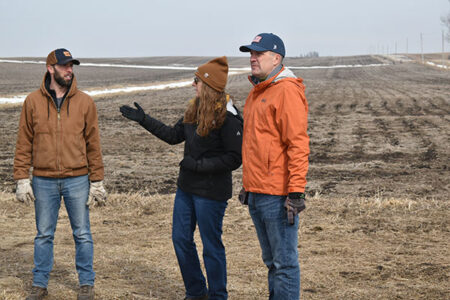
The project also complements the saturated buffers installed nearby, creating what McCabe described as a combination of edge-of-field and in-field conservation practices working together across the landscape.
Many of the conservation efforts highlighted during the tour are tied to broader efforts across Iowa to reduce nutrient pollution in rivers and streams.
Excess nutrients from agricultural runoff can contribute to water quality problems downstream, such as elevated nitrate levels in drinking water.
Conservation practices such as saturated buffers, wetlands, bioreactors and cover crops are designed to reduce those nutrient losses by capturing nitrogen before it leaves farm fields.
Naig said the projects demonstrate how farmers, conservation groups and government agencies can work together to address water-quality challenges while maintaining productive farmland.
“These are voluntary efforts led by farmers and landowners who care deeply about the land,” Naig said. “Projects like this help protect water quality while keeping farms productive for the next generation.”
Ohrt said conservation practices have long been part of how his farm operates. Over the years, the farm has incorporated practices such as reduced tillage, cover crops, and grassed waterways to limit erosion and protect soil health.
“This is good for habitat and it’s good for cleaning up our water,” Ohrt said during the visit. “Instead of having tile water go directly into a stream, it can be filtered first. That’s important to me.”
Ohrt added that the mission was simple: keep soil and nutrients where they belong.
“Once the soil’s gone, you never get it back,” Ohrt said.
The projects showcased during the visit are part of a larger conservation effort being coordinated by Heartland Co-op and its partners across multiple Iowa watersheds.
The organization’s batch-and-build initiative between 2023 and 2026 will result in 113 saturated buffers and bioreactors treating 148 tile outlets across the state.
So far, 74 of those structures have been installed, with 39 additional installations planned for 2026.
Earlier batches of projects in the Lower Cedar watershed installed 26 saturated buffers and 15 bioreactors treating 48 tile outlets during the 2023-2024 project period.
A second batch scheduled throughout 2026 timeframe will include 22 saturated buffers and three bioreactors treating 43 tile outlets.
Heartland agronomists say expanding the use of these practices can significantly reduce nutrient loss while helping farmers maintain soil productivity and long-term sustainability.
The farm tours concluded with a group photo and agreement that partnerships like these are instrumental in taking steps towards better water quality and improved conservation.
-
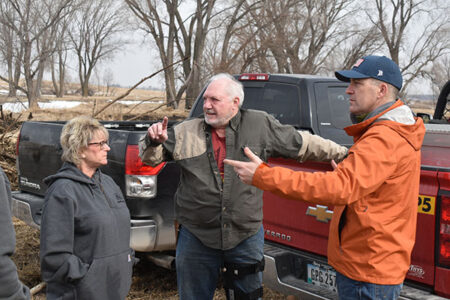
- T-R PHOTOS BY JONATHAN MEYER — From left: Lynn Ohrt and Brad Ohrt along with Iowa Secretary of Agriculture Mike Naig visit during a stop on the Ohrt farm in rural Grundy County, where the trip discussed the history of the Ohrt family’s farmland and ongoing conservation efforts on the property.
-
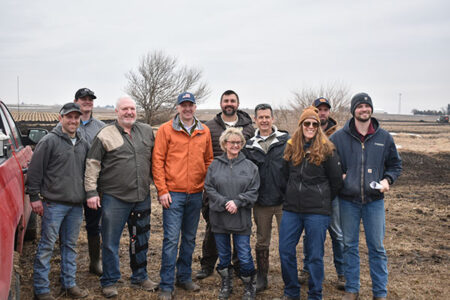
- At the end of the visit to the Ohrt property, those in attendance gathered for a photo with Iowa Secretary of Agriculture Mike Naig. From left to right: Nathan Greely, farmer; Brandon Iddings, Iowa Soybean Association (back row left); Brad Ohrt, landowner (second from left, front row); Iowa Secretary of Agriculture Mike Naig; Lynn Ohrt (front); Drew Diallesandro, U.S. Fish and Wildlife Service (middle back); Todd Stuphin, Iowa Soybean Association (back); Emery Davis, conservation agronomist, Heartland Co-op (front); Ruth McCabe, conservation manager, Heartland Co-op; Nolan Grove, conservation agronomist, Heartland Co-op.
-
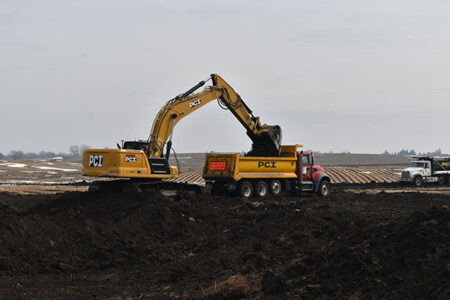
- PCI Machinery worked on an Oxbow project on the Ohrt farm during Secretary Mike Naig’s visit.
Todays News
Naig tours water-quality conservation projects in Tama, Grundy counties
Gov. Kim Reynolds supports U.S. war in Iran, mourns deaths of Iowans killed in strike

Iowa man charged with aggravated murder in the deaths of 3 women found in Utah

Local panelists speak of challenges faced on International Women’s Day

Ovens set to roar once again at Traer Pizza Palace