AI can do ‘a lot of different stuff’ in the workplace
‘What Can AI Do for You?’ class held at MCC Thursday
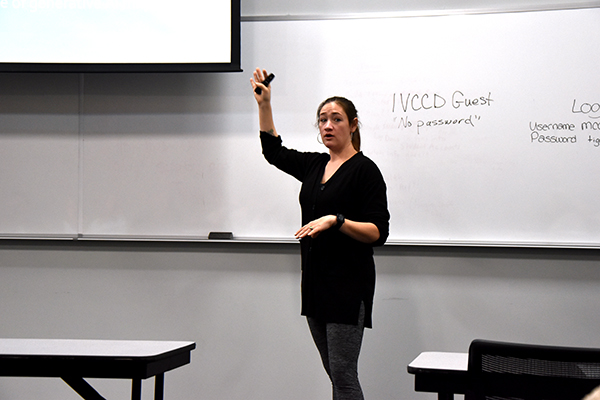
T-R PHOTO BY LANA BRADSTREAM Molly Mackey with the LeaderNship Institute tells a class about uses of AI (artificial intelligence) in the workplace during a two-hour at Marshalltown Community College (MCC) on Thursday, which covered various websites that can be used, how AI can be utilized and ethical concerns.
Whether people are ready for it or not, AI (artificial intelligence) is here and is becoming more widely used.
Its growing prevalence has created a need for classes and learning opportunities, such as what was held at Marshalltown Community College (MCC) on Thursday. The two-hour class, What Can AI Do For You?, was part of the Invest In Your Team: The Soft Skills Lunch & Learn Series and was instructed by Molly Mackey with the LeaderNship Institute. She started providing AI training classes two years ago.
“In the past two years, it went from most people not using it to people using it on a frequent basis,” Mackey said. “It’s a lot different than my usual topics, which are soft skills, but I found this niche where people want to know about AI. They also want to know what specifically they can use it for.”
She said AI usage is at the point where most people have at least experimented with it and are curious about how to get the technology to take care of mundane tasks. In the workplace, Mackey said AI is used frequently in communication — making emails sound more formal, marketing tools and more.
“There’s a ton of different stuff it can do,” she said.
Some practices Mackey suggested that people use to get more effective prompts from LLM (Large Language Models) AI such as ChatGPT include:
• Assign a role. For example, tell the AI it is in a specific role, such as a director of nursing;
• Define the styling output, such as the format, structure and tone;
• Be specific on what the AI should do. If the AI should create a cover letter for a director of nursing job application at a specific company, give those instructions;
• Add conditions, such as context or background details, constraints and persona;
• Provide data. Mackey stressed personal or sensitive data should not be included. She told about a healthcare employee who uploaded medical records of coworkers to create a database, which was a HIPPA violation.
Mackey spoke about a website, promptcowboy.com, she recently learned about that helps people design AI prompts.
“I have people do prompts that were up to two pages,” she said. “So, if you’re looking for different ideas on how to prompt AI, Promptcowboy is a good tool for that.”
Mackey said AI is being used for recruiting by some companies, such as Kohl’s. The Kohl’s AI is called Kira, and Mackey tried it to get answers to simple questions about working there. The positive aspect is that a user gets real-time responses. However, she found Kira was very aggressive in asking for phone numbers, and was unable to provide answers for scheduling policies.
“It can be nice if you’re looking to recruit folks and start those initial conversations,” Mackey said.
She has also seen people use AI for hiring in writing new job descriptions. When Mackey uses LLM for such tasks, she will ask the AI for three options, so she can pick the best one.
She also shared a tip on utilizing LLM, such as ChatGPT for when someone is trying to create a better prompt. Mackey will go to Microsoft Copilot to search for the top five sources of information, which supplies links to where the information came from.
“Some people ask if they can Google it, and you can,” she said. “I just find this is a little bit more effective than getting a bunch of pages. This will give the top five sources.”
Another usage for AI is virtual notetaking. Mackey said a client she worked with had two administrative assistants, and 80 percent of their job was taking notes at meetings.
“This could definitely replace that and make them more free to do more creative projects,” she said.
Mackey has used AI for team development ice breaker ideas.
“I said, ‘Hey, I’m a corporate trainer. Devise 10 zombie apocalypse ice breakers that are appropriate for the corporate atmosphere,'” she said. “I’ve used it for conference themes and for PowerPoint slides.”
For example, Mackey used Genspark to make a 50-minute training broken into two sections, critical health for the first and work and fire emergencies for the second. She added it is important to fact check such documents or creations as AI is not as accurate as people want it to be.
That is one of the ethical concerns with AI — misinformation and fake content. Other concerns Mackey said are common include intellectual property and copyright, privacy, loss of human touch and unemployment and job displacement.
The increasing usage and ability of the technology has made the latter a reality for some people, such as the fact that 40 percent of Block workers who were laid off in February. Mackey said AI has already disrupted the first rung on the job ladder – interns and college graduates.
There are two vastly different opinions from AI experts on that matter.
“Some experts say this will be absolutely catastrophic,” she said. “Some people, like Sam Altman, say people will need universal basic income because it will wipe out so many jobs. Other folks are saying this is like the industrial revolution, and the jobs will be replaced by something else. That is Kevin O’Leary’s opinion. I think it’s somewhere in the middle, and we will have to see how it plays out over the next couple of years. What the experts can agree on is (that) human skills, such as face to face communication, are going to be absolutely essential going forward.”
——-
Contact Lana Bradstream
at 641-753-6611 ext. 210 or
lbradstream@timesrepublican.com.
Todays News

Iowa DOT starts construction on Toledo roundabout Monday

OneroRx Inc. completes acquisition of NuCara pharmacy locations
AI can do ‘a lot of different stuff’ in the workplace

Gubernatorial candidate Rob Sand calls for term, age limits on elected officials

Speed limit on 2-lane highways could increase under bill passed by House