
Marshalltown author pens latest book titled ‘The Declaration Decoded’
Trending
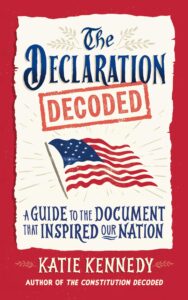
"We hold these truths to be self-evident, that all men are created equal, that they are endowed by their Creator with certain unalienable Rights, that among these are Life, Liberty and the pursuit of Happiness" is a key line from the Declaration of Independence. Nearly 250 years after the document was written, Marshalltown author Katie Kennedy has worked to explain and dissect the famed work, making it more understandable for middle grade readers. These efforts are her latest book: "The Declaration Decoded: A Guide to the Document That Inspired Our Nation." It is available in hardcover and ebook.
The final installment in a three book series (her prior two are called "The Constitution Decoded" and "The Presidents Decoded,") the tomes provide historical context and trivia, packed with primary source materials including speeches, letters, diaries, documents and more.
Kennedy said the book, which was a lifelong dream to write, got sandwiched between two other projects: "Did You Hear What Happened in Salem?" which came out last September, and the next book in the series "Did You Hear What Happened at the Alamo?" due out this September.
The research involved in writing these types of books is something she finds rewarding. She explained that Thomas Jefferson wrote the first draft of the Declaration of Independence but Congress edited it heavily. Kennedy said "taxation without representation" is just one component of the signers' protests.
"The document is structured so that you have the preamble, which sets up the right to revolution, and then the grievances, which are 27 charges, originally 28, made against the king (George III), not against Parliament, and he's the final link connecting them to the mother country, and they're breaking it," Kennedy said. "And then the third part of that structure is invoking the right to revolution that Jefferson set up in the first paragraph."
She noted some of the grievances are vague.
"He wasn't trying to explain something, he was trying to justify something," she added.
The "decoded" sections sprinkled throughout the book summarize takeaway points. Particularly, they break down the charges outlined in the document, using more contemporary language. In addition, Kennedy includes the 28th grievance and explains why it was removed from the final document. In it, Jefferson had accused the king of blocking colonial efforts to tax and end the transatlantic slave trade. Jefferson also grumbled about the Brits' offer to free enslaved men if they joined the British army to fight what would become the American forces. Kennedy writes that at least 40 of the 56 signers of the document held slaves. Jefferson would go on to oppose the international slave trade and advocate for gradual emancipation. He owned hundreds of enslaved people and ultimately only freed a few in his lifetime and in his will.
"I spent a lot of time with versions of the Declaration as it changed. You would track each word as it went through various drafts and revisions, and so on, and what happened to each word, or what was inserted, and what was cut. It got endlessly fascinating," Kennedy said.
She noted that Jefferson wrote the first draft "much hotter" than the final version ended up being after edits made by the Second Continental Congress. His writing was cut by 25 percent.
"Of course, it's coming from all of them; all of their necks are on the line," she said of the signers.
One of the stories Kennedy found fascinating is that of signer Caesar Rodney of Delaware.
"The vote for independence failed, and they needed his vote (to break a tie), and he wasn't there. They sent word that they needed him back the next day for the next vote. He rode 80 miles overnight in the dark," she said.
Rodney traveled on horseback through the rain from Dover, Delaware to Philadelphia, himself in ill health battling asthma and facial cancer. He arrived in time to cast a deciding vote for the document on July 2, 1776. He was part of the official signing of the document that August.
"When he signed it, his chance of getting medical care in Britain was shut off," she said of his bravery.
Kennedy said more books are planned in her "Did You Hear What Happened" series, including one slated for release next year on the Triangle Shirtwaist Factory Fire of 1911, which killed 146 people. The tragedy proved the catalyst for labor reform and laws regulating fire escapes, sprinklers, child labor and more. Following that book will be "Did You Hear What Happened at Gettysburg?" due out in 2028. She said this series is written in "snarky" first person narration.
Kennedy is an adjunct professor of history at MCC, and a part-time librarian at Marshalltown Public Library. Her debut novel for adults, a hockey romance entitled "Hearts On Thin Ice," came out in June 2024.
Learn more at: katiekennedybooks.com.