
Auditor: School choice cost Iowans $258 million
Trending
Nearly 79% of students who used Iowa's funding program for K-12 private schools were "already projected" to attend private schools, according to a report released Wednesday by Iowa Auditor Rob Sand.
Iowa Department of Education called the report a "policy advocacy brief" that critiqued statutory provisions of the Iowa Education Savings Account (ESA) program.
Iowa's ESA program provides funding to students to use on tuition and associated costs at private schools and had an estimated appropriation of $329.6 million for fiscal year 2026, according to the Legislative Services Agency. The auditor's report said this means the state paid roughly $38,000, per student for the 20% of ESA program users who were not already projected to attend private schools.
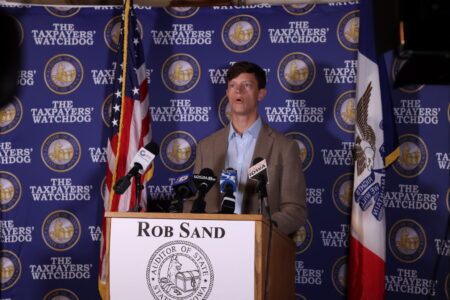
"The program itself, though, is still paying tuition for the wealthiest families in the state of Iowa, who can barely even feel the check that they write, and a lot of people who don't mind doing it at all," Sand said in a news conference Wednesday.
Fiscal year 2026 was the first year the ESA program did not have income limits for participants. Previously the program was limited to families with incomes at 300%, then 400% of the federal poverty level, or lower.
According to the auditor's report, 8,838 more students attended private schools in the 2025-2026 school year, than what Iowa Department of Education projections from 2022, prior to the implementation of the ESA program, anticipated for the 2025-2026 school year.
The report says it is "reasonable to conclude" that the nonpublic enrollment of these 8,838 students is a result of the ESA program, and that the other 78.5% of students who made use of the voucher program "were expected to attend nonpublic schools even if the program never existed."
"In other words, taxpayers paid roughly $258.7 million in FY26 to fund private school tuition that otherwise would have been paid privately," a news release about the report said.
The Iowa Department of Education said in a statement that Sand's office did not request data from the department, inform the department about the development of the report or allow the department to review the report for "data accuracy." It said the report was not an audit, nor did it pertain to "any formal role of the state auditor's office."
"In Iowa, all families are empowered to make informed educational decisions that best fit their child's learning style, interests and talents, whether it's a neighborhood public school, a public school outside a family's resident district through open enrollment, an innovative public charter school, an accredited nonpublic school or a homeschool learning environment," the Department of Education said.
The Iowa Department of Education agreed that the number of students enrolled in accredited non-public schools has increased since the start of the ESA program, but said enrollment in other forms of school choice, like public schools outside of resident districts, has also increased.
The department said public school enrollment was in decline "long before" the ESA program was implemented in 2023. This is supported by Iowa enrollment data and national projections from the U.S. Department of Education.
The ESA program sent an average of $1,656, according to the Iowa Department of Education, per program user, to the students' residential public school district during the 2025-2026 school year. The department pointed out that Sand's report "omits" this public school funding which amounted to more than $37.9 million in fiscal year 2026.
Sand said his office has asked questions about the ESA program "many, many times" but has been "limited" in its ability to evaluate the program.
In February 2025, Sand said the Iowa education and revenue departments did not provide certain documents related to the ESA program that his office requested. The departments and Gov. Kim Reynolds disputed Sand's claim and said it was a politically motivated attack on the ESA program. Sand eventually received the documents and his audit of the program from February 2026 did not find any spending issues or irregularities.
Sand is running as the Democratic nominee for governor and has been critical of the ESA program both in his official capacity and as a candidate. He said Wednesday even if his opponents want to call this new report a politically motivated move, he feels "it's important for Iowa taxpayers to understand" the cost of the program.
Closures and accreditation
The report also looked at the increase in the number of nonpublic schools opening in the state and the number of schools using independent agencies to receive accreditation.
The report found that since the ESA program was implemented, there has been an overall increase in the number of nonpublic schools in the state, as well as an increase in the number of private school openings and closing.
"But those schools are smaller and are more likely to shut down on a year-to-year basis," the report said.
According to the report, there has been an annual average of 21.7 nonpublic school openings and 5.7 nonpublic school closings since the 2023-2024 school year when the ESA program was implemented.
A 2013 law allowed school districts in Iowa to receive accreditation through approved independent agencies, rather than from the Department of Education. Sand's report said nonpublic schools have been "dramatically less likely to receive accreditation from the state" since the implementation of the ESA program.
Per the report, 66% of nonpublic schools that opened prior to 2023 received accreditation from the state and 2% of the nonpublic schools that opened since 2023 received accreditation from the state.
"I think that if the vast majority of private schools are now using these other accreditation methods, to the point where now only 2% are accredited by the state, we should be asking questions about why so many have moved in that direction," Sand said.
The Iowa Department of Education said the increase of independently accredited nonpublic schools is "primarily due to either new schools opening or existing schools choosing to become accredited."