
Council votes down data center moratorium
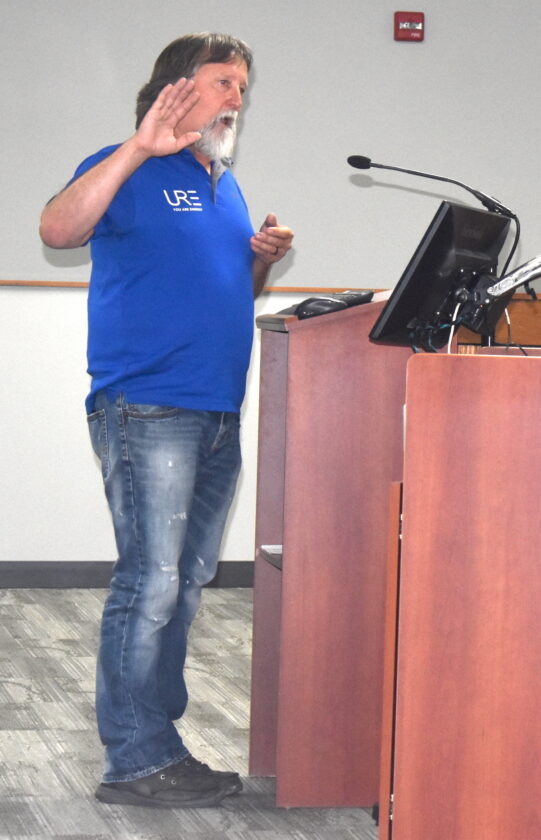
Jarrod Ulery of Le Grand, an electrical professional and data center developer, also spoke out against the proposed moratorium during Monday night’s city council meeting.
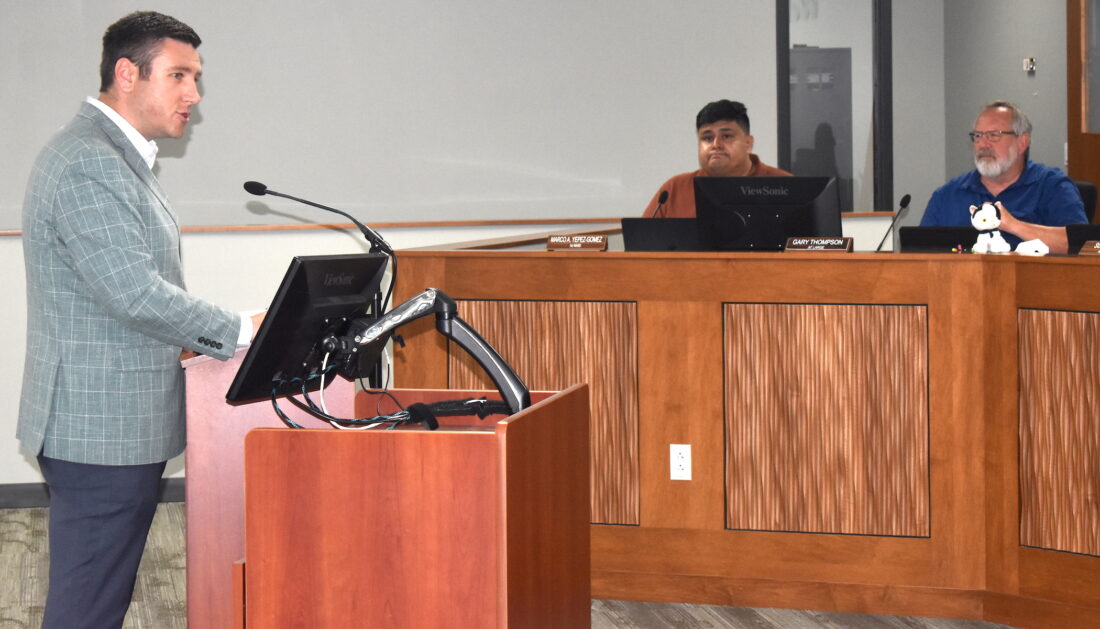
T-R PHOTOS BY ROBERT MAHARRY Marshalltown Area Chamber of Commerce President/CEO John Hall, left, addresses the Marshalltown city council in opposition to a potential data center moratorium as Councilors Marco Yepez-Gomez and Gary Thompson look on during Monday night’s meeting. The council voted down the moratorium, which Yepez-Gomez proposed, before approving a separate motion to work with the Chamber on development agreements for future data center projects.
Jarrod Ulery of Le Grand, an electrical professional and data center developer, also spoke out against the proposed moratorium during Monday night’s city council meeting.
T-R PHOTOS BY ROBERT MAHARRY Marshalltown Area Chamber of Commerce President/CEO John Hall, left, addresses the Marshalltown city council in opposition to a potential data center moratorium as Councilors Marco Yepez-Gomez and Gary Thompson look on during Monday night’s meeting. The council voted down the moratorium, which Yepez-Gomez proposed, before approving a separate motion to work with the Chamber on development agreements for future data center projects.
Trending
The Marshalltown city council will not move forward with a proposed temporary moratorium on data center construction after a lengthy discussion on the controversial and hotly debated topic during Monday night's regular meeting.
Councilor Marco Yepez-Gomez explained that he requested to place the item on the agenda due to inquiries dating back to March about the potential construction of a data center in Marshalltown, calling a moratorium a "proactive rather than reactive approach" to the situation.
"Data centers have existed for decades. In fact, here in Marshalltown, we already have one, but I think what's different this decade is that Big Tech (and) startups with venture capital are really pushing for data centers across small towns of Iowa. So, (I recommend) just really doing a moratorium, take a pause and send it to Zoning because we don't even have regulations on data centers," he said. "There's not a label in our zoning for that. It's just considered, quote, other utilities. We just got done talking about chickens, how to regulate them, but we don't even have the biggest development that's going to happen this decade."
His goal, he said, was to push for the temporary moratorium -- Yepez-Gomez initially suggested two years -- while allowing the Planning and Zoning Commission time to review city ordinances, considering a permanent ban on centers over 10 megawatts (mw), which have drawn the largest opposition around the country, and coordinating with Marshall County on proposed regulations. He cited a situation in neighboring Story County, where the county board of supervisors has passed a moratorium, but the developers are now pursuing a project within the city of Ames.
Mayor Pro-Tem Jeff Schneider asked that a pair of written public comments from Bob Higgins and Tom Deimerly be read into the record, both of which were in opposition to a moratorium. Higgins wrote that such a move would give him serious pause about investing in the community, especially with Alliant Energy expanding its local energy generation capabilities through the 720 mw Bobcat Energy Center project.
"A moratorium at this moment trades our biggest new asset away just as it appeared. The moratorium isn't a study. It's a do not call. You can't negotiate road funding, tax agreements and water rate protections with a developer you told to stay away," he wrote. "When you close the door to new taxpayers, the cost of our infrastructure doesn't disappear -- roads we can't fund, aging water and utility systems, a library that needs support, a city-owned former hospital that must be demolished and ready for redevelopment. All it still has to be paid for. Saying no to new development just passes that burden down to businesses and citizens already here (through) higher taxes, deferred maintenance or service cuts. A major industrial taxpayer is one of the few tools that broadens the base and eases the load instead."
Concerns about water use and energy capacity are warranted, he added, but he did not believe a blanket moratorium was the right way to go. Deimerly's letter was similar to a guest column he published in Monday's Times-Republican and cited Marshalltown's unique position to handle a data center project with the Water Works and Alliant expansions.
"We are about to post a closed sign before a single developer has knocked," Deimerly wrote, noting his educational background in forestry, natural resources conservation and economics. "I generally do not know whether a data center is right for Marshalltown. The environmental impacts of large new power and water consumption are real, and they deserve serious analysis. But here is what both degrees tell me. A moratorium is not the analysis. It is a closed door."
Assistant Housing and Community Development Director Clayton Ender then came forward and noted that there are no current zoning regulations specific to data centers, but the general regulations that govern all major utilities would be applicable. Currently, he said two counties in the state have enacted one-year data center moratoriums -- Woodbury and Madison.
Yepez-Gomez asked Ender about the specific possibility of banning data centers over a certain number of megawatts, and he replied that it would likely require a review with the city's legal counsel. Councilor Greg Nichols then inquired about whether the council would have a say in accepting or rejecting projects, and he said special use permits would go to the P&Z Commission for a recommendation and the Board of Adjustment for final approval.
"The only reason it would come to council is if they're seeking some type of development agreement. Otherwise, it is outside of the city council under the current zoning regulations," Ender said.
Councilor Melisa Fonseca asked about data centers already present in Iowa, and Ender told her there are already Google, Microsoft and Meta (Facebook) facilities in the Des Moines and Cedar Rapids areas, to name a few. It is estimated that there are approximately 100 around the state in all at the present time. The Marshalltown city council previously approved the construction of a 15 mw data center in the new industrial park on Edgewood Road a few years ago, but it never got off the ground.
Without a moratorium in place, Ender said a proposal would be considered under the current zoning regulations at the time of the application. Yepez-Gomez reiterated his position that if moratoriums can be placed on chicken keeping and ground solar panels within city limits, the same approach should be possible for data centers as polling numbers indicate widespread opposition to such projects within communities.
Councilor Mark Mitchell asked for a review of the impact on natural resources and health-based issues.
"We've got good water here. We don't need to ruin that. We need to keep it as clean and pure as we can, and data centers use a lot of water and it's non-reusable," he said.
Nichols responded that there are closed loop data centers and felt the council had time to put agreeable rules in place. Schneider welcomed Marshalltown Area Chamber of Commerce President/CEO John Hall to the podium as the city has an economic development contract with the organization, and Hall expressed surprise that the moratorium was on the agenda without any consultation of his team, citing the previous project in 2024 and Nichols' comment to bring more of them to the table at that time. He told the council that he felt there was "a lot of noise" surrounding conversations on data centers, especially in the national media, but he wanted to present a more accurate portrayal about water and electricity concerns.
Hall took umbrage with an article that claimed the long-term construction of data centers "took a toll" on the daily lives of community members.
"I welcome that. Construction jobs are real jobs, and to talk about it as just permanent jobs afterwards without looking at the 10-to-12 year impact that these opportunities have on the construction labor force, being in a community that is so built around construction, I take real issue with that because that is a real economic boon for a community," he said.
According to Hall, the companies behind the data centers in the Des Moines and Cedar Rapids areas have invested billions of dollars, created hundreds of permanent jobs and paid millions in annual wages, not to mention the taxes they contribute to the communities where they are constructed. With so many construction workers in the Marshalltown area, he felt that the opportunity to remain close to home and attend children's events could not be overlooked.
While acknowledging that there are good and bad actors in the space, Hall assured the council that the Chamber would remain discerning and avoid simply saying yes to any project presented, and he recommended requiring development agreements without enacting a moratorium or restricting megawatt usage. Kiley Miller, a member of the data center services team for Alliant Energy, spoke next and told the council he frequently references Marshalltown during discussions about economic development around the state.
"I've never been to a town where the community business leaders were more engaged and more ready to tout what was happening in the downtown," he said. "That's a credit to you. That's a credit to the economic development (team), and I just wanted to share that with you."
Miller told the council the company must work with all customers large and small to meet their energy needs, and he said major customers like data centers are required to cover their costs and fund the system upgrades but are not the only beneficiaries.
"Investments in the energy grid, whether generation, transmission or local distribution, increase energy capacity and improve infrastructure for everyone because the system is shared," he said. "Energy load growth helps utilities manage rates over time."
According to Miller, the expectation of new large customers, including data centers, helped Alliant keep base rates through 2030, and the ultimate objective is "growth without burden." Jarrod Ulery of Le Grand, an electrical professional who formerly worked for Alliant and Consumers Energy, introduced himself as "the data center developer" and noted his history building a bitcoin mining facility near St. Anthony. He described the proposed moratorium as "very alarming" and asked the council to get educated before making such a move, questioning Yepez-Gomez on his own educational credentials and his knowledge of data centers.
"I'm a software engineer," the councilor replied.
During the public comment period, MARSHALLTOWN Company President/CEO Joe Carter argued that the city should be inviting to new businesses and worried about the long-term negative effects of a moratorium, urging the council to oppose it. Doris Kinnick worried about the quality of life impacts of data centers and shared the example of a proposed data center project next to the Nashville Zoo in Tennessee, which has drawn opposition from famous names such as country music star Brad Paisley.
Roberto Gonzalez wondered how data center projects would impact household costs for average people and felt many of the businesspeople who had spoken against the moratorium before him were simply concerned about money. Layne Pieri endorsed the idea of a moratorium as an opportunity for a pause that will allow city officials to develop strong ordinances and regulations.
"I do think we are the kind of place that could attract something like this. We are building infrastructure. We are industry friendly, and we are trying to grow. But being open to investment does not mean being easy to take advantage of," Pieri said. "To me, the bare minimum is being honest up front about water use, power demand, utility impacts, noise, generators, lighting and who is paying for what. If a project creates major new demands that exist mainly for that project, I do not think those costs should roll quietly downhill onto existing ratepayers, and if that is not the case, I would like that in writing. That should be clear before anything moves forward."
In response to a question from Councilor Sue Cahill, Hall laid out the process for evaluating a data center proposal and said they would seek to examine the overall demand of the community related to a project. He also said he wasn't sure which component individuals were referring to in terms of quality of life as the proposed projects are all in industrially-zoned parcels far removed from residential areas and would be subject to already established noise control regulations.
"In most cases, these projects look like large warehouses, and they look like the big concrete warehouses that you see at the intersection of (Interstate) 80/35 when you go to the Des Moines area. That's what the size and scale of these projects tend to look like, and so yeah, they're not attractive to look at, but they're not necessarily built to look unattractive either," Hall said.
There may be increased traffic at local restaurants due to the influx of construction workers, he added, but that would provide a positive economic impact to the owners of those businesses along with hotels and retailers. Keeping construction workers from this area working in Marshalltown, Hall said, would be preferable to sending them to places like Cedar Rapids.
"There's probably a global conversation about the overall impact of data centers and whether that's a good thing or a bad thing overall. That would be a really great conversation over a beer sometime. That is not a conversation that Marshalltown saying no to these projects is going to have a global impact on," Hall said. "My perspective is (that) the relative benefits of these sorts of projects that I would like to take advantage of for our community -- the construction work during that time, the permanent jobs that will come afterwards and, probably most importantly, is the new tax revenue. The conversations at council year after year for the last five years I've been here have been about budget constraints and budget concerns. The legislature has not made that conversation easier. It's not going to get easier. This is an avenue to work towards addressing that or at least having some sort of relief valve to hit on that for the community aside from going back and just raising costs to everybody else."
At Fonseca's request, Ulery provided more background on the water usage at facilities he has already been involved in and noted the increased energy capacity as a result of the Alliant expansion project locally. Schneider then read written remarks from Mayor Mike Ladehoff, who could not attend the meeting, arguing that a moratorium would not be the right path and instead suggesting "the Cedar Rapids model" of setting specific terms with developers before approving construction.
Schneider himself called a moratorium "a terrible idea" and said the city needed a "bat signal" announcing itself as open for business, hoping the proposal would be soundly defeated.
After nearly 50 minutes of discussion, Yepez-Gomez motioned to send the issue to the P&Z Commission for further review, explore a ban on projects of 10 mw or more and enact a moratorium until the recommended regulations are approved by the city council.
Ender suggested a specified end date on the moratorium to place the city on a more solid legal footing, noting that it could still be extended, and Yepez-Gomez then proposed an amendment to set the length of the moratorium at six months as Schneider warned of the "reputational damage" such a move could cause. First, the amendment setting the six-month timeline failed by a 4-3 tally as Yepez-Gomez, Fonseca and Mitchell voted yes, while Cahill, Nichols, Schneider and Gary Thompson voted no.
Next, the original motion with no specified timeline on the moratorium failed by a margin of 5-2 with Fonseca joining the no voters, and Fonseca then motioned to enact the same motion but without a moratorium -- forwarding the matter to P&Z to develop an ordinance and exploring the 10 mw or more ban -- and it failed 4-3 with Fonseca, Yepez-Gomez and Mitchell voting in favor.
Finally, Schneider made a motion directing staff to work with the Chamber on establishing development agreements for such projects going forward, and it passed by a 6-1 tally with Yepez-Gomez as the lone no vote.
In other business, the council:
Approved the consent agenda as listed other than an item related to the chain link fencing proposal for the Center Street Viaduct, which was removed for further discussion.
Approved special five-day Class C retail alcohol licenses for the 13th Street District for the Red, White and Blue Celebration on July 3 at West End Park, the Marshalltown Area Chamber of Commerce on July 22 for RAGBRAI, and the 13th Street District for the Harvest Market on Sept. 11.
Approved an agreement with Eide Bailly LLP to extend audit services for the city of Marshalltown for the fiscal year ending on June 30.