
County, Animal Rescue League ‘miles apart’ on contract negotiations
Gaffney, Gillis speak during Wednesday’s Board of Supervisors meeting
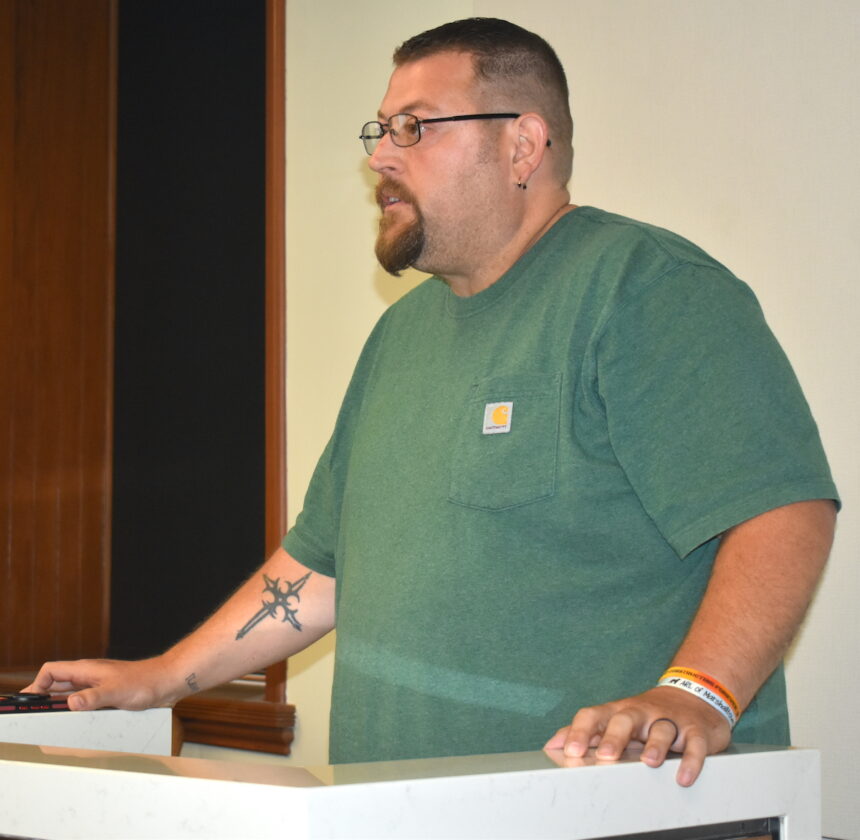
Animal Rescue League of Marshalltown Executive Director Austin Gillis responded to Gaffney’s comments and addressed the Marshall County Board of Supervisors about ongoing contract negotiations between the two entities during Wednesday morning’s regular meeting.
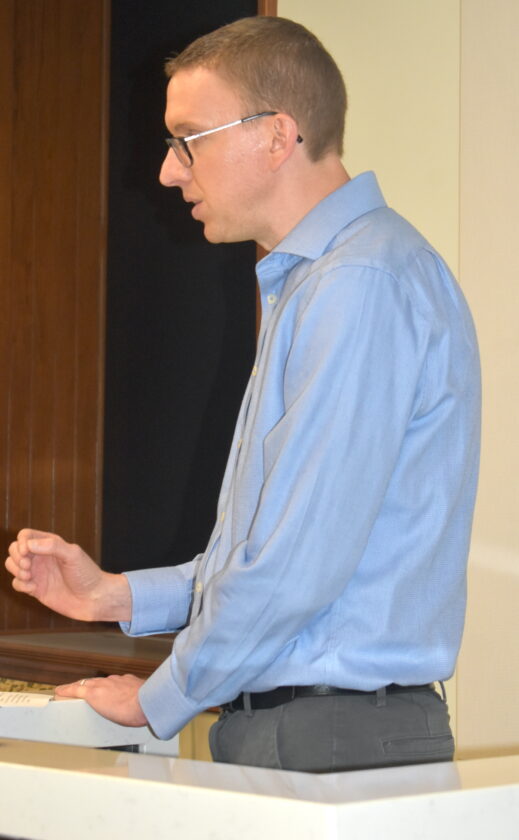
T-R PHOTOS BY ROBERT MAHARRY Marshall County Attorney Jordan Gaffney spoke to the Board of Supervisors about the contract situation with the Animal Rescue League of Marshalltown during Wednesday morning’s meeting. The two entities have thus far been unable to reach an agreement as Board Chairman Jarret Heil described their proposals as “miles apart.”
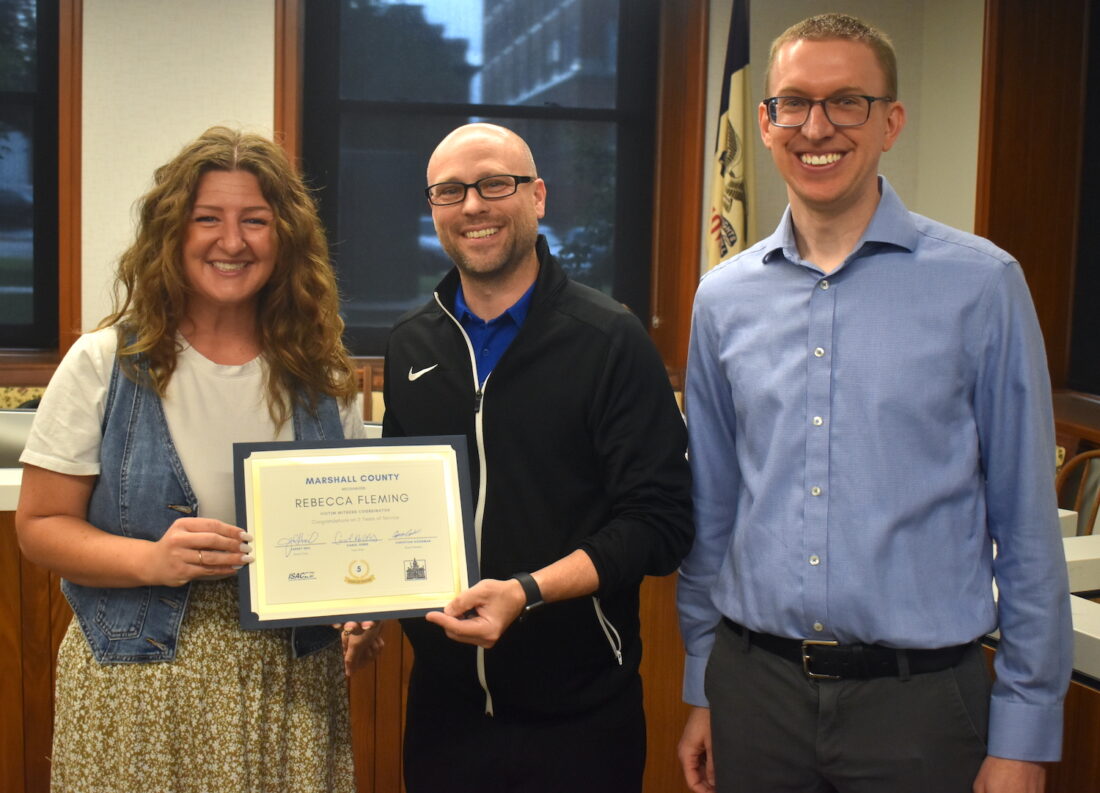
Victim Witness Coordinator Becci Fleming, left, was honored for five years of service to Marshall County during Wednesday’s Board of Supervisors meeting. Also pictured are Board Chairman Jarret Heil and County Attorney Jordan Gaffney.
Animal Rescue League of Marshalltown Executive Director Austin Gillis responded to Gaffney’s comments and addressed the Marshall County Board of Supervisors about ongoing contract negotiations between the two entities during Wednesday morning’s regular meeting.
T-R PHOTOS BY ROBERT MAHARRY Marshall County Attorney Jordan Gaffney spoke to the Board of Supervisors about the contract situation with the Animal Rescue League of Marshalltown during Wednesday morning’s meeting. The two entities have thus far been unable to reach an agreement as Board Chairman Jarret Heil described their proposals as “miles apart.”
Victim Witness Coordinator Becci Fleming, left, was honored for five years of service to Marshall County during Wednesday’s Board of Supervisors meeting. Also pictured are Board Chairman Jarret Heil and County Attorney Jordan Gaffney.
Trending
An ongoing dispute that came into the public eye through a Facebook post from the Animal Rescue League (ARL) of Marshalltown last week took up the vast majority of Wednesday morning's Marshall County Board of Supervisors meeting as Marshall County Attorney Jordan Gaffney and ARL Executive Director Austin Gillis took turns offering their sides of the story.
Gaffney, who spoke first, credited the ARL for doing "important work" in the community before noting that a longstanding agreement between the county and the ARL for animal pickups and safe housing of animals was terminated last November at the request of the ARL.
A temporary extension was granted by the ARL as the two sides negotiated, and the county sent a proposal on March 30. The ARL then sent a counterproposal on May 11, and Gaffney called it "unorthodox" in terms of procedure to have an open discussion without an agreed-upon contract in place but said the ARL had insisted on being heard.
Gaffney described the difference between the proposals as "a pretty wide gulf," with the county only seeking a simple contract for animal pickup, housing and care, while the ARL is seeking a more expansive agreement that would result in the creation of an animal investigator position. He then broke down specific portions of the ARL's proposal he found problematic, the first of which were the training procedures for the investigator position who would lead animal welfare investigations, which Gaffney called "a little vague" and "broad."
"I'm certain the ARL has minimum professional standards requirements, but when you look at the agreement as it is written, the ARL could plug in anybody into this position who's just simply read a few online Reddit forums. And I don't know that that's good enough for public service," Gaffney said.
He also took issue with language regarding resolution procedures for disagreements between the investigator and Marshall County Sheriff's Office (MCSO) deputies -- if they can't reach an agreement, they are instructed to issue a joint termination. Gaffney defended the deputies, their professionalism and the system they operate under and did not feel those decisions should be made by a third party civilian contractor without adequate county oversight. According to Gaffney, the ARL proposal also lacks the opportunity to terminate the contract for any reason other than a material breach by the ARL.
"For such a broad delegation of authority, there should be more meaningful provisions by the county and contract termination options by the county," he said.
He then discussed the proposed annual cost -- $7,250 with an automatic four percent increase every year going forward -- and the need to serve as good stewards of taxpayer dollars before pointing out a list of "a la carte" supplemental costs. By contrast, the city of Marshalltown pays the ARL approximately $85,000 a year for a more all-encompassing contract with the caveat that the city will provide additional reimbursement if the owner of a dog involved in a bite case fails to pay the ARL and that the care of the animal for the seven-day stray hold is covered should they need medical attention or something outside of the normal intake process.
"Why should the county pay the annual fee plus a standard pickup fee plus a handling fee at intake? What is the benefit to the public of the annual $7,250 when the taxpayers are just gonna get nickel and dimed on the back end?" he asked. "To put it in perspective, this pricing scheme would be like buying a car at an agreed-upon price, agreeing to finance at four percent and then agreeing to pay more on top of that for things like the engine and the brakes... I don't think this is advantageous for the county."
He also objected to a proposed provision that would place ARL staff on the county's insurance, while the county proposal calls for both entities to carry their own insurance. Gaffney felt the ARL proposal should give the board pause, and he then discussed the incident that incited the recent Facebook post -- a hoarding and animal endangerment case in Laurel with a large number of cats and dogs and a dispute over an invoice the ARL has since sent the county.
After initially responding along with the MCSO on May 5, ARL staff returned to the home four days later and took in additional animals into their custody, which Gaffney said took the sheriff's office by surprise as they had not requested or authorized the activity. The resident of the property had authorized the ARL to return, he said, but the county had no involvement and learned about it after the fact. Gaffney called the move "a red flag" because the ARL does not have any actual law enforcement authority in the county.
"They essentially unilaterally decided that there were more cats, there was no need to coordinate with law enforcement, and they took it upon themselves to deprive this person of their personal property," he said.
If anyone in the room that morning got a bill for services they hadn't asked for or approved, Gaffney added, they would likely think twice about paying it. The invoice from May 5, he contended, should raise major concerns for county taxpayers, and he reiterated his preference for the county's contract proposal.
"It's really a situation of a square peg trying to fit into a round hole. It's just not working," he said. "The ARL's contract proposal contains terms that are so lacking in boundaries, so vague and are so one sided that the county should not enter into this particular agreement."
He also called for a "substantial change" in the way the ARL operates before any agreement is approved and expressed optimism that the two sides could come together.
Gillis responds
With "a whole lot to unwrap" in responding to Gaffney's comments, Gillis said the ARL has had issues with deputies since he started his job in 2023, citing examples of finding animals outside in extreme cold temperatures and being told they're "just fine." He also highlighted his own credentials and extensive training in animal welfare and took a jab at Gaffney for speaking out against an animal torture bill Gillis had fought to get passed during the 2026 legislative session.
"We're able to prove everything that we can do. We're able to show that we are here to benefit the community, that we want to help the animals and that we want to bring animal welfare into a better light and better for the community," he said.
He provided his take on why the contract was terminated last year and said he was told by the Public Health department that there had not been a single dog bite in the county in the last two years, which Gillis did not believe. He also took issue with a lack of communication during the 120-day contract extension period other than a simple thank you.
When Gillis finally decided to officially terminate the contract, he said he quickly received a counterproposal from Gaffney.
"It's a pretty simple contract, and it's very vague. And the problem we're running into is we need more protection. We can't go out to these calls where there's a dog suffering and have a deputy tell us that it's OK and nothing's gonna be done, and then we just have to walk away and sleep with that at night," he said.
From there, he disputed the contention that dogs are allowed to run loose in the county, citing a chapter in the state code considering off-property domestic animals not properly tagged as at large. In the city of Marshalltown, the owners are frequently cited for such offenses, and the animals can be seized as a result. In one situation, a dog running loose near the Jasper County line ended up being hit by a car on the highway.
"I'm not blaming the county for the dog getting hit, but I'm saying if that owner would've been cited when the dog was at large, there may have been a way to intervene before that happened," he said.
Gillis felt that an animal investigator would allow the ARL to intervene in scenarios that they frequently receive calls about but are powerless to get involved in, and he shared another story of an emaciated chihuahua left at the ARL headquarters on a Sunday afternoon. To date, no charges have been filed against the owner.
According to Gillis, one of the biggest issues is communication, and he felt that much of the information presented had been "one sided," hence his desire to be placed on the supervisors' agenda and share the ARL's perspective.
"We really do just want to be a service. We want to help. We want to help the animals, and we're here to speak out for the voiceless," he said. "The animals don't have a voice of their own, so that's where we come in."
Regarding the Laurel incident, Gillis told the board that the ARL has an attorney reviewing the invoice, and he said there were animals that could not initially be caught on May 1, which was the reason for the return trip on May 5. He said ARL staff told deputies at the time that they may have to return to the site and noted that they were not open on the Saturday, Sunday and Monday following the May 1 incident, hence the return the following Tuesday.
Because the cats left the property in question, Gillis said they were considered strays and thus eligible to be placed in the custody of the ARL, and the person who had them was disabled and not able to drive. The objective, according to Gillis, is simply to recoup costs, and despite the fact that the $7,250 figure for the contract hasn't changed during his time there, calls for service and costs have increased.
With annual expenses estimated at $650,000 for the ARL, Gillis wondered why the county was so worried about $7,250 and asked if they could afford their own shelter as they are required to have some sort of animal welfare infrastructure. He told the board he wasn't asking for blind trust but rather an opportunity to prove the ARL's worth and showcase its expertise as a professional organization.
Recounting another story of an incident near Montour, he lamented that at-large animals without proper rabies tags "shall" be shot according to Iowa law and hoped to change it. He also expressed frustration with what he felt were conflicting answers from the county and the Laurel city attorney regarding the case there.
"I didn't plan on coming up here and airing out a bunch of dirty laundry. I really want to make this work. I want us to work cohesively together. We want to be able to offer you a service that is way above what you're paying for, and we can do that. But we also have to understand that we have overhead. We have a shelter that we have to run. I have payroll. I have to pay my electricity bill. I have to pay a guy to come out and chew up a tree," he said. "When somebody broke into our shelter and stole a dog, I had to pay for that door to get fixed. If we don't get this money reimbursed from this Laurel case, we're gonna have to shut down one of our outreach programs that we were getting ready to launch because we have to be able to keep our lights on."
He hoped the conversation could result in more protections being put in place for ARL staff before opening up the floor to questions and noting that they were willing to negotiate on specific pieces of the contract. Supervisor Carol Hibbs asked him, if he sought to address the issue professionally, why he posted on Facebook regarding the suspension of cat intakes and responding to calls in the county.
Gillis said the ARL often receives calls from people who assume they are a government entity and take heavy criticism, so this was a way to be transparent and explain why they couldn't respond to certain calls.
"When we get left on read, we have to take desperate measures to try to get people's attention," he said. "So while it may not have been my first choice or avenue to get that out there, unfortunately I have to say it worked."
He believes that the ARL would be able to come to the table and work through the situation constructively. County Auditor/Recorder Nan Benson noted that any conversation with all three supervisors must be conducted in a public forum. Ultimately, none of the supervisors were prepared to take action on Wednesday morning, and Gaffney and Sheriff Joel Phillips did not provide any further comments.
Board Chairman Jarret Heil said the two sides were "miles apart" and hoped the negotiations would continue until an agreement is eventually reached.
In other business, the board:
Approved the consent agenda as listed.
Recognized Victim Witness Coordinator Becci Fleming for five years of service to the Marshall County Attorney's Office.
Approved a state of Iowa alcoholic beverage license for Singlespeed Brewing Company DBA Myers Property for July 21-25.
Approved the intergovernmental agreement confirming and continuing the Marshall County Solid Waste Management Commission with several communities from Story County added.
Approved a change order of $47,396.03 for added brake metal and trim on the Sheriff's Office/Jail renovation project.
Approved the purchase of a temporary construction easement for $3,000, a permanent easement for $250 and a permanent drainage easement for $2,250 from John K. Allen and Debra Lee Allen in relation to the Marshall Ridge Dairy expansion.
Entered a closed session regarding pending litigation.