
Medical personnel, soldiers focus on teamwork during trauma care simulation at hospital
Trending
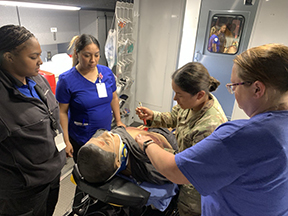
More than 100 people -- medical personnel, students and members of the military -- participated in the Trauma Simulation Day at UnityPoint Health in Marshalltown on Thursday.
The objective was to collaborate and enhance workforce development, education and community engagement by fostering partnerships between hospital systems, civilian emergency responders, military medical teams and academic institutions. The simulation also focused on communication, teamwork and adaptability.
UnityPoint Trauma Program Supervisor Jeff Gilchrist said it was a collaborative effort created by the hospital and the Iowa National Guard's 209th Medical Company.
"What we have created here is a learning environment for medical students, military medical teams, EMS providers and ER nurses," he said. "They are broken up into groups and all learning."
There were four stations focusing on critical aspects of trauma care and emergency response -- trauma procedures, civilian vs. military patient transport, triage and decontamination demonstrations as well as trauma simulation practice using patient simulation mannikins. Participants rotated through the stations
"We're trying to learn from each other, because if the governor were to activate the National Guard, a lot of times those activations include civilians," he said. "So it's important to learn about each other's equipment."
Driving the point home, Gilchrist said Marshalltown has gone through two severe events that could have gotten Guard activation if the damage had been greater -- the 2018 tornado and the 2020 derecho.
Some medical people have never seen the back of a military ambulance. So, Gilchrist said another station was set up to give attendees a better understanding of what was in the military vehicle as opposed to the hospital ambulance. Another station was an anatomy lab in which participants worked with pig carcasses.
"It's been really neat to see the interactivity and collaboration that is going on," he said.
Gilchrist hopes to see additional collaborative training sessions with the military.
"There is encouragement, because of what is happening in Ukraine with civilian and military interactions -- what would happen if something like that would happen here?" he asked. "How do we interact with each other and learn from each other? That is what this is about. Things are happening around the world, but how are we doing here?"
Iowa National Guard Sgt. Amanda McCrary said the 209th has never collaborated with a hospital before and believed the experience was fantastic.
"I've been a first sergeant for almost three years, and I've been working on this, but it kept getting pushed to the side," she said. "I feel like with how things are going, and the civilian populace is thinking more about how to work with the military, it's more their minds."
McCrary also hopes the training will be repeated in the future.
"This event provides a unique opportunity for participants to learn not only technical skills but also how to work seamlessly across disciplines during high--acuity situations," Gilchrist said. "It directly strengthens the region's readiness to respond to complex emergencies. We are proud to host this community event."
-------
Contact Lana Bradstream at 641-753-6611 ext. 210 or
lbradstream@timesrepublican.com.