
Midwest senators tout new study calling biofuels a ‘catalyst’ for agriculture
Grassley also calls for year-round E15 sales in Senate speech
Trending
U.S. Sen. Chuck Grassley and other Midwest senators celebrated the findings of a new biofuels study Tuesday during a Capitol Hill briefing in Washington, D.C.
The new report, published by S&P Global and commissioned by the U.S. Farmers and Ranch Association, says expanded biofuels demand "could transform American agriculture, reignite rural economies and provide global food and energy security," according to an S&P Global news release.
"Nobody needs to twist my arm to celebrate America's homegrown biofuels," Grassley, an Iowa Republican, said. "The report backs up what I've been saying for years. Biofuels are good for the rural economy, good for national security, good for the environment and good for American pocketbooks."
The key findings of the report say that using biofuels as a "catalyst" for the agricultural economy would drive corn yields up by 48%, increase U.S. soybean production by 1.4 billion bushels, significantly increase global biofuels output and boost the global food supply by 45%.
Democratic U.S. Sen. Tina Smith of Minnesota described the study as the "biggest opportunity" that the U.S. has had for value-added agriculture.
"I have long been a strong supporter of biofuels and ethanol," Smith said. "This is a way for us to get cleaner energy, renewable energy, lower cost energy and to create homegrown pathways for cutting costs and keeping economic opportunity here in the United States."
Smith said she is part of a bipartisan coalition with other Midwest senators, adding that the group recognizes the impact biofuels could have on the farming economy.
"We are in a tough time for agriculture," Smith said. "Putting a big emphasis on how biofuels and ethanol can be a path forward to a new structure for agriculture is just really exciting."
Key findings
Kevin Lindemer, an S&P Global executive, presented the key findings of the study, saying that the three factors driving the need for biofuels are decelerating population growth, agricultural production outpacing food demand and the decline in demand for energy and oil.
"We're not in a world that is supply limited, we are in a world that might actually be demand limited," Lindemer said. "We have a choice, we can rationalize capacity, which is what every industry, commodity industry does. If we have the opportunity to find new markets and create new markets, that is where we are headed."
Grassley advocates for year-round E15
In a fiery speech, Grassley reiterated his support for an appropriations bill that would make E15 fuel -- a 15% blend of ethanol and gasoline -- available year-round in the U.S., saying that the availability of E15 would save Americans "20 to 40 cents at the pump, sometimes even more."
The U.S. Environmental Protection Agency has restricted E15 from being sold from June 1 to Sept. 15, citing concerns about air quality. The agency has waived the restriction over the years, but farm-state lawmakers have long sought a permanent solution. A measure to eliminate the restriction passed the House in May but faces an uncertain future in the Senate.
"At my 99 county meetings I hold every year, I hear from farmers facing high input costs and commodity prices below the cost of production that a robust biofuels market enhanced by E15 would answer the prayers of farmers working their tails off to be profitable," Grassley said. "That's why I'm fighting for permanent year-round E 15."
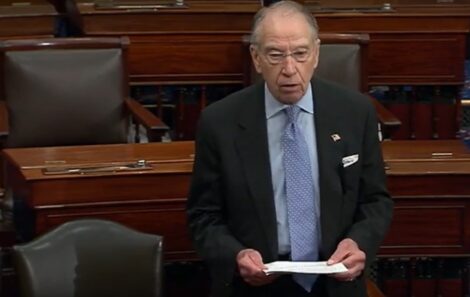
During floor remarks at the U.S. Capitol Tuesday, Grassley said that most of the "jobs and value" created from increased E15 production would benefit rural communities.
Grassley added that he and a bipartisan group of legislators from grain-growing states must collaborate to make E15 available nationwide.
"That's probably at least 28 senators from grain-growing states in the United States where we grow, at least 14 states, 28 senators," Grassley said. "We better put our heads together, or we're going to lose the opportunity of getting E15. It's through the House of Representatives. It's further than it's ever been. "