
Pesticides ‘shatter’ leaves of Iowa’s state tree
A conservationist’s 20-year quest to address pesticide damage in his oak savanna
Trending
In 1996, Tony Singh began rewilding a plot of land in LeClaire, hoping to restore its oak savanna, native prairie, woodlands and wetlands.
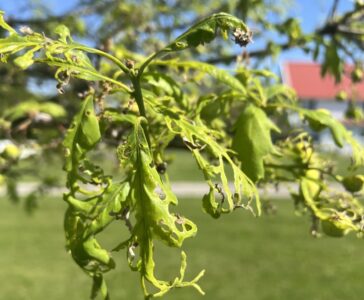
Less than five years later, he noticed the leaves on his oak trees were in tatters.
"When the leaf is coming out, if it is natural, it's a beautiful thing," Singh said. "But then they start spraying this pre-emergent herbicide, and the leaves get completely shattered."
Over the last 20 years, Singh has been documenting the phenomenon and trying to raise awareness about it. But his 50-acre reserve is surrounded by an industrial agriculture system that is economically entwined with the land he seeks to restore.
"Acetochlor has been correlated strongly with oak tatters, where the tissue just is missing from the oak leaf, and you just see the veins, or with dicamba, you'll see cupping and curling," said Iowa Department of Natural Resources Forest Health Program Leader Tivon Feeley.
Acetochlor and dicamba are two widely used herbicides. Acetochlor is typically applied to target early grasses and weeds on row crop plots. Dicamba is used to target broadleaf weeds.
Singh has noticed both effects in the oaks on his plot of land. Oaks are Iowa's state tree, but there are 12 different species of oak native to Iowa's forests. These oaks fall into the broader white oak and red oak families, but according to Feeley, "all oak species are sensitive to any herbicide injury."
Most oaks are especially vulnerable to herbicides during the spraying season, as it correlates with their emergence in spring. Breaking out of dormancy and pushing out their first set of leaves requires some of the most energy in a tree's lifecycle.
Feeley said a single year of exposure to herbicides is unlikely to cause long-term damage. "The greater concern is if we see repeated injury year after year," he said.
Singh said affected trees respond by pushing out a second set of leaves to account for the herbicide damage, but they're not designed to repeatedly push out a second flush each year they try to regrow in the spring. Instead, they weaken and die.
The ones that die are often many of his reserve's old-growth trees. Singh has lost over 50 bur oaks, many of them more than 200 years old.
The oak savannas Singh works to restore were once common through north America. The lands contained expanses of prairie grasses and native flowers with open-grown oak trees dotted the horizon. These underbelly and open canopy areas were maintained by low-intensity wildfires every one to 10 years.
In the Midwest, only 30,000 acres of these lands remain today -- between 0.02-0.06% of their original land coverage.
Singh said the weather plays a role.
"It doesn't have to be adjacent to you. (Herbicide) volatilizes, so if it's a warmer day, you spray it, it warms up, it evaporates, and it can even be in rainwater," Singh said. "It could be sprayed a mile, mile and a half away."
Dicamba is especially prone to volatilization, a process where the chemical dries and is converted into a gas. The gas is then swept up by the atmosphere and can drift for miles, impacting vegetation across the state.
As both Feeley and Singh noted, volatilization also makes herbicide drift cases difficult to enforce.
Repeated complaints leave issues unresolved
Singh has filed repeated complaints through the Iowa Department of Agriculture and Land Stewardship. The investigation process involves IDALS agents taking plant samples for analysis. In his experience, responses can take up to three or four months.
The result is often the same, he said -- the samples contain a different mix of chemicals depending on the year, but often they include acetochlor, and in recent years, more of them show traces of dicamba.
In 2025, IDALS conducted 257 misuse investigations, only 25 of which were non-agriculture related complaints. According to the department's website, investigation reports typically take more than five months to complete. The department cannot require an offender to pay for any losses due to pesticide misuse.
When clear documentation of a violation is not available, the department can dismiss the case with no regulatory action. The Iowa Department of Agriculture and Land Stewardship declined a request for comment.
"I'll get a response next year, and it is usually nothing, it's just, you know, a warning letter or notification to the farmer, but nothing, there is nothing punitive there," Singh said. "Forget punitive, there is nothing there to, you know, tell him the harm he has done."
Rather, Singh treats this process as a paper trail of "chemical trespass."
Singh has tried to address this problem in several ways. He rents and buys adjacent land from the neighboring farm to create a buffer zone between his reservation and the farmland. He also manages his reserve without the use of herbicides, removing invasive weeds "surgically."
He's also set up cameras around his property to record when neighboring fields are sprayed. He captures wind speed and temperature at the time of spraying to help bolster his annual tradition of an IDALS inspection, but still he's had "no relief."
He hasn't had much luck engaging elected officials either, going so far as to describe Iowa as a "captured entity."
"Nobody wants to come here. Nobody wants to see it, even though this is a beautiful place," Singh said. "The politicians have absolutely no empathy towards this, because they are beholden to the Farm Bureau, and that's how they get their money."
Feeley doesn't fear extinction for Iowa's state tree in general, but he has "some concern" for white oaks. He attributes the decline of white oaks partially to climate factors, including drought, but more prevalently to "lack of land management."
Feeley said oak trees need ample sunlight. Since trees are long-lived organisms, at some point they may need to be removed to open up canopy space for direct light. This type of land management is "really lacking in Iowa," he said.
Despite the many frustrations, Singh said he continues his rewilding project simply because it's a part of his identity.
"Most of us are driven by an innate sense of what we think is right. And it's in my nature to plant trees. I get innate joy out of trees," Singh said. "When the leaves are coming out after the dormancy, it is the most wonderful feeling I get."