
Data center deja vu
After another lengthy debate, council sets hearing on four-month moratorium for next meeting
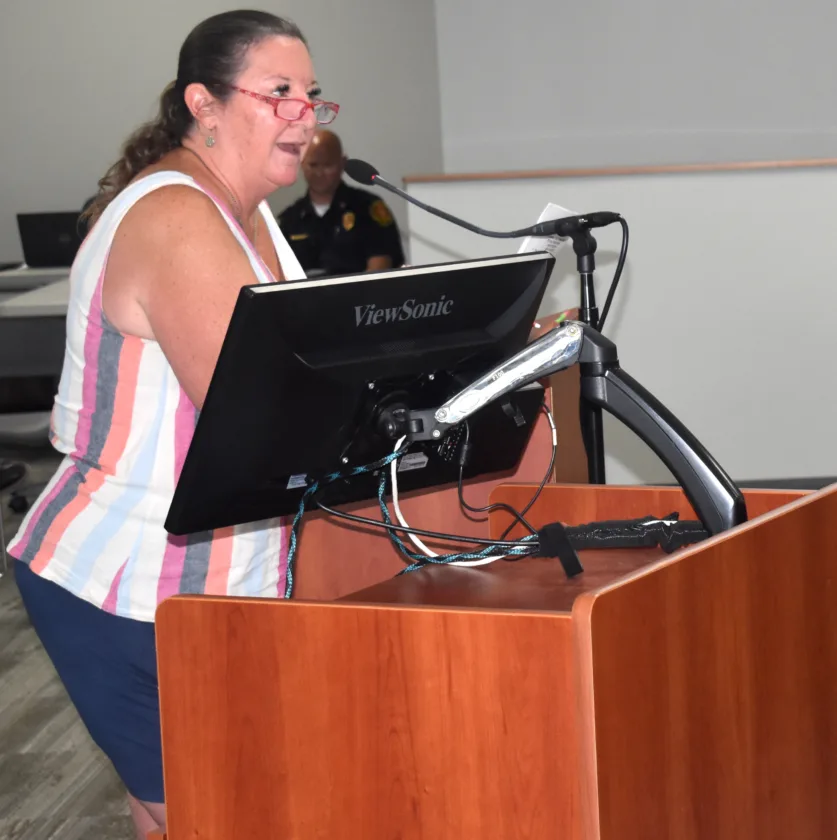
April Long of Marshalltown addresses the city council during Monday night's discussion on a proposed data center moratorium.
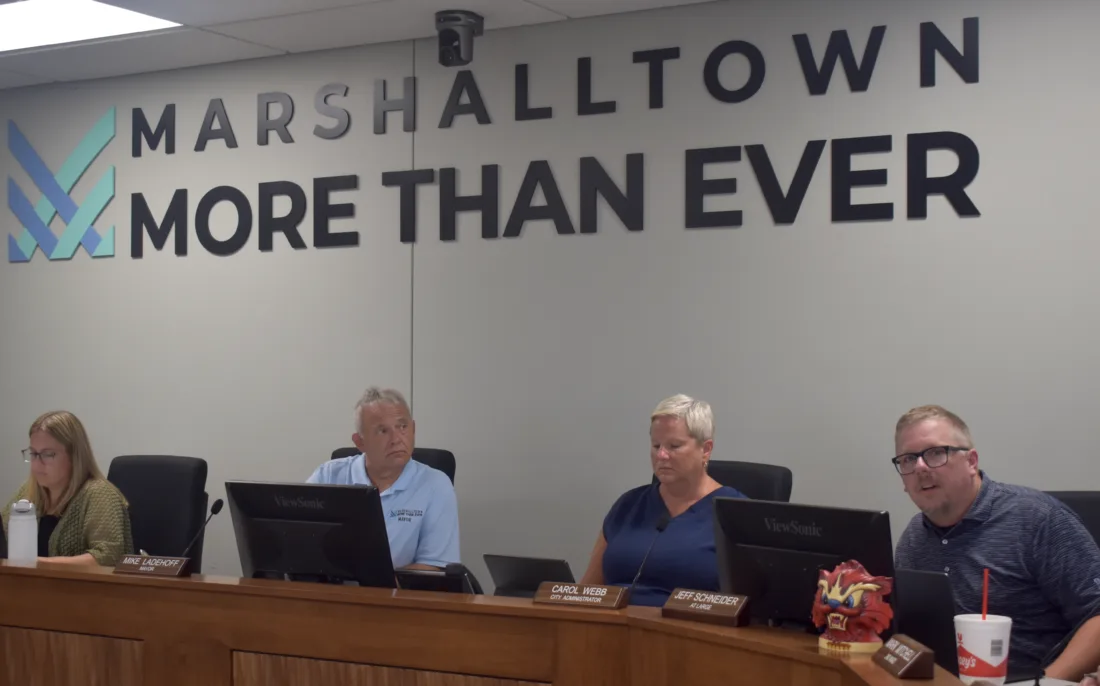
T-R PHOTOS BY ROBERT MAHARRY Marshalltown At-Large City Councilor Jeff Schneider, right, speaks out against a proposed data center moratorium during Monday night’s meeting as City Clerk Alicia Hunter, Mayor Mike Ladehoff and City Administrator Carol Webb listen.
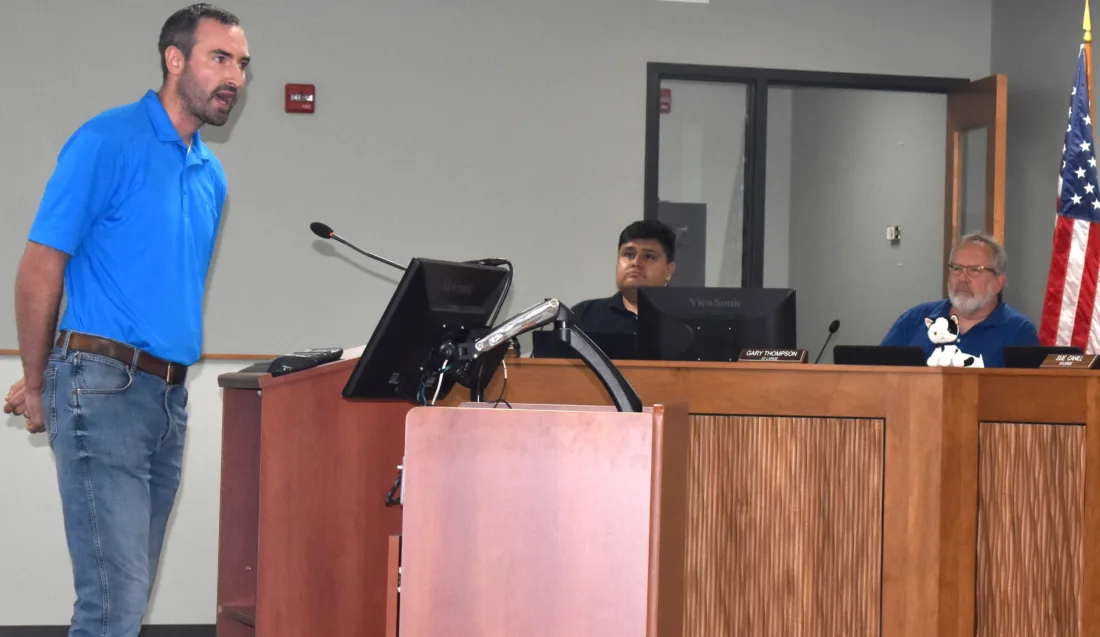
Zachary Hamilton of rural Marshalltown speaks during the discussion on the data center moratorium at Monday night’s city council meeting. The vast majority of speakers expressed anti-data center sentiments and supported the proposed four-month moratorium.
April Long of Marshalltown addresses the city council during Monday night's discussion on a proposed data center moratorium.
T-R PHOTOS BY ROBERT MAHARRY Marshalltown At-Large City Councilor Jeff Schneider, right, speaks out against a proposed data center moratorium during Monday night’s meeting as City Clerk Alicia Hunter, Mayor Mike Ladehoff and City Administrator Carol Webb listen.
Zachary Hamilton of rural Marshalltown speaks during the discussion on the data center moratorium at Monday night’s city council meeting. The vast majority of speakers expressed anti-data center sentiments and supported the proposed four-month moratorium.
Trending
For the third consecutive meeting, the Marshalltown city council discussed a proposed moratorium on data center construction at length on Monday night, and this time, they ultimately voted 5-2 to set a public hearing on a four-month moratorium for the next meeting on Aug. 10.
The item was pulled from the consent agenda at the request of Councilor Jeff Schneider, who, along with fellow Councilor Greg Nichols, has consistently advocated against imposing any moratorium. Schneider felt that the positive benefits of data center projects for Marshalltown and Marshall County taxpayers had not been sufficiently outlined.
"These projects generate a tremendous amount of revenue for the city, the school district, the county, the community colleges," he said. "Just rough math, for every $1 billion of development, expect about a million dollars to go into the city's general fund. Expect a million dollars to go to the school district's budget, about $400,000 to the county and $200,000 to the community college. These are real dollars in times where our property tax revenue is being squeezed every single year. We're gonna face a big shortfall in our general fund this coming year. It's not every day that somebody hands you a golden goose, and I think we need to be really careful that we don't chase that goose away before we even have a chance to collect some eggs."
Schneider said the city would not be offering any tax incentives to data center developers, and he acknowledged concerns about water and power use, contending that Marshalltown did not have an unlimited water supply to provide to a developer.
"What they'll use is similar to air conditioning. It'd be water-free dry cooling, so I think we should just take this water usage, water pollution off the table for this discussion," he said. "Yes, they are large electrical users, but as a community, we've been setting up for decades to get the power here in this community for that, manufacturing, whatever it is."
He also noted the boom in artificial intelligence (AI) over the last decade, describing it as "an extremely important technology" for business, medical innovation and national security, and he hoped Marshalltown would take the opportunity to benefit from it financially. Schneider felt the current zoning regulations already address issues like noise and setbacks and reiterated his opposition to a moratorium, touting the possibility of between 50 and 250 permanent jobs on top of the construction jobs while the large facilities are being built.
"I think this is just the right fit at just the right time, and saying no is easy to do. That's what this community has done for too long. We finally started saying yes to deals, and so I think we need to continue that," he said. "So we can say yes to this. We can fund the community needs and wants and get all of our priorities taken care of, or we can keep approving licenses for vape shops and liquor stores. It's our choice."
Councilor Mark Mitchell questioned the job number, recalling that when it was first proposed, he had heard a figure of seven permanent jobs in Marshalltown. Schneider replied that it all depended on which company ended up building here, but in communities where projects turn out well, they have created 50 or more jobs.
Nichols recounted his recent correspondence with Alliant Energy and said the company has already made a commitment not to raise rates through 2029 while noting that data centers are required to pay all of their own costs. Councilor Gary Thompson took a different position, pointing out that while he wasn't necessarily opposed to a data center in the future, he did want to ensure that Planning and Zoning ordinances were in place first.
"It's just a four-month pause, and in the big scheme of things, these buildings aren't gonna get built in four months. I don't understand. Four months is nothing," he said. "Once we approve the recommendations that come to us from Planning and Zoning, and if we all agree... how would I vote no on that? Because it meets the requirements that we put in place. This moratorium is not the step that says we don't want data centers or we do want data centers. All this says is let the professionals that do this, the people that have been appointed to the committees, Clayton (Ender), who we've hired, let's get input on both sides of it, let's take four months, and let's just hash it out. That's all we're asking."
He also pushed back against the idea that a moratorium delineates Marshalltown as "closed for business," comparing it to what he described as similarly hyperbolic arguments from anti-data center advocates. Mitchell agreed with the idea of a pause amid ongoing moratoriums in other states, and Councilor Marco Yepez-Gomez, who originally introduced the moratorium proposal, cited a poll indicating that 72 percent of Americans don't want a data center in their community "period."
"I don't get what's so radical about putting a four-month pause and sending it to planning and zoning. I don't get what's radical about that," he said. "All of the comments I hear are (that) they don't want data centers, and I don't know who other councilors are talking to or whatever, but no one is demanding for us to advocate for banks or the big businesses here in town or whatever. Everyone's saying no data centers, so I really don't get what's so radical about this."
Councilor Sue Cahill asked about the timeline for P&Z and council meetings related to the moratorium, and City Administrator Carol Webb said the third and final reading of the new ordinance would tentatively be passed on Nov. 23. The first P&Z meeting on the topic last week, which was covered in the July 25 edition of the T-R, is also posted on the city's YouTube channel.
From there, the floor was opened up to nearly 40 minutes of public comments, with the vast majority of those stepping forward opposing data centers and supporting the proposed moratorium. Erin Carpenter felt the city had mishandled the debate over ground-mounted solar panels and hoped to avoid a similar situation by putting the right rules in place.
"We have to have a process for the public to have input, and we have to make sure that the rules are in place to protect the people who live and work here and the employers that provide jobs for people who already live here," she said. "What needs to be put in place are guardrails so that development doesn't destroy the community and doesn't suck us dry."
Leigh Bauder said moratoriums are in place across the country and used AI to provide information on the energy that data centers consume while raising questions about several other concerns including decommissioning, eminent domain, air emissions, light pollution and the nature of the information being held in data centers, among others.
The next commenter outlined similar concerns about power usage as the result of data center projects elsewhere in Iowa, including the Des Moines metropolitan area, and sales tax and property tax exemptions for data centers, arguing that beyond a four-month moratorium, the city should simply say no to such projects outright. April Long, who told the council she lived on the east side of town close to where a data center would likely be built in Marshalltown, drew the biggest laughs of the night when she joked that expectations are not reality because if they were, she would still be married to her first husband. She worried about electrical rates jumping after 2029 and Marshalltown's water quality being jeopardized.
"Communities across our country are creating moratoriums and outright bans for data centers. They can't all be wrong. We're not that unusual," she said. "Asking for a moratorium and hopefully even a ban eventually makes us, I think, on the right side of history. We're not the only ones seeing a problem here."
She described data centers as "low hanging fruit" and urged the council to pursue higher fruits with more permanent jobs in its economic development efforts. Zachary Hamilton, a resident of Shady Oaks Road just outside of the current city limits, said that based on his research using AI, developers would likely see Marshalltown as a prime location for a hyperscale facility due to its proximity to Highway 30, available farmland and proximity to power generation. He hoped nearby residents and their quality of life would be taken into account, indicating support for the moratorium not to say no permanently, but to give the idea more thought.
Angelica Diaz questioned whether data centers would provide any tangible benefits for current Marshalltown residents if taxes and utility costs went up as so many of them already live paycheck to paycheck.
"A project of this size has the potential to permanently change our community, and if we commit our land, water, energy resources and infrastructure to develop (something) that provides limited employment, we just need to ask, is this truly the best future for our people that already live here?" she asked. "Marshalltown does not need growth if it comes with a deadly cost."
City Clerk Alicia Hunter speed read a letter from Alliant Energy that reiterated the company's commitment to "responsible growth" while protecting existing ratepayers and concerns that a moratorium could discourage such development. Joleen Ballard referenced the controversy over wind turbines in neighboring Tama County, which ultimately resulted in the board of supervisors being expanded from three to five members by petition and an entirely new board being elected, and she expressed her support for the moratorium to get new rules in place. She also, however, criticized those who worried about water and energy usage.
"By that way of thinking, we'd still all be driving Model Ts, and also, if we don't do these data centers, China will eat our lunch," she said.
Annie Grieshop of rural Melbourne began with the old adage "Marry in haste, repent at leisure" as a means of urging the council to avoid rushing into any agreements without doing its due diligence. She said data centers don't pay use tax, sales tax or even property tax in most towns, which led her to question the claims of a tax revenue windfall.
Marshalltown Area Chamber of Commerce President/CEO John Hall, the city's contracted economic development professional, then stepped forward and took the opportunity to respond to many of the criticisms leveled against data centers. In response to Yepez-Gomez's comment about the moratorium being considered "radical," he noted that the councilor had originally proposed a two-year moratorium, which Hall did consider radical. He added that the city worked through a previous overhaul of the zoning code without moratoriums and noted Marshalltown's heavy construction workforce, which leads to the county unemployment rate trending higher than the state average.
Hall told the council that they control items like Local Option Sales Tax (LOST) and property tax rates as they relate to data centers, and he encouraged anyone concerned about water usage to contact Marshalltown Water Works.
"Attractive articles to read on social media maybe aren't always stemming from truth or aren't stemming from our state. There's a great deal of propaganda around this that is very anti-data center. A lot of it doesn't contain factual information or contains very specific examples in very specific communities that are not what we're talking about here," he said. "We've got the strength of a team here inside the city of Marshalltown to lead through these conversations even while city staff goes through the appropriate zoning code pieces."
The meeting became contentious when Layne Pieri attempted to ask the council several questions about active data center applications between July 13 and Aug. 10 as the moratorium is not considered legally effective until enacted by law. Mayor Mike Ladehoff responded "yes" to the question without elaborating further.
When Pieri asked if the council could describe the nature of the request and whether it was being accepted, processed, held or evaluated for vested rights, the answer was "no," and Webb suggested that it wasn't the appropriate forum to answer Pieri's questions. She did, however, indicate that she would meet with him outside of the meeting and answer the questions.
"I do believe other people had their questions answered," Pieri said.
"Not in this way," Webb replied.
Pieri then asked if an applicant who submitted a proposal between July 13 and Aug. 10 could claim vested rights or legal reliance.
"You can state your questions. Council will not be answering them at this time. I'm happy to help you after the meeting and get you the answers that you need," Webb said.
Pieri then asked if their discussion could be made public, and Webb responded that it could because it is public record. He proceeded to ask several more questions, but the council did not answer any of them. MARSHALLTOWN Company President/CEO Joe Carter made the final public comment on the matter, offering his support for data center projects and indicating that the business and manufacturing community is "unconcerned."
"I think we're excited about bringing those jobs here, those property taxes here, so that we can share the load rather than having to take on more and more of that burden than we already do. It's important," he said.
Citing his own history building a new facility in Kansas City, Kan., Carter told the council that delays such as moratoriums, even on a short-term basis, can cause companies to look elsewhere if they prefer not to wait.
"If it really won't affect anybody, why have a moratorium? If you're gonna move so quickly and you think that four months is too fast, so fast that it won't block anybody from coming in here, why would you have a moratorium then? Finish your timeline, do your work on this," he said.
Carter expressed his support for Hall and did not feel that he would do anything to harm the community, and he called the debate over water usage "nonsensical" while worrying that a moratorium could result in data centers being built in other communities.
In response to a follow up question from Grieshop, Ladehoff said the city had been contacted about data centers, but there were no formal considerations at this time. When Long attempted to seek clarification on something she had heard, the mayor shut down the discussion and called for a vote.
The motion to proceed with holding the public hearing during the next meeting on Aug. 10 passed by a 5-2 tally with Schneider and Nichols opposed.
After the meeting, Webb responded to several follow up questions from the T-R and said that as of Tuesday, the City "has not received and is not processing any formal development application for a data center." Under the current rules and regulations before the moratorium is in place, any data center proposal would come before the Board of Adjustment for a special use permit, but the next BOA meeting is not scheduled until Aug. 18, eight days after the public hearing and potential adoption of the moratorium.
"I intend to recommend that the City Council suspend the requirement for two additional considerations and take final action on the ordinance on Aug. 10. That suspension requires a recorded vote of at least three-fourths of all Council members," Webb said. "If the Council approves final passage, the mayor signs the ordinance, and it is published before Aug. 18, the moratorium would be in effect before the next scheduled Board of Adjustment meeting. A special use permit for a data center could not be approved at that meeting while the moratorium is in effect."
Webb indicated that to her knowledge, there is no formal annexation application pending before the City for data center development on land outside of the current city limits.
"Any formal annexation would be required to follow the applicable process under Iowa law, including required public notice and City Council action in open session. Additional public hearings or state review may also be required depending on the type of annexation," she said.
Finally, without identifying them by name, she said city staff members who attended a preliminary meeting with a prospective developer did sign non-disclosure agreements (NDAs) at the prospect's request.
"To my knowledge, no elected officials have signed such an agreement. Before signing, staff expressly advised the prospect that the City remains subject to Iowa's public records law and that an NDA cannot override the City's legal disclosure obligations. Any request for records would be evaluated under Iowa Code Chapter 22, including any applicable confidentiality provisions, in consultation with the City Attorney," she said.
In other business, the board:
Approved the remainder of the consent agenda with the exception of an item related to the Center Street Viaduct, which was considered as part of a later discussion item.
Appointed Layne Pieri as an alternate to the Solid Waste Commission by a 6-1 vote with Schneider opposed.
Approved the vacation and conveyance of a portion of an alleyway located in block one of Westlake's Third Addition to JBS for a cost of $250 by a 6-1 vote with Yepez-Gomez opposed.
Passed the second reading of an amendment to the code of ordinances regarding the keeping of domestic livestock, poultry and domestic fowl by a 6-1 vote with Schneider opposed. Schneider proposed an amendment that would have raised the minimum number of acres for livestock, poultry and domestic fowl keeping to 19 from the proposed five, but it failed with just he and Councilor Melisa Fonseca voting in favor.
Voted 5-2 to enter into a closed session to discuss the purchase or sale of real estate with Thompson and Yepez-Gomez opposed.
Contact Robert Maharry at (641) 753-6611 ext. 255 or rmaharry@timesrepublican.com.