
Iowa farmer sees culture shift toward water conservation
Trending
MADRID - Nick Helland and his father have embraced a slew of conservation practices - bioreactors, saturated buffers, cover crops and a nutrient reducing wetland -- on their farm in the Greater Des Moines Watershed.
Helland said he feels there has been a "shift in the culture" among farmers from judging one another on how black they could till their soil, to now, how frequently they till and how much cover they leave on the fields.
"It's really starting to shift the culture, demonstrate to some of our neighbors and peers that hey, this can be done," Helland said.
Gov. Kim Reynolds and Secretary of Agriculture Mike Naig toured the Helland farm Monday to demonstrate the conservation tools and incentives they boosted with the implementation of the "farm-to-faucet" act.
The water quality program, passed as an amendment to the annual budget for the Iowa Department of Agriculture and Land Stewardship and Iowa Department of Natural Resources, represented a $319 million investment into conservation practices, water quality monitoring and water system infrastructure upgrades over a 12-year period.
The allocation included an estimated $52 million, over the 12-year period, to expand cover crop incentives, a streamside buffer program, wetland implementation and grazing systems in the 22-county Greater Des Moines Watershed.
Helland, a seventh-generation farmer, said his family has been implementing conservation practices, like no-till farming, since the mid-1990s.
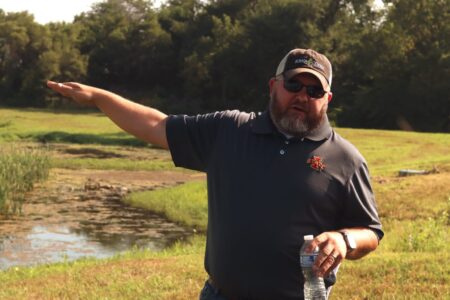
Nick Helland, left, shows Gov. Kim Reynolds a nutrient reducing wetland nestled between corn and soybean fields on his property near Madrid on July 20, 2026. (Photo by Cami Koons/Iowa Capital Dispatch)
He said the farm has planted cover crops since cost-share programs first launched in the early 2010s, but he said with the expanded cost-share this year, and several other conservation programs, he plans to put cover on all of his cropland, as opposed to the 20% to 30% he typically seeded with cover crops.
"I think it's taken us years to kind of figure out how to build these pieces and how to build the house correctly, but we've laid the right foundation, and pieces are coming together," Helland said.
As part of the Farm to Faucet program, IDALS expanded cover crop incentives so that farmers in the Greater Des Moines Watershed can now receive $25 an acre on up to 500 acres - an increase from a previous cap of 160 acres. IDALS also expanded a streamside buffer pilot project to pay farmers in the 22-county region for implementing either harvested or non-harvested streamside buffers, another conservation method present at the Helland farm.
Popular conservation strategies
Bioreactor: An excavated pit connected to a tile line and filled with wood chips that filter the water from the tile. The water is denitrified by bacteria as it passes through the wood chips. It can reduce 24% to 43% of nitrogen.
Saturated buffer: A strip with vegetation that helps to filter and absorb nutrients from the water out of a tile line. Practice can reduce 45%-50% of nitrogen.
Cover crops: A crop planted in between cash crops to keep roots in the soil that help lock in nutrients and soil in a field. Practice can reduce 25%-30% of nitrogen and 29% of phosphorus.
Wetlands: Strategically located to collect water from tile lines and runoff from a field, wetlands can filter nutrients from the water before it runs into a waterway. Practice can reduce up to 52% of nitrogen.
Buffers and wetlands also create additional wildlife habitat. Information and figures from IDALS and the Iowa Nutrient Reduction Strategy non-point source assessment.
Naig, speaking in front of Helland's woodchip bioreactor constructed along the Big Creek, said the farm to faucet program is about "investing more into things that are working," like the strategies on the Helland farm.
"Clean water is nonnegotiable," Naig said. " ... We really are here today to talk about that farm-to-faucet approach - so to get a chance to hear the ag side of the story, what's happening on this farm, but know that this farm is not the only farm where these things are happening."
Figures from IDALS show 147 water quality wetlands have been implemented in the state, along with 484 saturated buffers or bioreactors, more than 220,000 acres of streamside buffers and nearly 4 million acres planted with cover crops. All of these practices help to trap nutrients, namely phosphorus and nitrogen, that would otherwise flow off of fields, through tile lines and into waterways.
Reynolds said the Helland farm showcases the partnerships and "everything that our farmers are doing to protect our natural resources and water quality." She said farmers and the state need to "be flexible" to adjust programs based on what is working to improve soil health and water quality.
"Do more of what works -- it's that simple," Reynolds said.
Helland and Naig said sharing farmer-to-farmer knowledge and working with a conservation professional are important in helping a producer find the right conservation approach.
A recent report showed Iowa lost 17% of the county-level USDA staff that work with farmers to find and apply for conservation funding, loans or other programs. Naig said it's important these offices are staffed, but also that the state is "efficient" in delivering programs.
While some water quality advocates have argued conservation practices should be obligatory, rather than just incentivized for farmers, Helland said he feels a mandate would lead farmers to implement practices that don't work for their farm.
"If you're using incentives and you're starting to kind of help the farmers change the culture and everything, you're going to be more apt to get the right tool onto that right acre," Helland said.
At the faucet
The Farm to Faucet legislation also allocated a one-time, $25 million investment to Central Iowa Water Works to expand its infrastructure and increase nitrate removal capacities over the next three years.
Naig and Reynolds, along with Iowa Department of Natural Resources Director Kayla Lyon, visited the water treatment facility in Grimes that is planning an expansion of its reverse osmosis treatment capabilities.
Central Iowa Water Works, which serves more than 600,000 customers in the Des Moines region, has twice issued a lawn watering ban due to high concentrations of nitrate in the Des Moines and Raccoon rivers, which serve as source water for some of the water treatment systems in the area.
Naig said the farm to faucet program aims to "prevent pollutants from ever getting into our streams" with the implementation of conservation work in the watershed and to ensure there is an "appropriate amount of treatment infrastructure" downstream.
"Because that's how you actually can deliver clean, safe drinking water to Iowans," Naig said.
Tami Madsen, CEO of Central Iowa Water Works, said the investments upstream are an "essential part of Iowa's water story."
"While advanced treatment technology is essential, treatment plants are not expected to solve every water quality challenge alone," Madsen said. "... The future of Iowa's water will be built through partnerships like the ones represented here today: farmers, landowners, conservation organizations, utilities, water treatment professionals, researchers, local governments, and state leaders working together for that common goal."