
‘We’re still home’
Iowa Scenic Byways America 250 Road Trip tour wraps up at Meskwaki Settlement Sunday
Trending
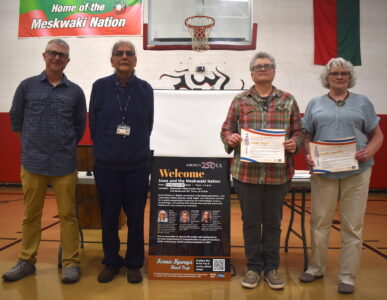
MESKWAKI SETTLEMENT -- Since January, the Iowa Department of Transportation (IDOT) has sponsored a series of events around the state dubbed the "Scenic Byways Road Trip" aimed at highlighting Iowa's unique history and people. After rescheduling the last stop more than once, the tour wound down at the Meskwaki Tribal Center gymnasium on Sunday afternoon as three speakers shared insights on the history, archaeology and resilience of the state's only resident tribe.
Iowa DOT Cultural Resources Team Lead Brennan Dolan moderated the presentations and introduced each speaker -- retired State Historical Society Archaeologist Kathy Gourley, Cindy Nagel of Tallgrass Archaeology and Meskwaki Nation Historic Preservation Director Johnathan Buffalo, a widely respected and authoritative voice on the tribe's extensive history.
"It's hard to believe that our road trip series has covered over 1,500 miles, but I feel like once you get to that 1,500 mark, we've entered the threshold of a legitimate road trip, which is kind of awesome," Dolan said. "The Meskwaki story and connection to Iowa is extremely unique... The Meskwaki Nation and the state of Iowa share nearly 200 years of history."
Gourley's presentation traced the movement of the Sauk and Meskwaki tribes, which the U.S. government has always considered one tribe although historians tend to classify them as separate tribes who formed an alliance during the wars against the French in the 1700s, from modern-day Canada into what is now the United States from Ohio to Michigan to Wisconsin and, finally, central Iowa. She made note of several key tribal leaders whose names are recognized today through cities and counties like Poweshiek, Keokuk and Black Hawk.
On the heels of the Indian Removal Act of 1830 and the Black Hawk War of 1832, an 1842 treaty signed just a few years before Iowa's statehood was formalized in 1846 ordered the removal of Sauk and Meskwaki peoples, but about 80 percent of them stayed in the state (others left for a reservation in Kansas) and formed small settlements before they made their historic purchase of 80 acres of land from Isaac Butler in 1857 that became the modern Meskwaki Settlement. Today, it spans well over 7,000 acres between Tama-Toledo and Marshalltown in western Tama County, and it maintains its unique designation as a settlement rather than a reservation because of the nature of how the land was acquired.
Gourley praised the Meskwaki people for their resilience and concluded by telling the audience of at least 50 people -- a mix of tribal members and visitors who attended the presentation -- how happy it made her to see the tribe thriving today.
Nagel, the next speaker, focused her presentation on an archaeological search at the Wacoshashe and Poweshiek village about 40 miles from the Settlement in modern-day Iowa County near the Amana Colonies, showcasing the artifacts, including both native and European-made gunflints, found in hopes of providing a glimpse into Meskwaki life in the mid-19th century.
The testing, she said, was fairly minimal given funding constraints, and more work remains to be done along with efforts to find more villages and trading posts.
"There's a lot more that can be done at this site and other Meskwaki sites in Iowa because they are a wealth of information, and it really does show the fortitude that they had from having to move constantly to the west," Nagel said. "I think further study would help with giving more of that timeline."
Buffalo, who grew up on the Settlement and has held his current title with the tribe since 1996, was glowingly introduced by Dolan, who commented that when he met Buffalo for the first time, a mutual friend told him to "prepare to learn a lot." The final speaker described his people as "very old," with roots dating back at least 40,000 years in North America, and he recounted that after continual displacement, violence and forced migration, Iowa has provided the "peace and safety" the tribe has always desired since the Meskwaki first arrived here in 1735.
"Within this land, we found shelter, food, medicine, everything we need," he said. "We are still home because this is home to us... We're still home when we look out the window and in the morning we go out, we see our dreams. We feel we're still home."
He also remembered an interview that was part of a special on Wisconsin Public Television about their former home in the Badger State and whether the Meskwaki people missed the area now. While acknowledging that it was "a heavy question" and considering how the tribe's history might have been different had they stayed there and never gone to war with France -- or, conversely, if they had been completely exterminated.
His answer, however, was ultimately no. They did not miss their old home.
"This is our home today," Buffalo said.
He expressed his gratitude for archaeologists like Gourley and Nagel, noting that the tribe gets older as searches move further east. As he shifted his focus to the modern era, Buffalo spoke of Iowa's increasing cultural diversity beyond just indigenous and white people and described the preservation of Meskwaki traditions even with the inevitable adaptation to current trends, joking that he and his wife Suzanne, who now reside in Marshalltown, drive a hybrid car, order food like pizza, Chinese, Mexican and Subway when they don't feel like cooking, speak English with a distinctly Midwestern Meskwaki accent and choose sides in the Iowa-Iowa State rivalry.
"We're typical Iowans, proud Iowans, and we're typical Americans in some ways, but we are still Meskwaki," he said. "We still remember where we come from, where we live, and we're still home."
As the session wound down, Buffalo fielded questions on his own life, the expansion of the Settlement over the last 170 years, the Meskwaki language, cuisine, the upcoming Proclamation Day on July 13 and more before Dolan presented Buffalo, Gourley and Nagel with certificates of appreciation for their work. The Meskwaki Tribal Museum stayed open for extra hours in conjunction with the event, and attendees were encouraged to visit.