
A year of change at East Marshall
District shifts from three to two buildings, superintendent hopes bond construction will begin by October
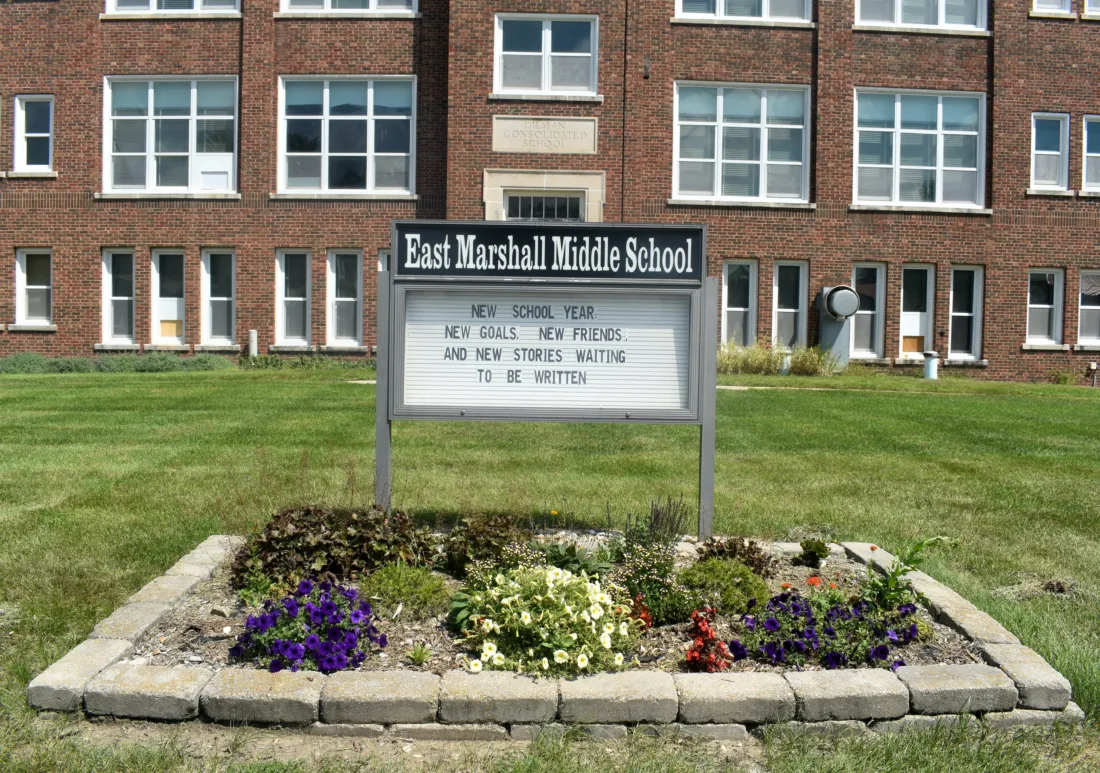
T-R PHOTOS BY ROBERT MAHARRY After over a century of serving students, the former East Marshall Middle School in Gilman is now closed as the district transitions from three to two buildings.
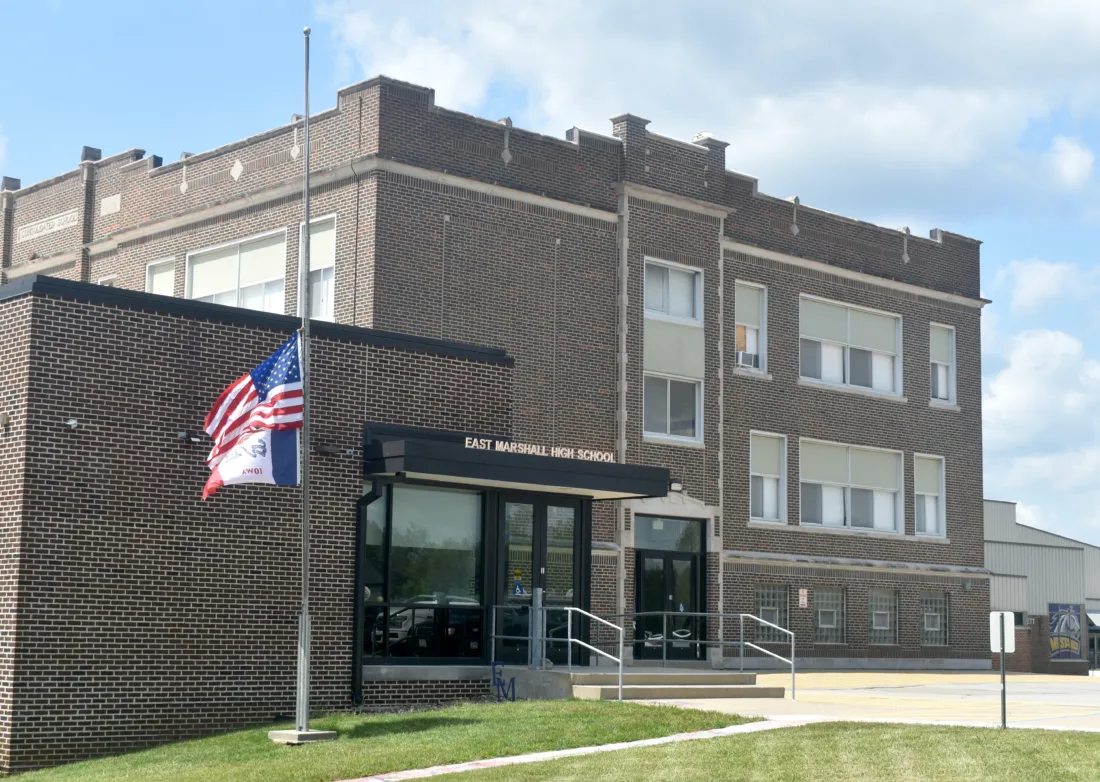
As part of the successful bond issue passed in 2025, the high school campus in Le Grand, pictured, will expand to accommodate grades 7-12, and the elementary in Laurel will be expanded to accommodate grades K-6.
T-R PHOTOS BY ROBERT MAHARRY After over a century of serving students, the former East Marshall Middle School in Gilman is now closed as the district transitions from three to two buildings.
As part of the successful bond issue passed in 2025, the high school campus in Le Grand, pictured, will expand to accommodate grades 7-12, and the elementary in Laurel will be expanded to accommodate grades K-6.
Trending
GILMAN -- The start of the 2026-2027 school year marks a major moment in the history of the East Marshall district as it has officially transitioned from three to two buildings, with grades K-6 now attending the elementary school in Laurel, grades 7-12 at the high school in Le Grand, and the old middle school in Gilman now permanently closed while options for its future potential uses are examined.
After the approval of a $19.8 million bond issue at the polls last November, construction at both of the remaining buildings will eventually expand them to accommodate the additional students -- about 100 in Le Grand and 50 in Laurel -- and during an interview with the T-R earlier this week, second year Superintendent Kevin Seney broke down where the process currently stands and what to expect throughout the year.
By closing the Gilman building a year earlier than originally planned, Seney, who still works out of a separate administrative office in Gilman, said the district was able to save approximately $500,000 in operating and personnel costs, and moving students before the bond project has even begun forced leadership to think "pretty creatively" about programming, room space and how students would move through the buildings.
"We didn't want to lose anything that we were currently doing under the three-building model that was beneficial to kids, so that was most of our conversations throughout the spring," Seney said. "So, programming wise, teacher certification wise, we feel like we're in a good spot in terms of ensuring that we can continue the programs that we've always been delivering to students and families."
He added that some logistical challenges have presented themselves including transportation of students, and all in all, the transition has gone well thus far with some opportunities for expanded programming.
"There's gonna be some things that pop up throughout the year that we hadn't thought of that we're just gonna have to mitigate as we come to light, but again, so far, I think Mr. Rasmussen's done a good job of integrating those seventh and eighth graders into that building," Seney said.
On the construction front, Seney shared -- in the spirit of transparency -- that early bid packages came in over budget, which has impacted the timeline. The original goal was to have shovels in the ground by early September, but now, it will likely be mid-October when dirt flies in both Le Grand and Laurel. Estes Construction is serving as the construction management firm, and both Estes and FEH Architecture are currently reviewing the schematics to optimize the project from a financial standpoint.
Of course, some factors beyond the district's control have come into play since initial cost opinions were brought to the school board earlier this year: increases in fuel and labor costs and a jump in the price of steel, to name a few.
"Had we issued (bid packages) maybe six months earlier, we wouldn't be in this boat, but given the complexity of these projects both happening in separate communities, both along the same timeline, it's added a lot more nuance and more complexity to the project, which, obviously has kind of pushed the cost of that up -- things we didn't think about back in March," Seney said. "We didn't think that gas would be at $4 a gallon. We didn't think that steel would've gone up 26 percent since March."
When it's all said and done, a two-story high school wing will be added to the southeast side of the property along Franklin Street in Le Grand with 14 classrooms, office space, storage and special education programming space, and four new classrooms and a full size gym will be built in Laurel in the first phase. The second phase, which should commence summer, will involve demolishing the 1923 building in Le Grand with a connector hub between the Kivett addition and the new construction.
As for the Gilman building, there are still plans to renovate the gym and office area and eventually move the administrative functions there and allow Seney and his staff to get rid of the current building on West Center Street. Because of changes at the state level on the use of Securing an Advanced Vision for Education (SAVE) sales tax dollars, however, with East Marshall facing a potential reduction of about $2 million, plans to demolish the 1925 and 1980 building while adding on a multi-purpose/wrestling room may have to change.
"That's quite a bit of money to take out of a project that we definitely needed," Seney said.
While acknowledging the temporary challenges that may arise this year, the superintendent credited his staff with handling the transition wonderfully and adjusting on the fly.
"Along with some of the newness and some of the excitement comes that fear of the unknown. Who am I gonna be working with? What kids are gonna be in my classes? Where's my room gonna be located? How's it gonna be set up? Am I gonna desks or chairs or tables or whatever? Am I gonna have air conditioning?" he asked. "There's just a lot of those little things that I think folks worry about, and hopefully we can alleviate some of those things and make sure that we give teachers the best environment and students the best environment to learn this year (and) that we can overcome those things."
Despite staff reductions due to budget cuts, the district was able to add a new preschool teacher, and even as a leader who came to East Marshall when its future was at a crossroads after a failed bond issue in 2024, Seney is now more optimistic than ever about its future even though the work is far from finished.
"I think we thought that once we passed the bond issue that we would have no more facility issues, that once this was done, we could really start to stockpile our PPEL and SAVE dollars and put it towards new buses and things like that that we really needed," he said. "We still have portions of our buildings even with the bond issue that are still gonna need renovation. We still need HVAC updates. We'll still need roofing repairs and some things like that. So I think the idea that the bond is gonna solve all of our problems is probably incorrect, and I think that many of us, including myself, thought (that) now we don't have to worry about facilities for 20 years, which is probably not the case. So I think the public just kind of needs to understand that yes, while these new classrooms and gym spaces and things like that are gonna be great for our district and are really gonna help us enhance the educational environment for our kids and the experiences of our kids, I think they also have to understand too that we still have facilities issues that will be ongoing that we're going to have to address."
As an example, he cited the fact that an addition built at the Le Grand campus in 1978, nearly a half century ago, is still referred to as "new."
"I think once we get going on the projects and once people kind of start to see the results of all of this come to fruition, they'll start to say 'Oh, that's where this is gonna be' or 'Hey, look at this,' and that's what we get to enjoy sometime in 2027 and beyond," Seney said.
Contact Robert Maharry at (641) 753-6611 ext. 255 or rmaharry@timesrepublican.com.