
Binford House Women’s Suffrage Celebration slated for Aug. 22
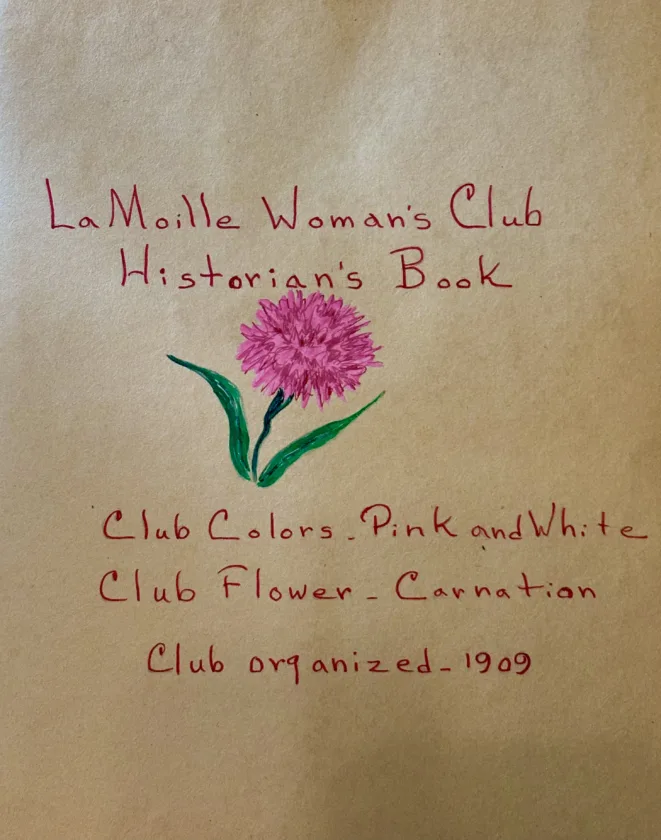
Many Marshall County women’s clubs records are stored at the Binford House.
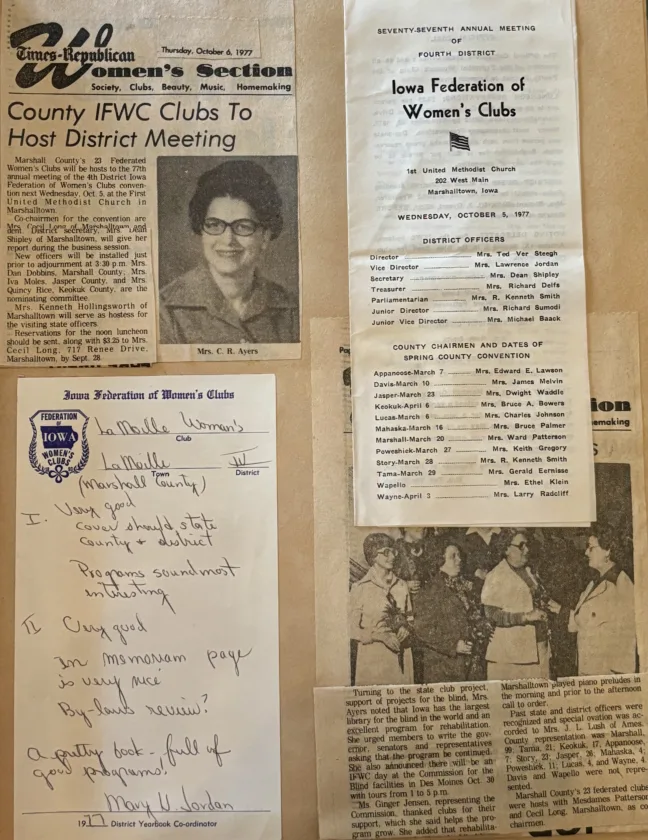
T-R PHOTO BY SARA JORDAN-HEINTZ Local historian Pete Grady will share the history of women’s suffrage in Iowa and the historical influence of Marshall County women’s groups, during talks at the Binford House on August 22. Stored at the home are many newspaper clippings, brochures, minutes to meetings and other women’s clubs' records.
Many Marshall County women’s clubs records are stored at the Binford House.
T-R PHOTO BY SARA JORDAN-HEINTZ Local historian Pete Grady will share the history of women’s suffrage in Iowa and the historical influence of Marshall County women’s groups, during talks at the Binford House on August 22. Stored at the home are many newspaper clippings, brochures, minutes to meetings and other women’s clubs' records.
Trending
It was on July 2, 1919, that the Iowa General Assembly voted during a special session to become the 10th state to ratify the 19th Amendment -- a victory decades in the making. Local historian Pete Grady notes it was women's clubs in Marshalltown and other cities, which not only championed the right to vote, but also advocated for social reforms, public education, better working conditions, and more. He will present his research at the Binford House during a Women's Suffrage Celebration on Aug. 22, from 11 a.m. to 3 p.m.
He will give short talks on women's suffrage and the historical influence of Marshall County women's groups at 11:15 a.m., 12:15 p.m., 1:15 p.m. and 2:15 p.m. Guests will also enjoy a charcuterie cup, dessert and iced tea or lemonade, for $20 a ticket.
"He got on our board because he was interested in all of the women's clubs who had all their information stored upstairs (in the house) since the 1900s. So he comes to the board every month and tells us about something he found. Some of these women were real activists who had no rights at the time," said board member Pat Hauser. "They will learn something without a doubt and be entertained by things he's found in the minutes."
Grady said the history of women's clubs is lesser known to the general public.
"I don't regret any time at all spent going through the minutes (of club meetings)," he said.
Although, the cursive script of some of the hand-written correspondence is harder for the modern reader to decipher.
Unfortunately, he notes, the first names of many of these women are unknown, as a common practice was identifying yourself as "Missus your husband's first and last name."
"You have amazing things they're talking about, but you don't know who they are," he said.
He's utilized newspaper archives to fill in the gaps. Causes these women's groups discussed included child labor, income tax and prohibition. He said their activism is what likely led to the creation of public playgrounds for children and normalizing girls finishing high school. Noted Iowa suffragist Carrie Chapman Catt even came to speak to the women in Marshalltown.
"When Mrs. Chapman was left a widow at 27 she became the first woman reporter in San Francisco, and what she saw and experienced there made her more determined than ever to obtain equal rights for women. She made her first suffrage speech fifty-two years ago in Marshalltown, Iowa. This was the prologue to speeches that she afterward made throughout the civilized world. In 1890 she married George William Catt but she did not give up her work," S.J. Woolf wrote on Jan. 8, 1939 in The New York Times.
But, Grady notes, the ladies clubs did not accept invitations to speak from just anyone. He found documentation where the women in Marshalltown turned down the opportunity to have Charlotte Perkins Gilman speak. She is perhaps best known for penning the short story "The Yellow Wallpaper."
Grady said Iowa women were some of the first in the United States to make headway in the fight for the vote. In 1913, both houses of the 35th Iowa General Assembly passed the amendment. It was again passed by the 36th General Assembly in 1915. But in June 1916, Iowa men voted against allowing women in the state the right to vote.
"This constitutional amendment was on a primary ballot, which was rare," Grady said. "It was a fight between the dries and the wets. Wets voted against women's suffrage."
The term "dry" referred to those who supported the 18th Amendment to ban alcohol, while "wets" supported legalization.
The Binford House, an Italianate-style home located 110 N. 2nd Ave., is owned by the Marshalltown Federation of Women's Clubs. Its most famous resident, Jessie Binford, gained national notice for her 60-year career working at Hull House in Chicago as a social worker, and was regarded as a disciple of Jane Addams. Jessie was active in the organization of the Legal Aid Society, which later became the Juvenile Protection Association, and served as its executive director for 43 years. Knowing the Marshalltown Federation of Women's Clubs needed a meeting place, in the late 1920s, Jessie offered the house to the organization, with the stipulation that it would never be mortgaged or sold, and instead used for the purpose of a meeting place for these groups. While the Federation used the residence throughout the ensuing decades, the deed was not turned over to the group until 1965. Jessie died in 1966.
Hauser said the board continues to maintain the home, which is available to rent. She said this event would give people the opportunity to see the new landscaping, new window treatments and a fresco painted in the fireplace room. People are welcome to attend the event in period attire, or as your favorite female icon, such as Rosie the Riveter.
Reservations are required by Aug. 18 by calling the Binford House at: 641-753-5450.