
Marshalltown city council passes first reading of data center moratorium
Motion to waive second and third readings fails with lack of 3/4 supermajority
Trending
The ongoing debate over data centers in Marshalltown took a somewhat confusing turn during Monday night's city council meeting as the council, after approximately 40 minutes of discussion, voted 6-1 to approve the first reading of a four-month moratorium on the projects before a motion to enact the ordinance immediately failed with the lack of a ¾ supermajority as three councilors voted against waiving the second and third readings.
In front of a packed house, the council held a public hearing on the matter and heard first from Assistant Housing and Community Development Director/Zoning Administrator Clayton Ender before opening it up to the audience. Ender explained that although the council had voted 5-2 in favor of a moratorium at its July 13 meeting, the city's legal counsel advised that they would have to go through the ordinance process, which requires three readings unless subsequent readings are waived, to ensure that it is legally enforceable.
The moratorium under consideration, he added, would apply to new construction and/or substantial expansions of existing data centers but not normal maintenance and repair work. The moratorium is currently set to expire on Nov. 23, four months and 10 days from the original motion on July 13, and the council can extend the moratorium one time by resolution for up to 60 days -- anything beyond that would require a new ordinance process. Ender also clarified that the moratorium would not preclude city staff members from speaking to developers, but no applications can be accepted.
"I want to be clear (that) currently no proposals have been filed with the city. Yes, we have had prospects reach out to us, but until they file an application, it's a prospect," he said. "But we could still theoretically move forward with things such as annexation, if that were needed, or other approvals because that does not constitute approving a data center. They're related, but they are different."
Last Thursday, the Planning and Zoning Commission unanimously voted to recommend the council's approval of the moratorium and the waiving of second and third readings. Mayor Mike Ladehoff then warned public commenters to keep their remarks focused on the moratorium itself and not their broader feelings on data centers.
The first question came from Annie Grieshop, who sought to clarify the issue of whether the moratorium is actually already in effect due to the fact that the four-month "clock" started on July 13, according to Ender.
"Legally speaking, it is not enforceable until it is adopted as an ordinance, per the city attorney," he said.
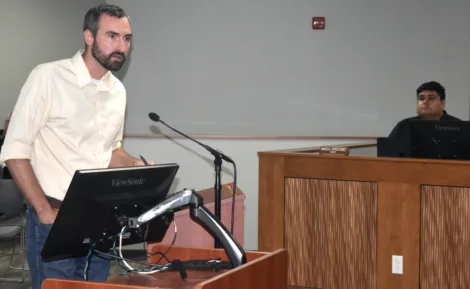
From there, a slew of public commenters stepped forward and endorsed the moratorium, with Daleen Michel calling on the community to "stand together on this issue" and Zach Hamilton, who lives on Shady Oaks Road just outside of the current city limits near the proposed site of one of the prospective projects, reflected on the stress he has endured recently but also thanked individuals -- some of whom he admitted having strong disagreements with -- for engaging in respectful conversations with him.
Nonetheless, he reiterated that while some commenters may not live anywhere close to a proposed data center, the Shady Oaks project would be in the front, side and backyards for he and 12 of his neighbors. Hamilton, comparing the process to his work at Emerson, endorsed putting guardrails, clarity and direction in place, which he also felt would benefit developers considering Marshalltown.
"The valves that make it across my desk the fastest are the ones that actually come in with definition and clarity. The ones that take the longest to get out are the ones that come in with doubt, lack of clarity and lack of direction," he said. "We end up trying to piece things together after the fact, causing more problems and more arguments than if it would've just been settled right out of the gate."
He also felt Marshalltown could still be "open for business" even with a moratorium in place. Layne Pieri indicated that he had sent a petition with nearly 400 signatures from Marshalltown residents in favor of the moratorium, and Pieri shared his preference for allowing the review of regulations before any applications can proceed.
"This is not a vote on whether data centers are good or bad. This is a vote on whether Marshalltown should finish writing the rules before processing applications," Pieri said. "I believe the responsible choice is to finish that work first."
Marshalltown Area Chamber of Commerce President/CEO John Hall stepped forward and told the council he believed, from an economic development perspective, that his organization could navigate a short-term moratorium without endangering any current prospects. He also addressed the marketing of the 1,224 "Marshall County Data Center" site on Shady Oaks Road, which was previously listed on the Chamber website, and said it came from a third party known as LOIS (Location One Information System) that the Chamber partners with as part of a statewide contract.
"It makes it look like things are our listings when, in fact, we don't even necessarily know what's going up there, when it's going up there, how it's being advertised, anything to that end," he said.
The easiest way to discern if the Chamber is directly involved, he added, is if his name is listed as the local economic developer -- otherwise, it's a scrape from a program called Resimplifi. In response to claims about the "rushed" nature of data center proposals, Hall also noted that as part of the organization's quarterly reports to the city, every report filed since 2024 has included language about such proposals. In February of 2024, with no public comments, the council unanimously and enthusiastically approved moving forward with the sale of 7.567 acres to Boost Run LLC for a data center project in the Edgewood Industrial Park near JBS, though it ultimately never materialized.
After noting his work in the tech industry and the fact that he owns land near one of the potential data center sites, Cody Brink endorsed the moratorium as a chance to get the rules right, as did Rick Lang, who said he had visited a data center in Altoona earlier in the day. Doris Kinnick worried about data centers taking farmland out of production, and Leigh Bauder submitted a written comment supporting the moratorium as a means to slow down and avoiding chasing the "golden goose" before the city's ducks are in a row.
From there, it was time for the council to weigh in with a motion and second made, and Councilor Greg Nichols welcomed Hall back to the podium to ask him how the moratorium would affect economic development prospects. According to Hall, the Chamber is handling between 12 and 20 current potential projects, of which "a handful" are specifically data centers looking at different land options, sizes and scales.
The prospects are working to gain control of land to perform power studies, environmental reviews and other due diligence, and Hall hoped that wouldn't impede the work they're doing while the city does its own due diligence. Councilor Mark Mitchell then asked Hall how many "players" he had at the table currently, and he replied that there are five prospects for data centers, three of which are considered active.
Other non-data center prospects include sustainable aviation fuel, advanced manufacturing and electronic and network equipment manufacturing, to name a few. Councilor Gary Thompson joked that while he loves the quarterly reports, they show that prospects come and go, and Hall responded that the Chamber "swings the bat a lot," but its hit rate isn't necessarily great.
"That is just a product of economic development is that we get to bat a lot and we swing a lot, but very rarely are we actually hitting the ball. And so when we are, that's when things become a lot more active. That's when we start to wrap in things like individual city staff members to help us evaluate because I'm not an expert in those spaces," Hall said. "With any of these projects, there's always a process in which they come forward and become a public project, and that's usually when they've gotten to the point of selection of a site."
Projects will always involve public input at some point in the process, he added, but the Chamber's goal is to evaluate the prospect and see what it will take to convince them to invest in Marshalltown.
With no further comments, the first reading passed by a 6-1 margin -- Nichols added "with regret" to his vote -- as Councilor Jeff Schneider was the lone dissenter, and at that point, it seemed as if the waiving of the second and third readings to enact the ordinance immediately was a foregone conclusion.
Thompson, however, then indicated that he would be voting against waiving the second and third readings -- pushing the council back below the ¾ supermajority required to do so -- because he believed the citizens of Marshalltown "shouldn't be shortchanged."
"Something may happen in the next four weeks, the next two meetings, the next two readings. I want the public to have the chance to come to the podium again. So for that reason, I'm voting no to waive the second and third reading. I think it's that important of an issue that you have the chance to be heard again," he said.
That led to further conversation over the actual legality and enforcement of the moratorium through the ordinance process, which, in technical terms, could be something closer to a two-month moratorium once the third and final reading is adopted at the Sept. 14 meeting.
Ladehoff warned that failure to pass the moratorium immediately could still leave the door open for a data center to apply for permits under the current system -- which requires a recommendation from P&Z and a final decision on a special use permit from the Board of Adjustment (BOA) -- but Thompson said he had faith in the five-member BOA to deny an application during the ordinance review process.
The mayor countered that the BOA can only base its decisions on current ordinances and could not make determinations based on members' own personal feelings, which prompted Thompson to note that they had recently denied a fence request for a property on Anson Street.
"I just don't think we oughta leave a window," Ladehoff said.
The vote to waive second and third readings was four in favor -- Marco Yepez-Gomez, Sue Cahill, Nichols and Melisa Fonseca -- and three opposed -- Thompson, Mitchell and Schneider. Ladehoff initially commented that the motion passed, but City Administrator Carol Webb corrected him because waiving subsequent readings requires the aforementioned supermajority.
An audience member asked for clarification on what had occurred, and Ladehoff provided the explanation about the need for at least six votes to waive subsequent readings. Additional readings will now be held at the Aug. 24 and Sept. 14 meetings unless the council votes to waive the third reading on Aug. 24.
"Everyone here wanted it passed today, just saying," an audience member said.
"You should've talked to your councilman," Nichols replied.
In other business, the council:
Approved the consent agenda as listed with one item removed for further discussion.
Heard a quarterly update from Arts + Culture Alliance Executive Director Amber Danielson and an update on the Growing Iowa’s Economy advocacy group from Hall.
Approved a Class C retail alcohol license for La Capital Del Taco and a Class E retail alcohol license and retail tobacco permit for Now & Forever LLC.
Approved the third and final reading of the new ordinance regulating domestic fowl and livestock keeping within city limits by a 6-1 vote with Schneider opposed.
Approved the first reading of ordinance changes regarding weapons, window tint and fireworks to bring city code into compliance with new state laws. Cahill was the lone no vote against the new weapons ordinance.