
Marshalltown residents voice data center questions during well-attended community roundtable
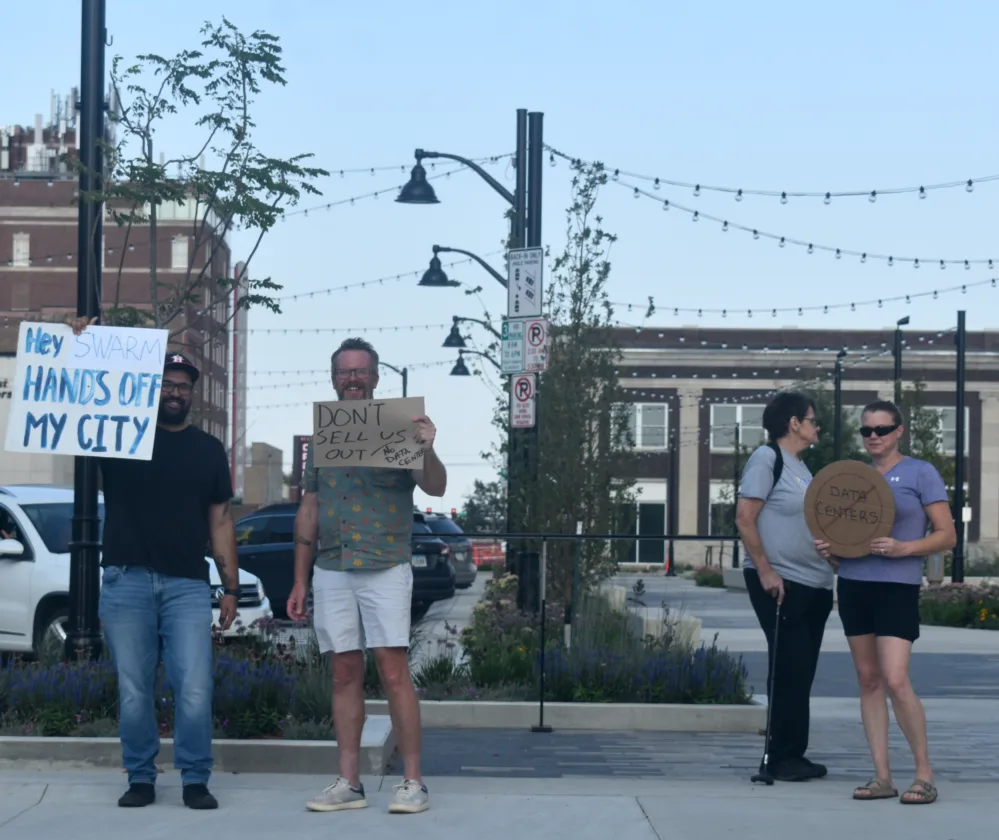
T-R PHOTO BY ROBERT MAHARRY On the night before the roundtable, a group of residents gathered outside of the Marshall County Courthouse to protest data center development in the community.
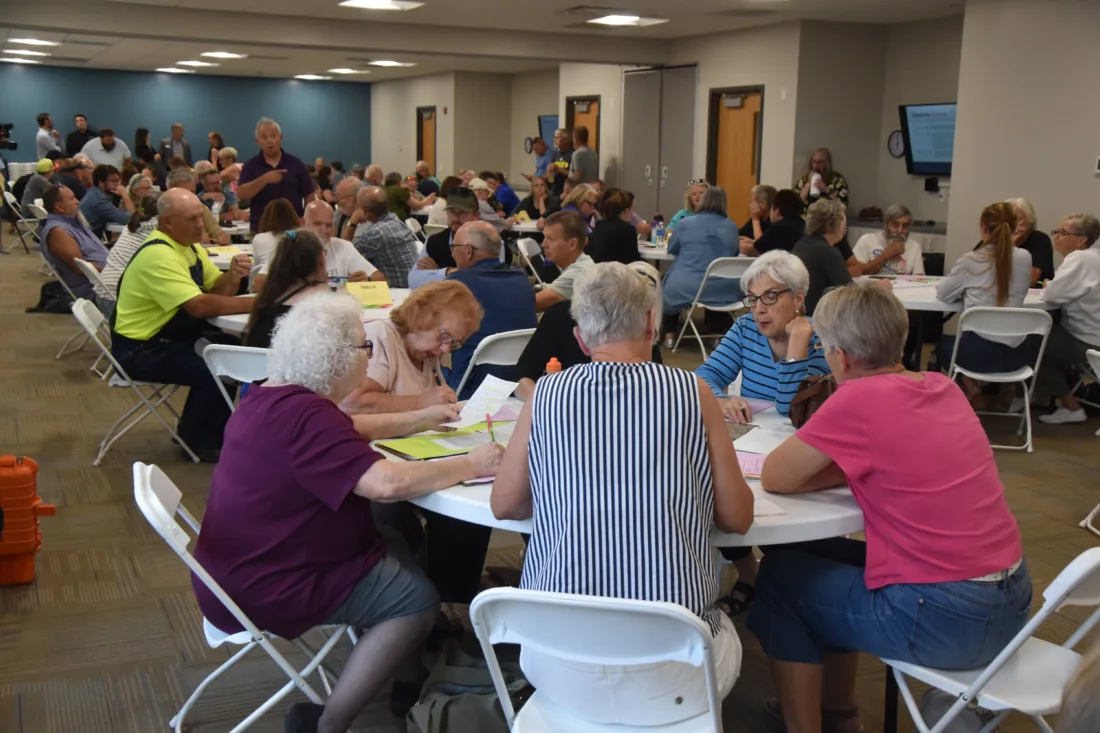
T-R PHOTO BY LANA BRADSTREAM Marshalltown residents conducted small table discussions at the data center roundtable meeting Thursday evening. The event was held so the city could hear citizens' concerns before moving forward with possible regulations on data centers.
T-R PHOTO BY ROBERT MAHARRY On the night before the roundtable, a group of residents gathered outside of the Marshall County Courthouse to protest data center development in the community.
T-R PHOTO BY LANA BRADSTREAM Marshalltown residents conducted small table discussions at the data center roundtable meeting Thursday evening. The event was held so the city could hear citizens' concerns before moving forward with possible regulations on data centers.
Trending
(EDITOR'S NOTE: This is the first in a two-part series on the data center roundtable meeting held Thursday night at the Veterans Memorial Coliseum)
The voices of Marshalltown residents were heard Thursday evening during a public roundtable on data centers attended by more than 100 people at the Veterans Memorial Coliseum.
The crowd listened to a brief presentation by Marshalltown Assistant Director of Housing & Community Development Clayton Ender, wrote down their questions about data centers and were given the microphone to bring their concerns out in the open.
The purpose of the roundtable was to bring some data center information to residents and hear concerns so the city could move forward in the creation of data center regulations.
"We want to hear your feedback tonight," Ender told attendees. "Rather than just me speaking to you, we want you to speak to us. . . . This is intended to be a conversation, not strictly a presentation. We are still gathering information. We have not begun preparations for regulations. That is the next step we will be moving into."
Ender gave brief explanations of the types of data centers and updates of terminology. The term "data center" can be confusing as it continues to change, he said. Older terms were "server room" and have evolved to terms such as "hyperscale facility" and "AI factory." Those labels are not always consistently used, so the city needs additional information. Specifically, how much land will be necessary, how big the facility will be, what equipment will be used and how much electricity and water it will require.
After the presentation, attendees were asked to hold small table discussions with one another before opening the floor to everyone. At one table, Marshalltown Planning & Zoning Commission Chairman Jon Boston helped provide answers and let people know if there was information he could give. One question asked was if a data center company would receive a tax break. He said that was a matter left up to the Marshalltown City Council, and they were trying to think of proper parameters.
"[For example,] we have parameters for fences -- what materials it can be made out of, where they can be located," Boston said. "We need to do the same thing for a data center. Right now, we don't really have tight enough controls on a data center. We have some controls. For example, we have a noise ordinance that would cover it. We have a lighting ordinance that would cover it. We want to hear what your concerns are, what your thoughts are."
He has heard concerns about the amount of water used by data centers, particularly ones using an evaporative cooling system. In that, water evaporation is used to cool the facility and the servers. However, it requires a large amount of water. Boston would like a potential data center to use a closed loop cooling system.
"It works like the radiator of a car," he said. "You fill it up, put some antifreeze in it to make it transfer heat better between coils and use that to cool computers. Then they pump that outside and blow a fan over the coils to cool them down. Then they pump [the water] back inside again."
Another person asked why Marshalltown would want a data center to begin with. The biggest advantage is the expansion of the property tax base, which could lower residential taxes and benefit the city, county, community college and school district.
"With the state passing (the) regulation that they can only do two percent increases on existing properties, the only way a city can keep up with the cost of living is having buildings go up," Boston said. "Building one new house doesn't add a lot to the property tax (base). Building a $300 million facility does."
After the small table discussions ended, Ender opened the roundtable floor and invited volunteers from each table to share what the general consensus and biggest concerns were. The first volunteer was Leigh Bauderm who said her table focused on finances because the industry is volatile and they are concerned about an AI bubble burst. She asked if the company that owns the data center would be able to survive such a burst.
"We want to look at revenue. . . . How do we generate revenue from services that are being provided," Bauder said. "If they have $1 billion of services that they are providing, how do we get a piece of that pie?"
She continued that they had concerns about barring foreign ownership of the data center, and would want permanent, on-site employees, not remote.
Lisa McElaney said a big issue they talked about is fire hazards because data centers contain a lot of lithium batteries.
"You cannot fight a lithium fire. It just has to burn out," she said. "What about the fire department? Are there new technologies in order to fight these fires? What kind of chemicals are going to be released into the air in the event of a fire?"
McElaney suggested the developer should be required to relocate any homeowner within 2,000 feet of a facility, if that homeowner chooses to move. Then the city could use the homeowner's property as a green space.
"Once a data center goes in, those property values are going to bottom out, and I don't think that's fair," she said.
Amber Lawthers said she wanted to bring to light that 70 percent of polled Americans do not want data centers in their communities.
"I wanted to ask why we weren't asked if we wanted a data center here in the first place," she said.
Additional shared concerns were regulations of visual and audible impacts, negative impacts on the high quality of Marshalltown's drinking water, the company putting shareholders and not residents first, the low number of jobs after construction is complete and requiring the center to have an electromagnetic force (EMF) shield. It was also asked what would be lost in the future by Marshalltown supporting a data center now, and why it seemed like actions were being taken toward building a data center when a moratorium was in place.
Contact Lana Bradstream at 641-753-6611 ext. 210 or lbradstream@timesrepublican.com.