
National group releases cover crop tool modeled after Iowa ‘batch and build’ program
Trending
An Iowa program that deploys conservation practices across an area, rather than one at a time, served as a model for a cover crop adoption program launched by American Farmland Trust.
The conservation agriculture group released a guide to help producers follow the "batch and grow" cover crop program, which it said removes barriers, lowers cost and streamlines cover crop adoption for participants.
The program follows the "batch and build" model initiated in Polk County to install water quality edge-of-field practices, like bioreactors and saturated buffers, in batches across a neighborhood or community. Now the batch and build model has been adopted by the Iowa Department of Agriculture and Land Stewardship for water quality projects in counties across the state.
Similarly, the batch and grow model, which was first initiated in Dubuque County, enrolls "batched" acres in a region and a local farmer-led group initiates contracts for cover crop seed and application.
According to the Batch and Grow Roadmap from American Farmland Trust, this method "removes several barriers of adoption for farmers" like part of the financial risk, uncertainty about seed mixes, lack of technical experience and the lack of time during harvest season. The roadmap is meant to support other organizations around the country as they look to implement similar systems.
Midwest Senior Program Manager Julie Larsen with American Farmland Trust said the roadmap helps interested groups initiate these programs without having to "recreate the wheel."
"It draws on those lessons learned and is filled with practical information to help organizations launch their own Batch and Grow program, ultimately putting more cover crops on the ground to improve water quality and soil health," Larsen said in a news release.
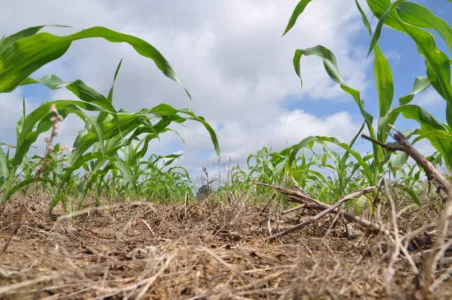
Cover crops are a conservation method in which a farmer seeds a second crop into their standing cash crop so that once the corn or soybeans, for example, have been harvested from a field, a different crop has already taken root. This helps to keep roots in the ground, which in turn help soil and nutrients from washing off of what would otherwise be a bare field.
The Dubuque County project resulted in nearly 16,000 acres seeded with cover crops across land from 125 farmers in 2025, according to the Sand County Foundation, which partnered with Dubuque County Watersheds on the initiative.
The effort started in Dubuque County in 2024 and in 2025, American Farmland Trust helped expand the batch and grow model to areas of Illinois with funding assistance from the U.S. Department of Agriculture Natural Resources Conservation Service.
According to the roadmap from American Farmland Trust, "batching" cover crop seed purchases and applications resulted in savings between 3% and 56% depending on the seed mix, as compared to per acre Environmental Quality Incentives Program payment rates - a popular USDA conservation funding program.
The first step to bringing a batch and grow program to an area, according to the roadmap, is to identify potential farmer-led groups, like the county conservation district or local grassroots farmer groups, to gauge the interest in starting a batch and grow program.
Farmer-led groups are a "critical component" of the program, as these groups make decisions on things like seed mixes, dealers, application methods or contractors, project geography and more.
Putting these decisions on the farmer-led group, versus an individual farmer, is part of how the batch and grow system removes barriers of cover crop adoption. The trust also recommends the groups work with a local support organization, like a nonprofit, local municipality or small business that can help coordinate the effort.
Next, the group should establish goals and timelines for the project, before it can create applications for interested farmers and initiate contracts with seed dealers and applicators. The project in Dubuque County utilized drone contractors to seed cover crops, a practice that is growing in Iowa.
Once farmers have enrolled and the farmer-led group has approved applications, they can work with USDA's NRCS and Farm Service Agency offices to try to secure funding that will support the projects. Alternatively, farmers could also pool resources for the cover crop costs. According to the roadmap, the program in Dubuque County asked farmers to pay $10 per acre enrolled to "stretch" public funding.
Finally, the group can coordinate cover crop implementation with enrolled farmers. Having a central group plan and execute contracts with dealers helps the farmers who might otherwise not have time to do these things during harvest season, according to the roadmap.
In addition to streamlining the logistics of adding a cover crop, the roadmap said the collaboration among participating farmers allowed them to ask for advice and learn from one another. According to the roadmap, more than a quarter of participants in existing batch and grow programs were implementing the practice for the first time.
More specific information and tips on the batch and grow process can be found in the American Farmland Trust roadmap.