
P&Z Commission unanimously recommends four-month data center moratorium
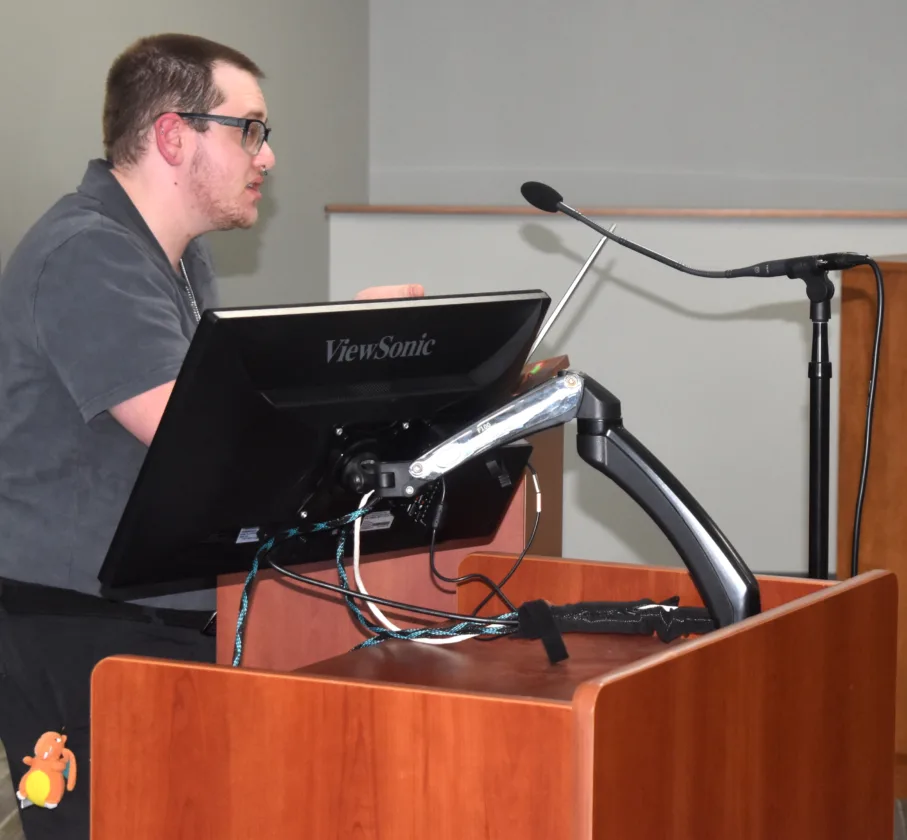
Layne Pieri, the founder of the Marshall County Data Center Moratorium Facebook page, speaks in favor of a proposed moratorium during Thursday night’s Planning and Zoning Commission meeting at city hall.
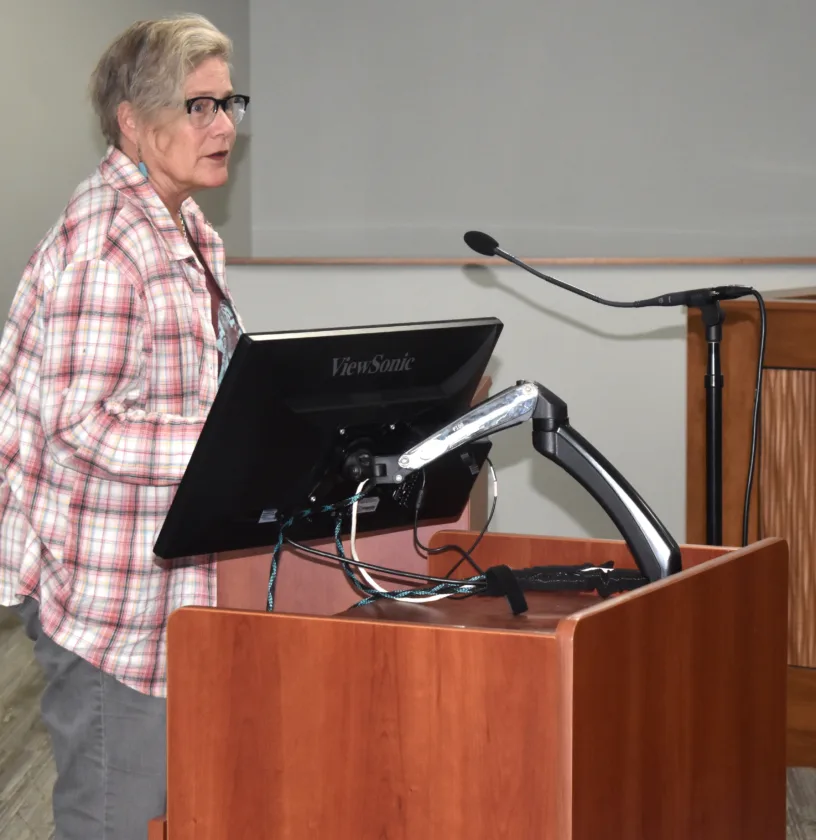
Marshalltown resident Nancy Adams speaks in favor of a proposed data center moratorium during a Planning and Zoning Commission meeting held Thursday at City Hall. The commission voted 6-0 to recommend a four-month moratorium, and the city council will vote on it Monday.
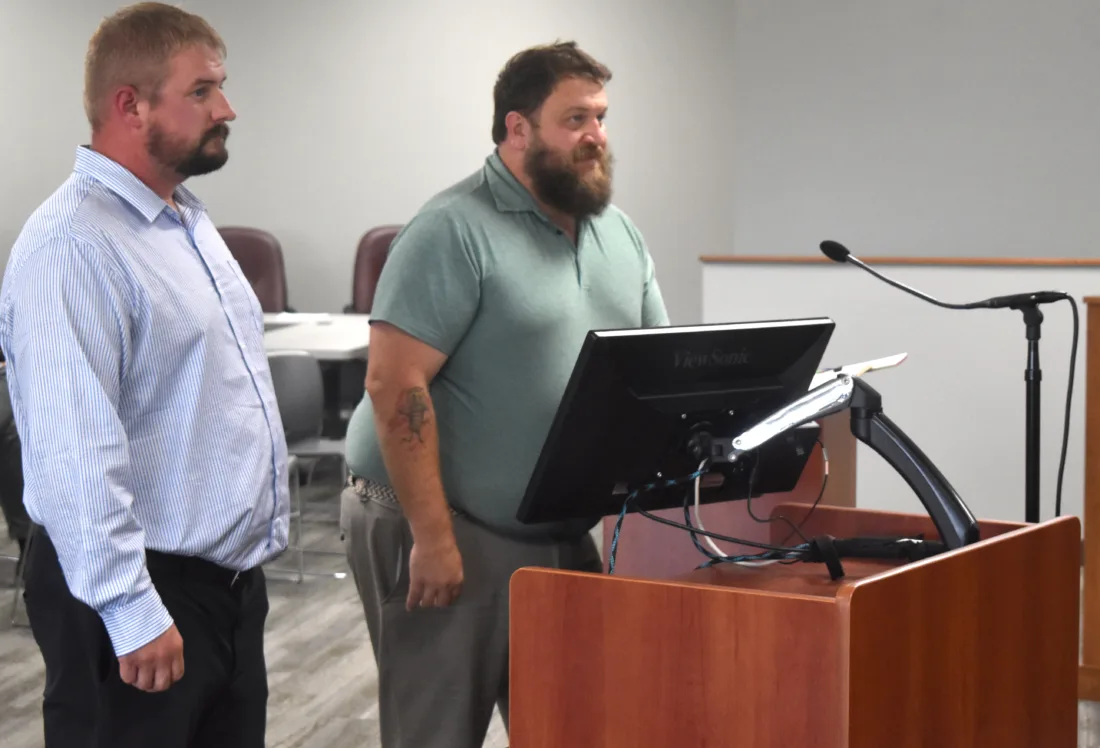
T-R PHOTOS BY ROBERT MAHARRY Marshalltown Water Works General Manager Zach Maxfield, left, and Assistant Housing and Community Development Director/Zoning Administrator Clayton Ender, right, address the Planning and Zoning Commission during a work session on data center regulations held Thursday evening.
Layne Pieri, the founder of the Marshall County Data Center Moratorium Facebook page, speaks in favor of a proposed moratorium during Thursday night’s Planning and Zoning Commission meeting at city hall.
Marshalltown resident Nancy Adams speaks in favor of a proposed data center moratorium during a Planning and Zoning Commission meeting held Thursday at City Hall. The commission voted 6-0 to recommend a four-month moratorium, and the city council will vote on it Monday.
T-R PHOTOS BY ROBERT MAHARRY Marshalltown Water Works General Manager Zach Maxfield, left, and Assistant Housing and Community Development Director/Zoning Administrator Clayton Ender, right, address the Planning and Zoning Commission during a work session on data center regulations held Thursday evening.
Trending
As the issues of data center regulations and a potential moratorium continue to garner ample attention within the community, seats were hard to come by at Thursday evening's Marshalltown Planning and Zoning Commission meeting, during which the commission, down a member after Matthew Brodin's resignation, unanimously recommended that the city council adopt a four-month moratorium and waive second and third readings at its upcoming meeting set for Monday.
In an email announcing his immediate departure sent Wednesday afternoon, Brodin cited his young family and a growing workload, indicating that while he had hoped to finish out the year, such a commitment no longer felt realistic. He also seemed to make reference to the data center controversy later in the email.
"I don't like stepping away before important items are considered, but I believe the community deserves someone who has the time and energy to fully commit to this role," he wrote. "I have also become uncomfortable with some of the behind-the-scenes issues surrounding recent matters. I believe in serving the community with transparency and professionalism, and I feel it is the right time for me to step aside. Thank you for the opportunity. I wish the commission and the City the very best moving forward."
Applications are now being accepted to fill the vacancy on the city website for a term ending March 31, 2028. The remaining six members, led by Chairman Jon Boston, first discussed and ultimately voted unanimously to recommend the adoption of the four-month moratorium after hearing from several public commenters, all of whom spoke in favor of the moratorium.
After sharing some definitions and background with the audience, Assistant Housing and Community Development Director/Zoning Administrator Clayton Ender clarified that the moratorium would only affect new construction and would not apply to maintenance of any existing facilities. He also said the moratorium would still apply to pending applications while it is in effect, though he would defer to the city attorney on whether a developer had "vested rights."
Once Ender had shared his findings and staff recommendation for the council, the public hearing was opened with Boston instructing those in the crowd to focus their remarks on the moratorium itself and not general feelings on data centers.
Leigh Bauder endorsed the moratorium as an opportunity to become more informed before making a legacy-defining decision in the city and highlighted a new data center decision tool from the University of Iowa. Erin Carpenter felt the moratorium could protect the city from doing damage control later on, especially given the "extreme" demands of data center projects. Linda Clark called for slowing down the process to ensure full transparency, and Roberto Gonzalez shared a similar message urging the commission and the city council to take its time, likening it to building a house on a solid foundation.
Nancy Adams suggested that the city "hit the pause button" to allow decision makers to gain knowledge and confidence, and Layne Pieri, the founder of the Marshall County Data Center Moratorium Facebook page, began reading a prepared statement before Boston redirected him toward simply commenting on the moratorium itself.
"I am very for the moratorium," Pieri said.
Maggie Valentine, another supporter of the moratorium, felt that many of the attendees likely hoped to get a chance to speak on the regulations themselves and asked when an appropriate time to address them would be. Boston pointed to a public open house set for Aug. 27, most likely at the Veterans Memorial Coliseum, and the city council will have to pass three readings of the new regulations once they are finalized with a public hearing attached to one of the readings.
Annie Grieshop began speaking about research into parcels on Shady Oaks Road just outside the current city limits that have been marketed as a potential data center site before Boston redirected her toward the moratorium specifically, and because of that, she advocated for enacting the moratorium as quickly as possible. At that point, the public hearing was closed, and Boston clarified that the recommendation to waive the second and third readings of the temporary moratorium ordinance was meant to keep an application from coming in between Monday night and the third and final reading of the ordinance with no specific regulations in place.
"We want to get that in place as quickly as possible if the city council agrees," he said.
Commissioner Ben Harris-Medina then asked Ender if any application submitted before the moratorium took effect would still require a special use permit from the Board of Adjustment as a major utility, and Ender said that was his determination.
"Any proposal would require public meetings (and) public hearings if it came through. As this ordinance is drafted and should second and third readings be waived by city council, I don't see a practical path that an approval could occur," Ender said.
Fellow Commissioner Steve Valbracht also sought clarification that the moratorium would not preclude city staff from discussing prospects during those four months, and Ender agreed with the interpretation that those conversations would still be allowable as long as no formal approvals were granted.
From there, Valbracht moved to approve the recommendation, and it passed by a unanimous 6-0 vote. It now heads to the city council on Monday.
Work session on regulations
For the next 70 minutes, Ender dove into the "meat and potatoes" of the topic as the commission held its first official discussions on which regulations should be enacted and ultimately presented to the city council for final approval. He has reached out to Iowa's three regent universities for guidance and said he would welcome helpful input from academics, business professionals, citizens or any other reputable sources.
Ender offered up a number of specific areas as potential starting points for discussion, and Boston welcomed Marshalltown Water Works General Manager Zach Maxfield to the microphone as water usage is one of the most controversial aspects of data center projects.
Boston began with a relatively simple question: if a data center came into town and wanted to hook up to MWW's water supply, what would you tell them?
"Just like any business, any other industry that's looked to come in before, there's a long process," he replied. "Currently, we don't have the capacity to feed more than 100 or 200,000 gallons a day to anybody."
He did, however, note that a new treatment plant is being constructed that will increase the capacity by about 2 million gallons per day with an estimated completion of spring 2028. Maxfield also laid out the process for an annexation request, which would require approval from the city council and the Water Works Board of Trustees. Valbracht raised the issue of closed loop systems, which are believed to use little to no net water after the initial fill-up, but he admitted he had more research to do on the topic and wasn't ready to commit to only allowing one type of system.
"We're gonna have to come up with some sort of definition that manages that water risk, so I think we all have to think about and learn a little about the different types of systems," Valbracht said.
Ender added that in his research so far, closed loop systems do require some sort of "top off" after the initial fill-up due to evaporation. As the conversation segued toward the next topic, Ender and Boston agreed that the regulations being discussed should most likely be applied to all heavy water and electrical users, not simply data centers, to avoid accusations of unfairness or singling out one type of business.
"If it's not binary, it's not open loop bad, closed loop good, then we need help from you to understand the shades of gray or in how to draft in a way that allows for the shades of gray," Commission member Deirdre Gruendler said.
Ender noted that the technology will likely continue to evolve in the years to come, which may require ordinances to be revisited, and Boston opined that data centers should be required to hook up to the larger electrical grid and not build "their own little power plants" unless they need to use backup generators. Ender raised questions about which zoning classifications data centers should be allowed in depending on their size, and Boston recommended dividing them up by size.
"I don't want to see one of those monster buildings that's 500,000 square feet. I just don't think it fits Marshalltown," Boston said, noting that the largest current building in town is likely the Emerson factory on Governor Road at about 350,000 square feet.
As a point of reference, the Meta campus in Altoona contains over 5 million square feet under roof spread across several buildings.
"We don't want that either. In my mind, it's one business, one building," Boston said.
That prompted Valbracht to ask if every industrial customer would be treated that way simply because the city doesn't like the way it looks and where a line would be drawn.
"If we don't draw the line somewhere, we're gonna end up with one of these," Boston replied.
From there, Ender discussed the various types of data centers including hyperscale, enterprise and colocation along with crypto mining facilities, as well as architectural regulations in General Industrial zoning districts.
As the discussion wound down, the focus shifted to the economic development opportunities presented by data centers, and Valbracht said that the city should leverage its available resources while managing the risk. Boston noted changes in state law regarding property tax growth in cities and counties, and Ender acknowledged the argument that data centers create a relatively low number of permanent jobs. The lengthy buildout, however, does create long-term construction jobs.
"We have a strong construction trades industry here in Marshalltown. It's wise for us to support that and let them have local work. I don't want to dismiss that industry," he said.
Ender and the commissioners agreed they have plenty of work to do before their regularly scheduled August meeting next Thursday evening, and Ender pledged to explore data center regulations in peer communities across the state and the country while utilizing the new tool from the University of Iowa.
Before adjournment, Ender put in another plug for the upcoming community roundtable, which is set to be held at the Coliseum on Aug. 27 at 5:30 p.m. with the opportunity for public input. The next P&Z meeting on Thursday, Aug. 13 will also include a recommendation on the Reimagine Marshalltown Comprehensive Plan.
Contact Robert Maharry at (641) 753-6611 ext. 255 or rmaharry@timesrepublican.com.