
City official provides information on various types of data centers
Trending
(EDITOR'S NOTE: This is the second of the two-part data center roundtable series.)
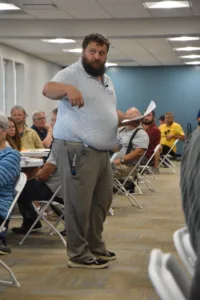
There are different types of data centers, they come in different sizes and the language has evolved to define what they are. Marshalltown Assistant Director of Housing & Community Development Clayton Ender gave attendees of the Thursday data center roundtable at the Veterans Memorial Coliseum some general information regarding the controversial structures.
"This is intended to be a conversation, not strictly a presentation," he said. "We are still gathering information and have not begun preparation of [any] groundbreaking. That is the next step we will be moving into."
Ender said city officials encourage residents to ask questions as they try to help guide the community.
He started his presentation with the terminology, stating "data center" can be confusing as the vocabulary has changed. Terms such as "server room," "machine room" and "server farms" describe data centers and have been around since the 1960s. Newer terminology includes "hyperscale facility," "enterprise facility," "large load" and "AI factory." He said it is important to know the scales and types of data centers so different proposals can be evaluated.
"These labels are not always used consistently," Ender said. "A company may describe itself by who owns it, who uses it, what work it performs, how large it is. For a local government such as ourselves, the name alone is typically not enough."
The more useful questions which would benefit the city when it comes to regulations are ones such as how much land will the center require, how big the building will be and how much electricity and water it will consume. Additional useful questions, he said, are asking what equipment will be used and how much neighboring properties would be impacted.
"Those are measurable characteristics and they are more important than a marketing label," Ender said.
He then broke down the different data centers, starting with "enterprise facility," which typically only serves one company or institution. Ender said that an enterprise facility could simply be a server room or it could be an entire building. A "co-location facility" rents space and computing capacity to multiple customers. Those are often larger and may require staff to address customer needs.
A "hyperscale facility" could include multiple buildings, some which might be millions of square feet. Ender said a hyperscale facility campus could be built in phases and use hundreds of acres. The electrical demand of a small facility could be several megawatts, but the large campuses can get into potentially gigawatts.
"I have to admit, I had to wrap my head around what a gigawatt is," he said. "It's a lot of power."
Ender added that some data center campuses have expanded, and others were originally intended to be big, but were scaled down.
Some things that should be considered by Marshalltown citizens are the use of a potential data center, the available electrical infrastructure of the community, the type of cooling systems to be used and the project scale. He said the city government does not determine utility rates.
"That is from the utility provider and the Iowa Utilities Commission," Ender said. "It's an important question, and it's unfortunately one where we as a city are not able to answer. I want to make that clear."
He pointed out that some of the Iowa data center campuses use a large amount of water, and others use very little. The type of cooling system is important to consider, as it comes with a trade-off. Evaporative systems use more water, but reduce the electrical need. Closed loop systems use less water, but may require more electricity.
"Water use is not determined by size alone," he said. "It does depend heavily on the cooling technology selected within the facility."
The cooling system is oftentimes the source of the noise residents have expressed concerns about, he said. The city does have a noise ordinance, but a data center could still fall below the decibel limit.
Ender ended his presentation on the topic of job creation. During construction, there is often substantial employment and investment. Afterward, he said it is more likely a modest number of permanent jobs, and it depends on the type of data center.
The main takeaway, Ender said, is that a "data center" encompasses facilities with varied footprints and impacts. He said it is important for local governments and communities to recognize the large range of data centers, instead of assuming each one is the same.
"One of the lessons I want you to take from my presentation is that we should not just copy," he said. "We need to look at the local context of what makes sense in Marshalltown, but we can look at these other communities for inspiration and examples."
IOWA DATA CENTERS
Iowa towns such as West Des Moines, Altoona, Cedar Rapids, Waukee and Council Bluffs host the largest facilities in the state for companies including Microsoft, Meta, Apple and Google.
"They've invested billions of dollars across those communities," Ender said.
Included in Thursday's roundtable meeting was a list of 12 Iowa data center campuses, the total building area and the number of acres each campus uses.
Cologix, Cedar Falls, 12,008 square feet building area, 4.03 site acres; Enseva, Hiawatha, 16,014 sq. ft. building area, 4.4 site acres; Ark, Marion, 18,208 sq. ft. building area, 10.03 site acres; Bluebird, Bettendorf, 56,465 sq. ft. building area, 3.85 site acres; CyrusOne, Council Bluffs, 118,492 sq. ft. building area, 20 site acres; Edged, Ankeny, 138,787 sq. ft. building area, 17.314 site acres; Lightedge, Altoona, 76,699 sq. ft. building area, 7.313 site acres; Meta, Altoona, 3,736,162 sq. ft. building area, 613.314 site acres; Microsoft 1, West Des Moines, 1,209,862 sq. ft. building area, 155.45 site acres; Microsoft 2, West Des Moines, 980,400 sq. ft. building area, 164.73 site acres; Apple, Waukee, 327,624 sq. ft. building area, 2,077.72 site acres; QTS, Cedar Rapids, 2,788,719 sq. ft. building area, 615.74 site acres.
Contact Lana Bradstream at 641-753-6611 ext. 210 or lbradstream@timesrepublican.com.