
Iowa CCI holds ‘No new data centers’ community meeting at Vets Coliseum
Rapid acceleration of AI is reason for data center proliferation, speaker says
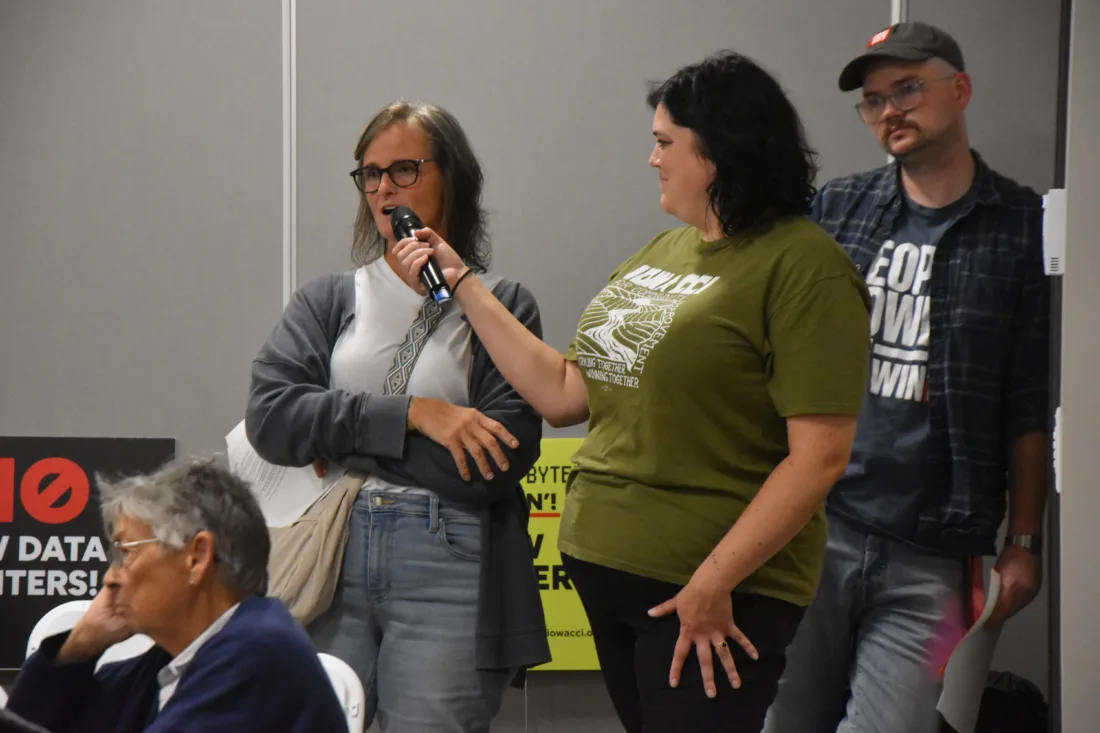
Amy Sinclaire of Haverhill asks about data center ordinances during the Iowa Citizens for Community Improvement meeting on Wednesday. She was asking for ordinances specific to Marshall County.
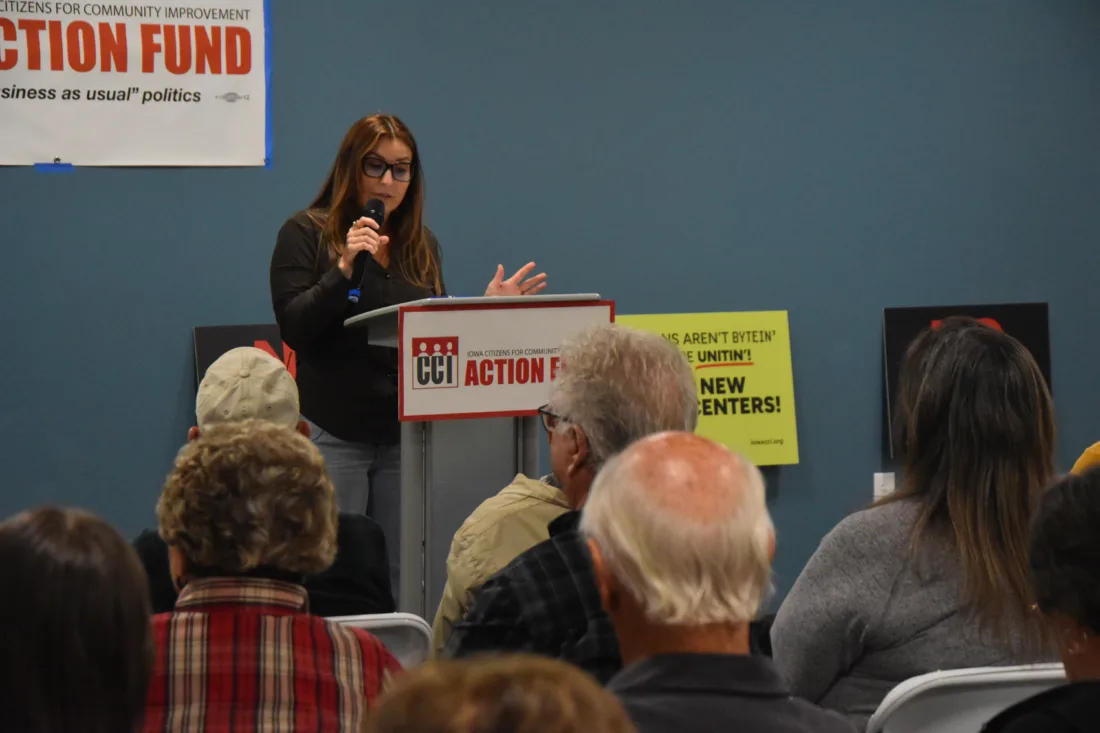
T-R PHOTOS BY LANA BRADSTREAM Misty Rebik tells meeting attendees about how the push for data centers is stemming from the rapid acceleration of artificial intelligence technology at the Veterans Memorial Coliseum in Marshalltown on Wednesday night. The meeting was hosted by Iowa Citizens for Community Improvement, which is trying to get a one-year statewide data center moratorium.
Amy Sinclaire of Haverhill asks about data center ordinances during the Iowa Citizens for Community Improvement meeting on Wednesday. She was asking for ordinances specific to Marshall County.
T-R PHOTOS BY LANA BRADSTREAM Misty Rebik tells meeting attendees about how the push for data centers is stemming from the rapid acceleration of artificial intelligence technology at the Veterans Memorial Coliseum in Marshalltown on Wednesday night. The meeting was hosted by Iowa Citizens for Community Improvement, which is trying to get a one-year statewide data center moratorium.
Trending
Data centers were once again the focus of a community meeting, hosted by Iowa Citizens for Community Improvement (CCI) on Wednesday night at the Veterans Memorial Coliseum in Marshalltown. The added focus was artificial intelligence (AI).
Iowa CCI brought speaker Misty Rebik, an advisor to Sen. Bernie Sanders (I-Vermont) who grew up near Gilman. The proliferation of data centers across the country is due to the rapid development and advancement of AI. And only a handful of billionaires – Elon Musk, Mark Zuckerberg, Jeff Bezos, Larry Ellison, Peter Thiel and Sergey Brin – are making the decisions regarding AI development, she said.
"Their goal is to achieve more wealth and power than what they already have, no matter the impact their work has on ordinary people," Rebik said. "Let me be clear – AI and robotics are the most transformational technologies in the history of the world."
In a few years, she said AI will be able to do anything humans can do, but better. The economic impact is the potential elimination of millions of jobs, wiping out entire professions and making it harder for young people to enter the workforce. Beyond the economy, psychologists have warned that the increased isolation and mental health challenges young people are facing is largely due to AI and screentime.
Educators are concerned about the decreased capacity for learning in the younger generations, and experts have issued warnings about AI eviscerating privacy rights, Rebik said. It is easier for that technology to analyze every written email and text, every website visited and every trip taken in cars.
"They are creating a mass surveillance state right now," she said. "Political scientists have warned us AI can threaten the integrity of our elections and political institutions."
Rebik made a "radical suggestion" that if the lives of every person are going to be fundamentally changed by the technology, then the American people should make the decisions, not a handful of oligarchs.
"That starts with controlling how and where data centers are developed," she said. "AI cannot function without the mass growth of data centers."
The meeting was held because the corporations behind AI are demanding expensive energy to continue expansion.
"They want your water. They want your land. They want your tax breaks, and they plan to pollute your air," Rebik said.
The country already has enough data centers to cover everyday digital needs of the population, she noted.
"The truth is the only reason we only need more data centers is so the top seven AI companies can continue to race to develop the most potent AI," she said. "They are in a race with each other. Who will create the most intense, smartest, super intelligent AI?"
Rebik asked what data centers are not, and added that they are not long-lasting job creators. The few jobs that are present are mostly subcontracted, so the employees are not directly connected to the data center. She said they are not good for local economies as the companies do not pay their fair share of taxes.
"Some of the wealthiest companies in the world are securing massive tax breaks to build these data centers," Rebik said. "Oftentimes these deals last for decades. . . . In North Carolina, Google paid just $5 million in taxes while receiving $73 million in taxes. That's 14 times more than they contributed. . . . What else could we do with that money? Could it go to our schools? Could it go into filling potholes? Could it go into working with our local business owners and having more local businesses, parks, safety, bridges? There's all sorts of things that we need."
Data centers are not necessary for national security, she assured, despite contrary claims. There should not be a competition with China to destroy millions of jobs and the planet, she said. The centers are not inevitable and can be stopped, which is why the Marshalltown meeting was held.
Additional moratoriums in Iowa, such as the four-month one in Marshalltown, are necessary, Rebik said. Those are not anti-AI stances, but just requests for a pause to ensure the safety of humanity. Getting people in communities organized is important in getting data center regulations passed, she added.
Iowa CCI is advocating for a one-year statewide moratorium on data centers, said Political Organizing Director Katie Biechler.
"There is too much happening too quickly for people to be able to make informed decisions about our communities," she said. "The local moratoriums protect local places, land, homes and communities. A statewide moratorium is the only way we can protect our water."
Questions
The floor was opened to questions, and the first was how to counter an offer made to a farmer, one that is four times the market value of the land, citing an example in Marshalltown with the Shady Oaks developer. Rebik said the answer is difficult.
"The truth is farmers are in a bad position in this state and have been for a long time," she said. "I can understand why that is enticing. There's a couple mechanisms, but if you're talking about massive farm land, you need to change the zoning of that land."
One of the things that can be done is encouraging the city council and zoning commission to not change the zoning.
"I think the biggest way is the more people who are showing up is people power," Rebik said. "The reality is if you give elected officials a chance to disappoint you, they will. It's our job to make it really difficult for them to do that. Local communities are easier at doing that because you know them. You can show up at council meetings, write letters, call ins and make life hard for people. . . . My suggestion is build your movement as big as you can with as many people as possible."
She urged people within the movement to be respectful and listen to the opposition during conversations.
Another question was how to get young people more involved in the movement. Rebik's answer was to talk about data centers and what AI is doing. The cognitive power of the younger generation is lower than the previous generation for the first time in history.
"There is a deep connection to the use of screens, and I think young people know that," she said. "They are worried about their peers. They are worried about their own ability to write and read and find themselves more dependent on AI to write papers. I want to encourage the older generation to not judge young people for this. Young people have been told to learn computers, use computers. They've been handed screens and phones since they were very young. . . . I think connecting AI issues with data centers for young people is very important because they don't own homes yet."
Contact Lana Bradstream at 641-753-6611 ext. 210 or lbradstream@timesrepublican.com.