
Lenihan students experiment with band, orchestra instruments during tryouts
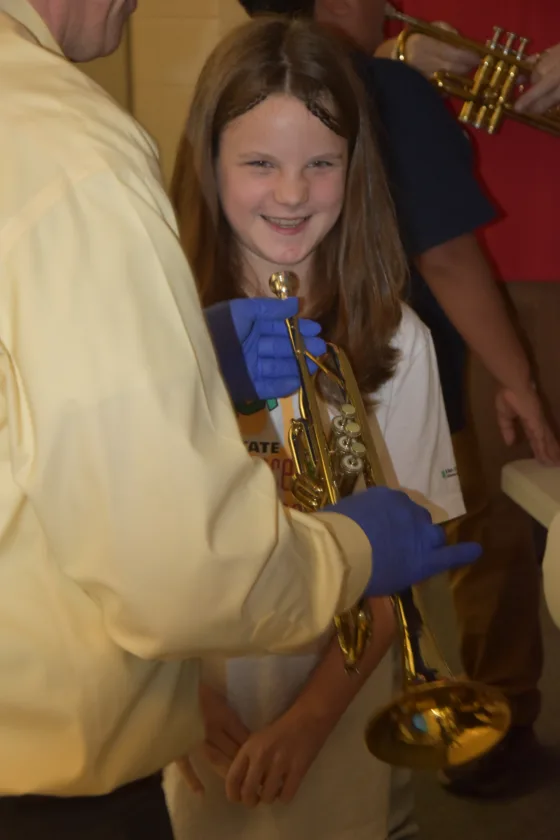
Music brings a smile to Annabelle Taylor’s face after she successfully blows through a trumpet during Lenihan band “tryouts.” In addition to a trumpet, she tried a trombone, tuba, flute and clarinet.
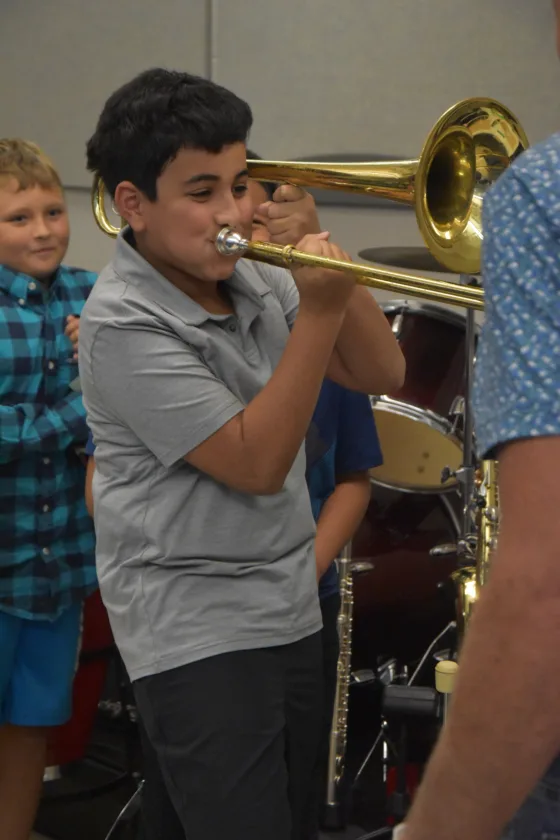
Ayoubi Oulmaati laughs as he tries to blow through a trombone during Lenihan Intermediate band tryouts. Even though they are called “tryouts,” any student who choose to participate in band or orchestra is given the opportunity.
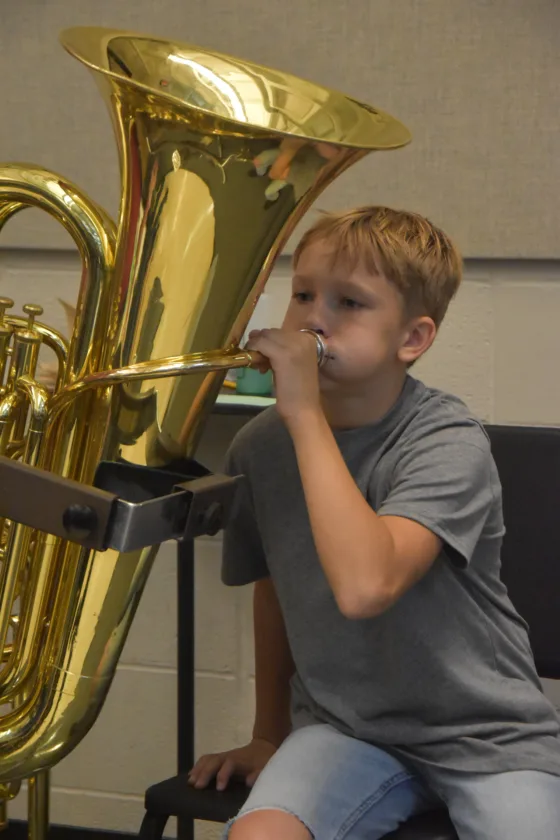
T-R PHOTOS BY LANA BRADSTREAM Lenihan fifth grader Johnny Sheets purses his lips and blows through a tuba during “try outs” yesterday. Students experimented on different instruments to figure out which ones they like best.
Music brings a smile to Annabelle Taylor’s face after she successfully blows through a trumpet during Lenihan band “tryouts.” In addition to a trumpet, she tried a trombone, tuba, flute and clarinet.
Ayoubi Oulmaati laughs as he tries to blow through a trombone during Lenihan Intermediate band tryouts. Even though they are called “tryouts,” any student who choose to participate in band or orchestra is given the opportunity.
T-R PHOTOS BY LANA BRADSTREAM Lenihan fifth grader Johnny Sheets purses his lips and blows through a tuba during “try outs” yesterday. Students experimented on different instruments to figure out which ones they like best.
Trending
Students at Lenihan Intermediate are seeing if they have or can develop musical skills. On Thursday, the fifth graders "tried out" for musical instruction. Some of them had their first encounters with the instruments such as flutes, clarinets, trumpets, trombones and tubas.
Fifth grade band teacher Jason Kirke said trying the instruments replaces guesswork with direct experience.
"A student may arrive expecting to choose one instrument and discover that another feels more comfortable or produces a sound more naturally," he said. "Finding a good initial match can reduce frustration and help the student experience success sooner."
Kirke assured no one expects students to know how to play beforehand, and the first sound does not have to be perfect.
"It may be clear, airy, squeaky or it may not come out right away," he said. "Every musician begins by experimenting."
Typically more than 400 students participate in instrument-exploration sessions which are only for fifth graders.
"Although they are often called 'tryouts,' these sessions are not competitive auditions," he said. "We think of them more as an instrument petting zoo -- a chance for students to explore several instruments and experience what it is like to produce their first sounds."
During the sessions, students are instructed on the basics of breathing and sound production, before getting hands-on assistance. Kirke said an instructor or volunteer may hold or position the instrument so the student can focus on breathing and forming the correct mouth shape.
"The goal is to help identify which instrument feels most natural and may provide the most encouraging start," he said. "Any recommendation we make is intended to guide the family's decision, not restrict the student's choice."
Fortunately, there is no cutting process. The "try outs" are experiments, not tests.
"The instrument-exploration process is intended to open a door, not determine who is allowed to walk through it," Kirke said..
Every student who wants to play an instrument will have the opportunity and can choose between band or orchestra and participate in large-group rehearsal every other day and receive a weekly individual or small-group lesson. They can also opt for choir. Kirke said the fifth grade schedule only allows participation in one. In later grades, students can choose to participate in more than one if schedules allow. On average, 150 to 200 will choose band, which turns the first discovery into sustained learning.
"Students develop musical literacy, coordination, focused listening, perseverance, responsibility and confidence," he said. "They learn how to accept feedback, work through challenges and recognize the progress that comes from consistent effort."
In addition, band participation provides a strong sense of belonging. Every student contributes to the ensemble and they learn their individual preparation affects the success of the entire group.
Students’ choices are not limited to the four instruments they were introduced to, either. He said they can also choose alto saxophone, the French horn, baritone or percussion. Regardless of a family's financial situation, the district wants to make music participation possible. He does not want families to assume the cost of an instrument places band or orchestra out of reach. Families may rent or buy an instrument from an approved music vendor, use one they already own or borrow one which is school-owned. Kirke added qualifying families can borrow through the Marshalltown Youth Foundation Instrument Lending Library.
"Our beginning-band process is built around access, exploration and possibility," he said. "It is not designed to identify a small number of students who already appear musically advanced. It is designed to give every incoming fifth grader a genuine opportunity to begin."
Students do not need prior instrumental experience or come from a musical family.
"The most important qualification is simply a willingness to learn," Kirke said. "We want students to leave the instrument-exploration session knowing that they are welcome, that imperfect first sounds are a normal part of learning and that musical ability is something they can develop. When students, families, teachers, volunteers, community organizations and local music vendors work together, more children have the opportunity to discover a lifelong connection with music."
Contact Lana Bradstream at 641-753-6611 ext. 210 or lbradstream@timesrepublican.com.