
Marshalltown city council discusses street repair plans, financing options
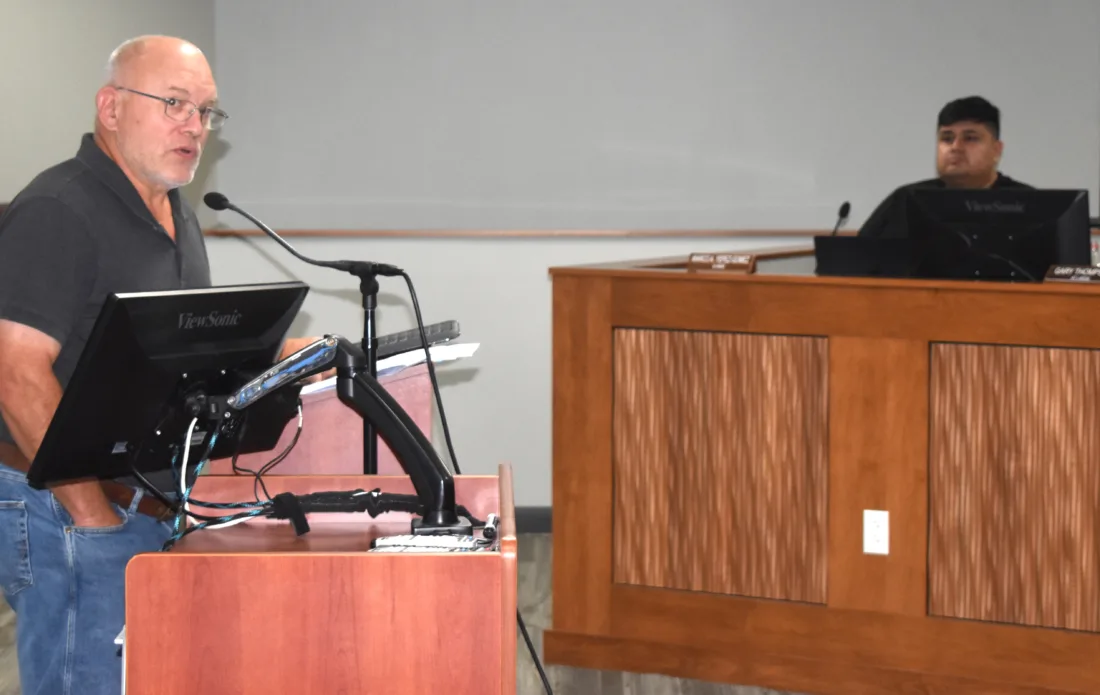
Mark Eaton, a member of the streets steering committee, addresses the council with thoughts and recommendations during Monday night’s meeting.
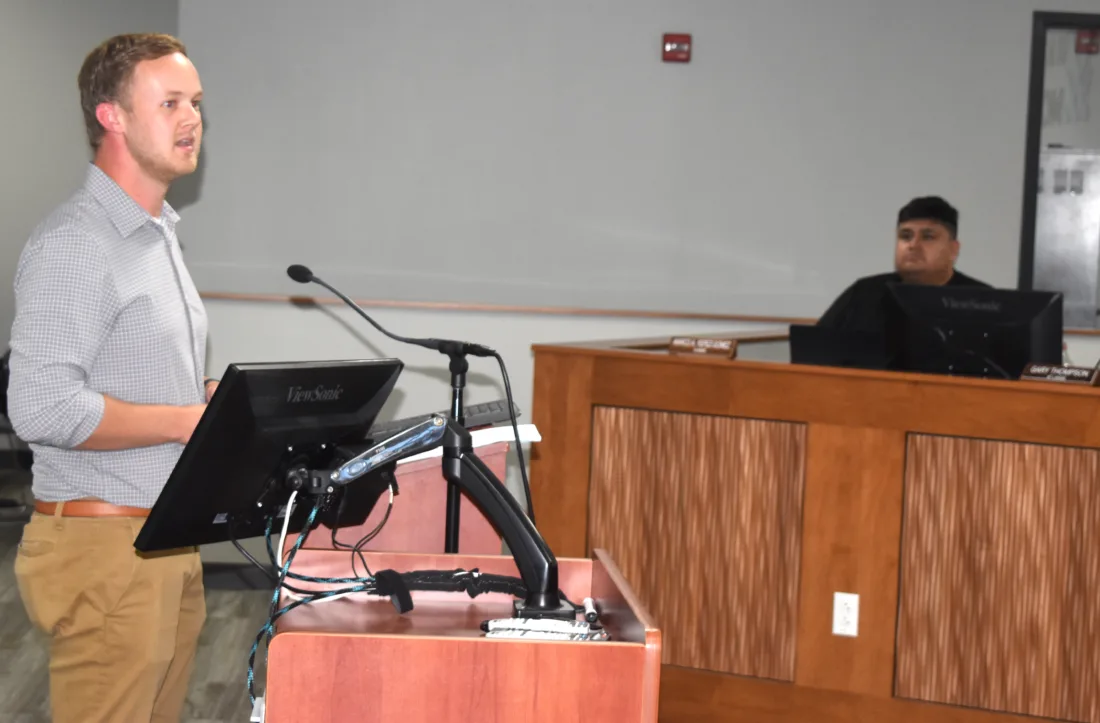
T-R PHOTOS BY ROBERT MAHARRY Project Engineer Caleb Jansen of HR Green Inc. speaks on the conditions of Marshalltown’s streets during a presentation to the city council on Monday night. The council is exploring allocating $35 million over the next five years to maintain and improve streets.
Mark Eaton, a member of the streets steering committee, addresses the council with thoughts and recommendations during Monday night’s meeting.
T-R PHOTOS BY ROBERT MAHARRY Project Engineer Caleb Jansen of HR Green Inc. speaks on the conditions of Marshalltown’s streets during a presentation to the city council on Monday night. The council is exploring allocating $35 million over the next five years to maintain and improve streets.
Trending
For the first time in quite some time, data centers were not on the agenda at the Marshalltown city council meeting held Monday night, but the council did spend the final 50 plus minutes of the open session discussing another familiar topic -- the condition of the city's streets and how much it will cost to repair and maintain them in the years to come.
Public Works Director Heather Thomas explained that the goal of the presentation was to develop a five-year plan and share some of the findings from the ongoing pavement management study. HR Green Project Engineer Caleb Jansen then stepped forward to provide an overview of the pavement management study thus far, noting that pavement management is about selecting "the right treatment for the right pavement at the right time."
After breaking down the basics of how pavement deteriorates over time and the various options for rehabilitation. In 2022, the average Pavement Condition Index (PCI) score in Marshalltown was 54.3 on a scale of 1 to 100, and Jansen said a lot of streets are in a good position to be rehabilitated.
"But if they go untreated, they will only continue to fall in condition," he said. "The pavement management process really is trying to make those prioritized decisions between how we address this backlog of work while still not neglecting the streets that are in poor condition today."
He added that the city's arterial roads are generally being maintained well currently before describing project options such as major rehabilitation, minor rehabilitation and preservation activities. Over the next five years, Jansen estimated that it would cost $31.8 million to maintain the current PCI average across the city.
Mayor Mike Ladehoff asked Jansen if cities in Iowa are generally struggling to keep up with road maintenance and repairs, and he answered affirmatively, noting that the age of cities and rates of growth also have an impact. The average score in the state is in the low 60s, according to Jansen.
From there, Thomas welcomed a member of the streets steering committee, Mark Eaton, who served alongside elected officials as well as Terrie Gibson and Robert Proffitt, to the microphone. Eaton commented that roads have been neglected for such a long time that they have now reached a point where they must be fixed.
"I know that street construction causes some consternation between people who can't get to their driveways, but we've got to do it. We've gotta paint the house. We've gotta shingle it. We can't let it fall down around us," Eaton said. "Infrastructure is the key to a city."
He said decisions on which streets would get repaired first would be based on the PCI numbers, so they may not necessarily be even across all wards. Like Thomas, Eaton advocated for a five-year plan to help the committee look to the future similar to the existing Capital Improvement Plan (CIP).
"We need a long-term vision of what we can do with streets so that we can keep it going every year," he said.
Finally, Eaton spoke about the money, noting that just to keep the streets at their current PCI scores, the city would need to spend about $6.3 million a year, and to improve them, the figure would jump to $7.1 million. Currently, Marshalltown's score is comparable to communities like Sioux City, Ottumwa, Newton and Mason City.
The next speaker was City Finance Director Cole O'Donnell, and as Thomas introduced him, she highlighted the steering committee's recommendation of a $35 million funding commitment over five years and how it could be financed. Options include Road Use Tax (RUT), Local Option Sales Tax (LOST), a franchise fee and General Obligation (GO) bonding, the last of which was described as the most likely scenario by O'Donnell.
He warned that all of the council-designated LOST revenues will probably have to go back into the general fund in future years and shared some details on how the debt service levy could be affected if the council opts to bond for the money. O'Donnell noted that in Ottumwa, where he previously worked, the public works director was "overjoyed" about the opportunity to put $2.5 to $3 million per year toward street projects.
Councilor Melisa Fonseca suggested committing a portion of a potential franchise fee toward the street program, and City Administrator Carol Webb indicated that it would have to be included in the revenue purpose statement ahead of a likely vote at the polls in 2027. During the most recent discussions, the council had agreed on pursuing a three percent franchise fee on utility bills with the revenue going toward public safety.
Returning to the podium, Eaton referenced a recent story in the T-R about Reinbeck voters approving a capital improvements reserve fund levy, and O'Donnell noted that the city of Marshalltown already has one in place. Thomas noted that there are also three large projects pending -- West Main Street from Center to 3rd Street as part of the downtown project, East Main Street from 5th Avenue to 12th Avenue, and Highland Acres Road between Lincoln Way and West Main Street -- which are estimated to cost over $17 million combined. The water main portion of the West Main Street would be reimbursed by Marshalltown Water Works.
Councilor Jeff Schneider, communicating remotely, told the mayor he didn't see any other way to fund the projects other than GO bonding and adjusting the city's self imposed borrowing limit, which is no more than 70% of Iowa's statutory constitutional limit. If the city bonded for $10 million annually, $7.1 million would go to the street projects, while the remaining $2.9 million would be split between a plethora of CIP expenditures.
Ladehoff then asked for council direction, and while Fonseca and other councilors felt the $35 million plan was the right way to go, Councilors Gary Thompson and Marco Yepez-Gomez expressed trepidation about the cost.
"I don't know how we're gonna pay for everything else (in the CIP) capped at $2.9 million, so I have reservations about this no matter what we do," Thompson said. "I also understand it needs to be done. It just seems like a lot of money to keep our head above water. It's not picking us up, so I don't know."
Yepez-Gomez said the current situation was similar across towns that "sprawled out" in the 1960s, and he felt like Marshalltown had reached that point. The council ultimately did not take official action, but Webb felt she had sufficient direction to explore further options before making a decision.
In other business, the council:
Approved the consent agenda as listed after Thompson pulled every single item for individual discussion and consideration.
Heard an annual report from Marshalltown Central Business District (MCBD) Executive Director Danielle Lekin.
Approved a resolution on an Urban Renewal Plan Amendment for Area No. 4 to include the former downtown UnityPoint hospital and authorizing an internal advance for funding of the urban renewal project.
Approved a change order for the Center Street viaduct removing the railing work from the contract at a decrease of $254,381.
Approved the second reading of an amendment to the zoning map for 707 E. Linn St. and 205 S. 8th Ave. as part of the MARSHALLTOWN Company expansion project by a 6-1 vote with Fonseca opposed, and waived the third reading by the same vote tally.
Approved the second reading of an ordinance amendment repealing and replacing Section 50.027(B) regarding collection vehicles by a 6-1 vote with Schneider opposed.
Contact Robert Maharry at (641) 753-6611 ext. 255 or rmaharry@timesrepublican.com.