
‘This is how you rebuild rural Iowa’
Dem. Secretary of Ag candidate Chris Jones visits El Patio in Marshalltown Thursday evening
Trending
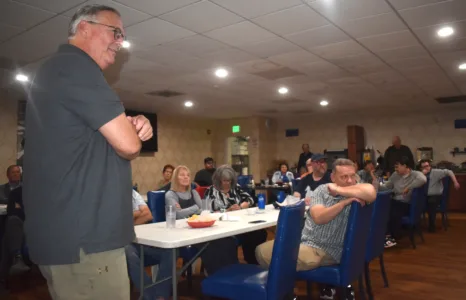
Chris Jones, an author and former research scientist at the University of Iowa, has been sounding the alarm on Iowa's water quality issues for about a decade now, and the Democrat who hopes to become the state's next secretary of agriculture focused primarily on that familiar topic during an event hosted by the Iowa Latino Caucus and the Marshall County Democrats at El Patio Bar and Grill in Marshalltown on Thursday evening with about 30 people in attendance.
After a brief introduction from Marshall County Democrats Chairman Tom Swartz, Iowa House District 52 candidate and former Marshalltown Police Chief Mike Tupper spoke for a few minutes about his background and why he decided to seek elected office. He is challenging incumbent David Blom (R-Marshalltown), who was first elected in 2024.
"We just need more average, everyday Iowans to run for these positions, people who care about the community, and they want to make a difference and solve problems," Tupper said. "Too often, we elect people, and they go to Des Moines or they go to D.C. and they start doing stuff that we haven't talked about, things we haven't asked them to do, and they forget about us back at home. And they're more concerned with raising money and getting re-elected than solving problems for folks back home."
He pledged to support Iowa's educators if elected, address affordability (he commented that he wasn't sure the middle class still existed in the state) and improve water quality and protect natural resources in light of Iowa's high cancer rates. Tupper predicted that he was in for a close race and would likely either win by two points or lose by two points, urging residents of District 52 -- which includes the entire city of Marshalltown and the southeast corner of Marshall County -- to register and vote, regardless of who they plan to support.
"A decade or more of one party control has not worked out, and we can do better," he said.
From there, the featured speaker took over, beginning with a joke about how one of his columns was published in the Kansas City Star, which prompted Chiefs fans to confuse him with the team's star defensive lineman and for one of them to insist that he should stick to football. Jones, who is challenging incumbent Republican Mike Naig, also referenced the recently deceased writer Wendell Berry as he weighed in on the loss of dignity in agriculture.
"Mr. Tupper here told us that our government has let us down, and I feel like we don't even have the dignity left here where we can turn our faucet on and think that the water is safe to drink, or we can't drive the countryside in many parts of our state and breathe the air because we have the stench from the CAFOs," he said. "We've lost our dignity such that we can't even have a clean breath of air to take, and we see our small towns. So many of them have been hollowed out by all this consolidation in agriculture, and our small towns have lost their dignity because they lose their young people. They lose their physician, their attorney, their grocery store and their post office, and they've lost their dignity."
His goal in coming out of retirement and running for secretary of agriculture, he said, is to transform farming in Iowa, and to do that, he said he needed Democrats like Tupper to be elected to the legislature. Jones called for a wider diversity of crops being grown in the state, which is currently dominated by corn and soybeans, noting that Iowa was once the top oat growing state -- now, however, Quaker Oats in Cedar Rapids imports its products from Canada.
He also pushed for a return of the beef industry utilizing pasture land, criticizing the Trump administration's decision to import "junk meat" from South America, and called for growing more fruits and vegetables as well, which he said would reduce cancer rates long term.
"We spend $13 billion every year in Iowa on groceries. That all leaves the state, completely gone, right? We can keep that here," he said. "We had canneries all over Iowa for sweet corn, tomatoes, fruit, all kinds of stuff. We can do that again. This is how you rebuild rural Iowa. You diversify your farming systems. You get a greater assemblage of crops. You get small scale livestock production and pastoral systems where the animals aren't polluting the water. You get small scale meat processing. We once had 800 small meat processors in Iowa. Now we have 68. So if you want to raise meat at a small scale, you can't even do it because the big packers don't want your animals. You're an annoyance to them."
Other crops Iowa once grew abundantly, he added, include honey, barley, alfalfa, sorghum and apples. Instead, Jones lamented that residents are told data centers are the only engine of prosperity in rural parts of the state, and he rejected the idea outright.
"If we want to get young farmers on land, we can't be building these monstrous data centers all over the place. What is the highest use for our land in Iowa? Historically, we've said the highest use here is for food production. We hardly do any of that anymore," he said. "We're growing commodity grains that never make it into people's mouths."
Finally, he turned to ethanol, noting that about ¼ of the state is used to grow corn for the blended fuel and arguing that it has not brought prosperity to Iowa. Counties that have ethanol plants, Jones said, have lost more population and jobs than the counties without them. He also predicted that the demand for liquid fuels would decline due to the rise of electric vehicles and a general reduction in driving.
"We are at a place in our state where we need to talk about ethanol strategically because we have so much corn that goes to that use. Almost 70 percent of our corn goes to that use, believe it or not," he said.
Before opening up the floor to questions, Jones criticized Naig for claiming that nearly $1 billion has been spent on water quality projects over the last decade with minimal results to show for the investment.
"Does the water look a billion dollars better to you? Because it doesn't to me," he said. "So we have blown so many millions of taxpayer dollars on this to no effect. We see Des Moines is still rationing water. They still have the world's largest nitrate removal facility. We see that our beaches are unusable in the summertime. They're posted all summer long for the toxic algae and the e. Coli. We see 6,000 private wells in Iowa contaminated with nitrate above the 10 parts per million limit that EPA has. We have thousands more contaminated with e. Coli. We have about a million people in Iowa drinking water that has nitrate above a level that's associated with this whole suite of cancers... So let's spend money trying to transition this farming system into something that's not gonna pollute in the first place instead of spending all this money on these Band-Aids and diapers that just amount to public relations projects for politicians."
In response to a pair of questions from former Marshalltown Mayor Joel Greer, Jones expressed a bit of surprise about how he had gone from a pariah in Iowa politics to someone whose ideas have been adopted by members of both parties -- including gubernatorial candidates Rob Sand and Zach Lahn -- as his positions were previously considered "taboo" because the agriculture industry had a "stranglehold" on acceptable speech.
"Now, the floodgates have broken, and everybody is talking about it and everybody is trying to catch up," Jones said.
He called for restoring funding to the Iowa water quality monitoring program, but he added that monitoring alone would not solve the larger problem.
"If we know there's a risk -- and we know there is a risk -- and we know that we have the capacity to develop policy to reduce that risk -- and we do have that capacity, then why don't we do it?" he asked. "If we know there's a risk, if we know we can reduce that risk, then why don't we reduce that risk? That's what we need to do. That's why we need Democrats in the legislature."
Tupper asked Jones how farmers could be encouraged to diversify their crops, and he replied that the state would need to develop infrastructure to support a new system. It may sound like a lot, he added, but certainly possible when considering how much taxpayers have already contributed to the ethanol industry. Indemnification would also be likely for the first few years, according to Jones, but would be worth it in the long run.
"Let's spend this money strategically so we get a farming system that's going to not pollute in the first place. That's the solution," he said.
Some farmers may want to stay within the current system, Jones said, and he believes they should be subject to regulations on nitrate application. Retired farmer Larry Ginter of Rhodes spoke of the 1980s farm crisis and how the loss of pasture land led to overproduction of corn, and he argued that corn and soybeans are chronically undervalued -- corn should be $15 a bushel, and soybeans should be $40.
Another questioner worried about the proposed Constitutional amendment that would require a ⅔ supermajority to increase state income taxes, and Jones said he opposed the amendment because it will result in increasing the sales tax and placing a larger share of the tax burden on low-income Iowans. He also criticized efforts to kill the ⅜ of a cent sales tax voted on by Iowans to fund conservation projects and called what is currently happening "sinister," and a questioner speculated that outgoing Gov. Kim Reynolds is attempting to set Rob Sand up to fail if he is elected.
Rep. Blom asked Jones about a budget for the water quality monitoring system, which, three years ago, was $470,000 for 70 sites, and he figured the number would be up due to inflation. When asked about Lahn making water quality a focal point of his campaign, Jones replied that he believed the gubernatorial candidate's views were "genuinely but shallowly held" and said he was happy to see Republicans taking the issue more seriously.
"This is how things happen now in government. It's the only way things happen in government is when both parties see pressure from their constituencies to address a problem," he said. "So I see this as a positive that Republicans want change. I think there's obviously other issues here that we take into the voting booth, but look, who's the conservative here when it comes to using taxpayer money? Mike Naig says all the time, there's progress because I've spent this much money... One thing he never talks about is there's progress because the water quality is better."
He then rhetorically asked if Republicans were truly the party of fiscal accountability when they throw money at the water quality problem without improving it. Ginter then launched into a lengthy diatribe about underpricing of commodities and rising costs and taxes, expressing his support for FDR's New Deal parity pricing program, advocating for a government that understands "market discipline" and arguing that politicians weren't hearing his message.
"We're underselling ourselves, folks. We're just cheating our own selves here. We're cheating the world," Ginter said. "I've had it with both parties because they will not recognize the value of what we do here on the farms in rural America. We should be one of the richest areas in the world. We should be better than Saudi Arabia. We're producing a commodity every year, and we're not satisfying that. I'm sorry to sound like I'm upset because I am upset."
Jones responded that when an individual gets this frustrated, they should run for something and disputed the contention that he wasn't incorporating science into his policy proposals. In the candidate's view, the solution is more farmers and smaller farms as opposed to an industry largely controlled by large corporations.
When Jones thanked Ginter for his passion, he countered that it was a "putdown" and told him it was wrong to contend that large agricultural organizations were still making money.
Contact Robert Maharry at (641) 753-6611 ext. 255 or rmaharry@timesrepublican.com.