
Can’t you smell that smell?
Marshalltown city council discusses odor ordinance, potential fines for JBS
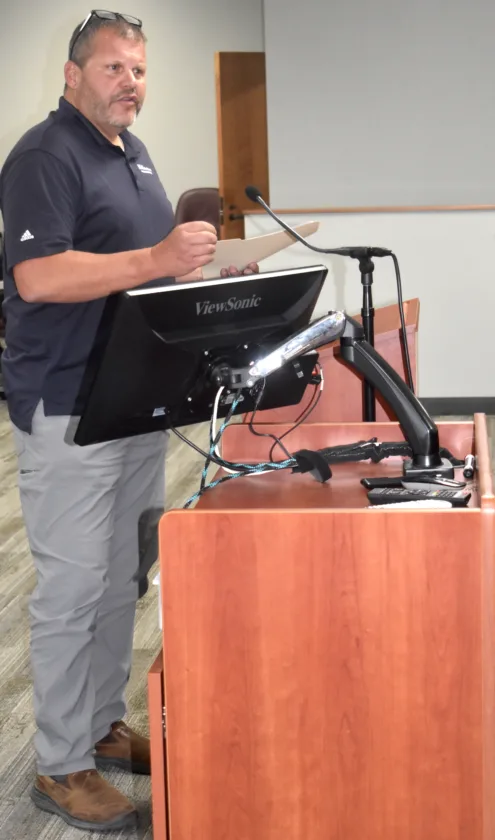
Marshalltown Water Pollution Control Plant Superintendent Bob Ranson addresses the city council about the odor hotline during Monday night's meeting.

T-R PHOTOS BY ROBERT MAHARRY The Marshalltown city council discussed its odor enforcement policies as they relate to the JBS plant, which is the largest source of complaints, during Monday night's regular meeting.
Marshalltown Water Pollution Control Plant Superintendent Bob Ranson addresses the city council about the odor hotline during Monday night's meeting.
T-R PHOTOS BY ROBERT MAHARRY The Marshalltown city council discussed its odor enforcement policies as they relate to the JBS plant, which is the largest source of complaints, during Monday night's regular meeting.
Trending
The Marshalltown city council spent approximately 40 minutes of Monday night's regular meeting discussing its offensive odor ordinance and whether more aggressive action should be pursued against the JBS plant, the city's largest employer, when violations occur.
Assistant Housing and Community Development Director Clayton Ender kicked off the discussion by noting some of the common complaints the city's nuisance enforcement office receives and breaking them into three major categories -- junk and debris, animal waste and industry. The hotline allowing residents to call in complaints is routed through the city's water pollution control office, and Ender said that all of the complaints received in the month of September were associated with JBS.
"I did not receive information going further back, so I don't want to say conclusively that they're the sole source of odor complaints. But I can surmise that they're probably the bulk of the complaints at least, which I don't think would surprise many people," he said.
In reviewing the ordinance, Ender conducted research on peer Iowa communities with similar sized meatpacking operations -- Waterloo, Perry, Ottumwa, Storm Lake and Sioux City -- and all with the exception of Sioux City, which has a citizen odor review committee that meets quarterly and a more robust set of procedures in city code, essentially follow the state code verbatim with regard to offensive smells. Ender reached out to the peer cities for further information but said he had not heard anything back as of the meeting on Monday.
He then ran through the process for enforcing the code and issuing a penalty, which could end up in court, and welcomed Water Pollution Control Plant Superintendent Bob Ranson forward to provide more insight on the odor complaint hotline and how details are collected. If the complaint pertains to JBS, the city employee taking the call notifies the company's environmental manager, who is sent out to investigate it. Every second Tuesday of the month, Ranson meets with the JBS management team to talk about "various processes" between the two plants, but the main focus is odor complaints, and they often explain issues that cause the complaints while explaining what maintenance they've done on their equipment. Mayor Mike Ladehoff asked Ranson if he found JBS leaders to be receptive during their meetings, and he said they generally were. Ranson also reminded the public to be considerate when they call in as they are simply the intermediary.
"It's kind of like yelling at your mailman for bringing you your water bill. We're just the call service. We are not making the odor. We can't turn it off. We don't have the switch. We don't have the chemical, so I just would ask that everyone be kind to us," he said.
In response to a question from Councilor Greg Nichols, Ranson told him they typically receive between eight and 15 calls related to JBS per month, and it is also seasonal and dependent on weather factors. Since 1999, they have received a total of nearly 3,000 odor complaints. Councilor Gary Thompson wondered why the calls come to the WPCP as opposed to city hall, and Ranson replied that it was likely because the two entities work together closely on pre-treatment and already have a built-in relationship. Fellow Councilor Mark Mitchell said he reached out to a nuisance officer in Ottumwa, where JBS operates a similar facility, and was told they had never received a complaint there.
"There must be something going on down here at our plant that they need to do differently because Ottumwa is pretty much the same operation, just about the same exact quantity too, I believe," Mitchell said. "So we need to come down and start making them clean things up, and if not, then we need to start giving them fines. And maybe that would get them on the ball to get things cleaned up down there and get the rendering plant taken care of."
A $1,000 a day fine, he added, could do a lot for infrastructure in Marshalltown. During the public comment period, Mark Eaton told the council that he felt the call count was not an accurate encapsulation of the problem because so many people had likely given up on reporting it due to a lack of enforcement. He also noted dissatisfaction with the downtown smell during RAGBRAI back in July and shared examples of how other cities -- including much larger ones like Pittsburgh and Louisville -- handle industrial odor complaints through web-based apps.
"There (are) these tools that we can do, but we need JBS to be a good neighbor," Eaton said.
He added that the chemicals in the air causing the odor have negative health effects for children and elderly people, and Eaton said he had heard rendering may be brought from Ottumwa and Perry to Marshalltown because they don't have to use the odor masking chemicals here. If the city doesn't plan to address the problem, he felt the ordinance should be taken off the books.
With the conversation shifting back to the council, Councilor Marco Yepez-Gomez said he was surprised that JBS had never been fined and believed the rules had to be enforced in the future. Thompson agreed with Eaton that if an ordinance wasn't being enforced, it should be taken off the books, and he felt it was time to send a message -- the maximum fine for a first offense is $750 followed by $1,000 for subsequent offenses.
"I've had employees that have retired from JBS (who) have told me that they purposely have not run the scrubbers to save money," Thompson said. "I can't vouch for that information firsthand, but I don't think there's a reason for my brother to lie to me."
Councilor Melisa Fonseca said she had studied the Sioux City approach and believed Marshalltown should adopt something similar by creating a separate odor emissions chapter, and she asked if there were any other entities in town that had been fined for odors. Ladehoff said the landfill, located west of town, does have occasional odor issues.
Fonseca moved to direct staff toward creating a separate odor emissions chapter, and after it was seconded by Councilor Sue Cahill, Councilor Jeff Schneider asked how a smell and source can be definitively proved.
"It's really tough to have any sort of evidence that holds up. Modern scientific sensors are not anywhere near as sophisticated as our noses," Schneider said, before adding that he would like to talk to the city's legal counsel about enforceability and whether JBS would fight back. "I would love to see them clean up their act and have no smells or very infrequent smells around town."
The motion passed 4-3 with Fonseca, Cahill, Nichols and Schneider in favor and Thompson, Mitchell and Yepez-Gomez opposed. From there, Thompson asked City Administrator Carol Webb whether the current ordinance would be enforced.
Webb replied that she would consult with the city attorney to see if enough evidence exists to issue a citation, and Thompson urged her to "bypass legal" and simply issue fines.
"I would say the next call that comes in, I'd like to see that information sent to Clayton's staff and the citation written. I don't think that's asking too much for the public to expect that," Thompson said.
Ender then explained that a municipal infraction complaint would have to be filed against JBS, and he said they would need to have residents willing to testify in court. Cahill worried that they could be headed into "dangerous territory" by attempting to determine what is the fault of JBS and what is simply nature taking over.
Thompson reiterated that he was confused as to why the city was so hesitant to hold JBS accountable, and Schneider noted that smell is ultimately subjective. Mitchell said the smell can be detected all the way on the opposite side of town, and as it seemed that the discussion had ended, more public commenters came to the podium.
Joleen Ballard called on the city to "put its foot down" now, and Doris Kinnick, who works downtown, said the smell has only been "sporadic" as of late. Leigh Bauder called for enforcing the existing ordinance and addressing all smells when the new committee is formed. Linda Clark fondly recalled the late Councilor Bob Schubert's efforts to address the smell and felt something more had to be done now.
Before the discussion finally came to a close, Yepez-Gomez echoed Thompson's confusion about why JBS had never been fined.
"If we already do the investigations, if we already do the 15, 30, 45 minute calls to investigate what the source is, isn't that enough documentation to fine them and, I guess, start litigating it or whatever we need to do?" he asked.
Webb answered that historically, the process has been handled in "less of a stick and more of a carrot" type of process.
"I don't disagree with using the stick, using the ordinance. It hasn't been the past practice here to do that. We've really worked more (on) communication with JBS, about what's going on, what are they doing to solve the problem, it's been handled, historically, in that manner," Webb said. "That's not an excuse, really, I'm not trying to give an excuse for that, but I think, too, the challenges of enforcing odors, just the nature of that, is difficult... I think it's a combination of those things, but I'm feeling like I've got support from council this evening to go a citation route, which would be a break from past practice. But I think we can pursue that."
She also recommended that the nuisance officers should issue the citations.
In other business, the council:
Approved the consent agenda as listed.
Approved a temporary outdoor service area for the Marshalltown Arts and Civic Center (MACC) for the grand reopening of the Martha-Ellen Tye Playhouse on Oct. 30.
Approved the appointment of Christian McMurray to the Investment Advisory Committee for a term ending April 1, 2028.
Approved the appointment of Robert Thomas to the Investment Advisory Committee for a term ending March 13, 2031.
Approved a resolution accepting a bid and authorizing the award of contract for the Flow Equalization improvements for the Industrial Pretreated Wastewater project in the amount of $2,049,7000 to Woodruff Construction.
Approved the facade grant application for Lara's Bakery 3 LLC at 15 S. Center St., the former Pentz Appliance building.