
City council considers data center regulations, defers decision on extending moratorium
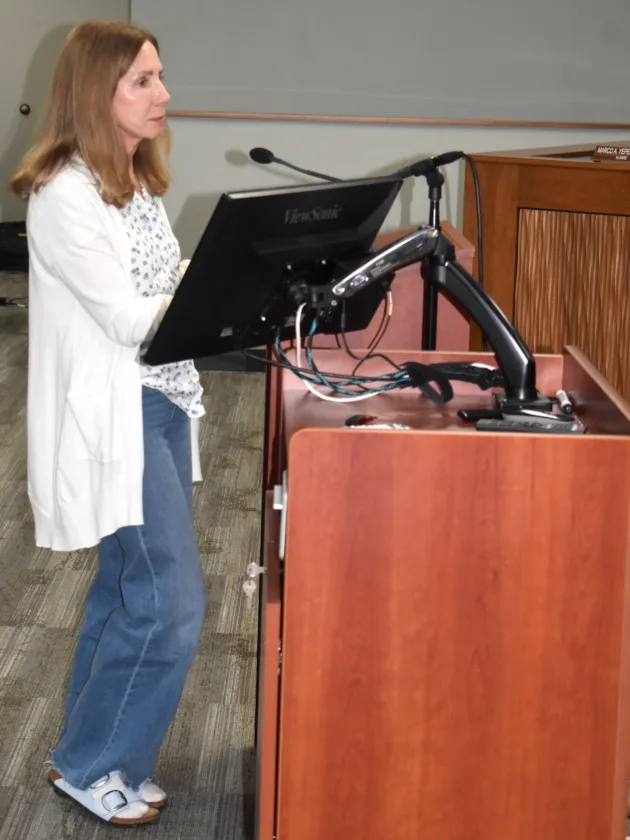
Lea Husak called for a public vote on the data center issue during her comments at Monday night's city council meeting.
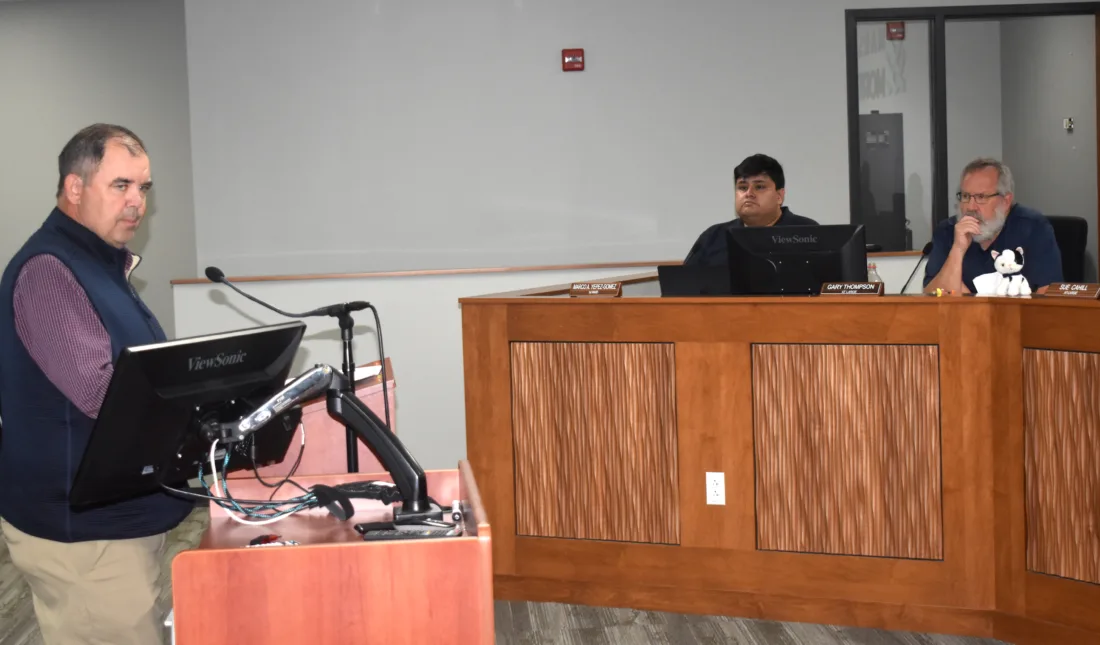
Marshalltown Community School District Superintendent Theron Schutte addresses the city council in opposition to extending the data center moratorium during Monday night's meeting.
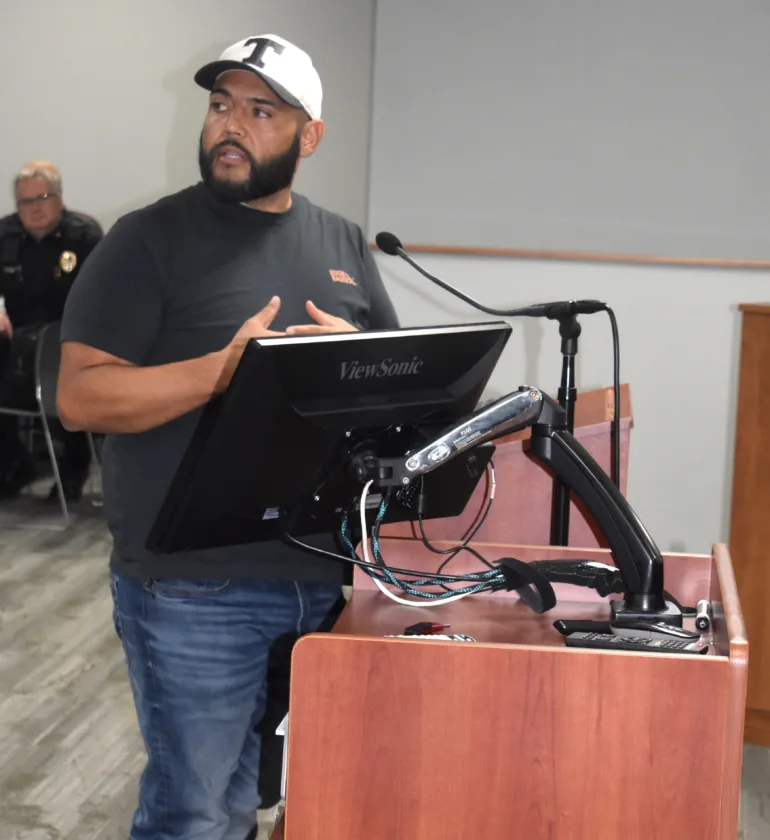
Francisco Zambrano of Marshalltown, citing his own experience building data centers, told the council he would not want to see one here, and he urged councilors to extend the current moratorium.
Lea Husak called for a public vote on the data center issue during her comments at Monday night's city council meeting.
Marshalltown Community School District Superintendent Theron Schutte addresses the city council in opposition to extending the data center moratorium during Monday night's meeting.
Francisco Zambrano of Marshalltown, citing his own experience building data centers, told the council he would not want to see one here, and he urged councilors to extend the current moratorium.
Trending
(Editor's note: This is the first story in a series on Monday night's Marshalltown city council meeting and the ongoing debate over data center regulations in the community.)
The Marshalltown city council gathered Monday night to discuss a series of data center regulations recommended by the Planning and Zoning Commission during a meeting that ran well over four hours and featured a plethora of public comments, primarily from citizens who felt that the proposals in front of the council did not go far enough and should either be strengthened or rewritten entirely.
The discussion began when the first of several related items was pulled from the consent agenda to set the public hearing on the amendment to Chapter 156 establishing the data center and development review process and the amendment establishing the initial boundaries of the data center overlay zoning district. A motion from Councilor Marco Yepez-Gomez to move the item to later in the agenda after the ordinances failed by a 4-3 vote with Yepez-Gomez and fellow councilors Mark Mitchell and Melisa Fonseca voting in favor, and a subsequent motion to set the public hearings for the next meeting on Nov. 9 passed by a 5-2 tally with Thompson and Yepez-Gomez opposed.
Thompson asked for clarification on whether the public hearing should be moved back because of the potential for substantial changes that will ultimately mean the first reading of the new regulations won't be voted on until the Nov. 9 meeting. City Administrator Carol Webb responded that it was commonplace to hold the public hearing in tandem with the first reading and didn't see it as an issue.
After a brief discussion on a dress code policy, the council then considered a resolution to extend the current data center moratorium, which is set to expire on Nov. 23, by 60 days. Assistant Housing and Community Development Director Clayton Ender provided background on the process thus far and noted that the P&Z Commission had recommended not extending the moratorium after presenting a draft of the proposed regulations. Thompson explained that he asked for the proposed extension to be on the agenda to allow for public comment in a "general, broad way" without causing confusion during the consideration of specific ordinances.
Councilor Sue Cahill asked whether the vote before the council on Monday would be the only chance to extend the moratorium, and Webb replied that it could not come back to the council if it is voted down due to council rules.
From there, a series of public commenters came forward, the first of which was Marshalltown Community School District (MCSD) Superintendent Theron Schutte.
MCSD Superintendent Theron Schutte
Schutte expressed his appreciation for the council making difficult decisions and opposed extending the moratorium.
"Lately, to me it feels like we're kind of sitting on a fence allowing unfounded theories to dictate our timeline rather than using objective data and proactive leadership," he said. "When a community evaluates multimillion or even billion dollar infrastructure investments, we owe it to ourselves to provide empirical research, not internet rumors."
He pointed to the prospective property tax revenue as an avenue to fund schools, essential services and road repairs within the community while creating high-paying jobs. Schutte worried that if Marshalltown continued to drag its feet, data centers would simply be built elsewhere, and he hoped the community could figure it out "sooner than later."
Leigh Bauder asked that a community betterment agreement, emergency response plan and decommissioning plan be included in the regulations, and felt the moratorium should be extended to allow P&Z to work on those aspects. Daleen Michel pointed to the potential for major changes to state and federal policy after the Nov. 3 election as a reason to extend the moratorium.
Maggie Valentine expressed frustration with the regulations as presented and called for an extension.
"I don't feel like the ordinance that is coming before you tonight represents the public comments or the public input almost at all. It doesn't limit building size. It doesn't limit water usage. It doesn't give us an opportunity to have public hearings and public input," she said. "I think we need to try again and go back and look at those public comments and include them. People are not gonna be happy with this ordinance at all. I think we need to reconsider a lot of issues... Tons and tons of public comments have completely been ignored, so we'd like to try again."
Amber Lawthers pointed to the unknowns surrounding Artificial Intelligence (AI) data centers as a reason to extend the moratorium, and Denise White, who recently moved back to Marshalltown, did not feel that a data center would make sense in Marshalltown and called on the council to slow down.
Conversely, Joleen Ballard commended the P&Z Commission for its work and thought a data center could be beneficial as long as all of the proper steps are followed. Annie Grieshop reiterated her previous concerns about the moratorium clock starting before it was officially enacted, and Jimmy Landt, citing his own experience as a Vietnam combat veteran, called for an extension and asked about the toxic waste that could be released into the atmosphere if a fire occurs at a data center.
Mayor Mike Ladehoff responded that it would be difficult to know what types of batteries will be used until a specific proposal is in front of the city, and Landt called on a public vote about whether or not to allow data centers. April Long called on the council to take its time and get the issue right by extending the moratorium, arguing that not enough people have consented to allowing a data center in the community and questioning the transparency of the process.
"They can sell you anything they want when they're selling you a data center -- lots of pipe dreams. Doesn't mean it's real, doesn't mean it's actually going to happen," she said.
Jim Palmer felt that the city's existing ordinances governing noise, water, zoning and electricity were already sufficient to regulate data centers, and he didn't see any need to extend the moratorium. Francisco Zambrano told the council he had firsthand experience building data centers and didn't believe the public understood the magnitude of the projects.
"So I strongly disagree with this data center. I don't think it has any place here," he said. "I've worked in these places. I know what it takes, I've poured a lot of concrete there. And it's just a ferocity of a building, and it's not just one. Just one building is farther than your eye can see... They're just gonna consume more land, more water, more power, they're gonna consume everything. And once they get their foot in the door, it's over with."
Larry Ginter of Rhodes called for extending the moratorium and described data centers as a "Trojan Horse," referencing Landt's experience with Agent Orange, and called for generating revenue through tax increases on the wealthy instead. Doris Kinnick suggested either tabling or extending the moratorium, and Lea Husak called for a special election to allow the public to decide on the issue. Ladehoff replied that state code only allows for special elections on specific measures.
Mark Eaton noted that the council had been democratically elected and thus had the authority to make decisions on the issue, and he commended the P&Z Commission for its extensive work and public engagement.
"They had their opportunity to speak in the planning process. That's when the public should've spoken. This is, like, too late. If you wanted your input, you should've done it then," he said. "I am not for extending the moratorium. I think we have economic challenges before us, and we need to address those challenges. I think if we don't take this industrial development phase seriously, we're gonna miss out on it... We're at a tipping point, and I don't think we should extend the moratorium."
As the public comment period wrapped up, Thompson shared his concern that if the ordinances are substantially changed enough to delay the first reading of the ordinance, the third reading will not yet be passed by the time the moratorium is currently set to expire, potentially resulting in a data center developer being grandfathered in under the old regulations.
Ultimately, it was determined that the motion could be withdrawn, and Yepez-Gomez, who made it originally, agreed to do so, and it can still be on the agenda at the next meeting.
In other business, the council:
Approved the consent agenda as listed other than the item that was pulled for further consideration.
Approved the FY 2026 PHA annual review.
Approved a resolution adopting the personnel policy amendment to policy 2.19 dress code by a 5-2 vote with Mitchell and Thompson opposed.
Approved the first reading of an amendment to the code of ordinances by adding Iowa Code references and amending penalties by a 7-0 vote, and waived second and third readings by a 6-1 vote with Fonseca opposed.
A story detailing the discussion surrounding the proposed regulations themselves will be published in Thursday's T-R.
Contact Robert Maharry at (641) 753-6611 ext. 255 or rmaharry@timesrepublican.com.