
Council considers data center regulations, proposed amendments
Trending
(Editor's note: This is the second story in a series on Monday night's Marshalltown city council meeting and the ongoing debate over data center regulations in the community.)
After a brief update and public hearing on the Public Housing Agency (PHA) Fiscal Year 2026 review with Housing and Community Development Director, the Marshalltown City Council returned to the topic of the night -- data centers -- and discussed the proposed regulations for over two hours before unanimously voting to delay the first reading of the ordinance to the next meeting scheduled for Nov. 9.
Assistant Housing and Community Development Director Clayton Ender then returned to the microphone and recounted the process of drafting the regulations, including public hearings, a community roundtable and open house, noting that it has received extensive media coverage during that time. The regulations, he added, do not pertain to any specific project but are meant to govern all future development.
As he summarized some highlights, he noted that a 600-foot separation is required between equipment such as electric generators and exterior cooling gear and residences and other public uses. The setback distance can be reduced to as little as 300 feet if a noise study supports doing so. The standards also establish two different types of buffer yard requirements.
The regulations call for closed loop cooling systems as the primary method but did grant an allowance for adiabatic cooling, which uses water evaporation to lower the temperature of incoming air or cooling fluids, only as a supplemental use. Ender said any land annexation for a data center would have to go through the city council, but a project within the current city limits and the data center overlay district could be granted by right. Outside of the overlay district but within the general industrial zoning district, it would still require a special use permit from the Board of Adjustment regardless of size.
City Clerk Alicia Hunter read a pair of written comments opposed to data center development and warning of the negative impacts they would have on Marshalltown -- Dave Schultz, for one, described the projects as "billionaires trying to kill us." Layne Pieri wrote that the ordinance did not reflect the public's comments and concerns and urged the council and Planning and Zoning Commission to extend the moratorium. He also criticized the city for relying too heavily on individuals who stand to benefit from data center development in drafting the regulations.
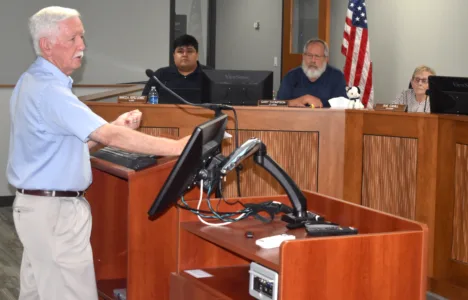
From there, a series of speakers came to the podium, most of whom were opposed to data centers outright. Evans McWilliam worried that they would permanently change the nature of the community. Another commenter raised concerns about the negative impact the noise would have on autistic children in the Marshalltown Community School District (MCSD), and Rose Fricke felt the noise would simply affect too many people.
P&Z Commission Chairman Jon Boston came forward and explained what went into the process of drafting the regulations while adding that they could only focus on the purview of zoning -- not fire code or electrical issues, which are regulated by the Iowa Utilities Commission. There were initial conversations about breaking the data centers into three categories by size, but that idea was ultimately scrapped, as well as a suggestion to classify them by megawatt usage.
"Alliant will not tell you how many megawatts a facility uses. They won't tell you for any building here in town that exists," he said. "So we went back to setbacks, square feet, that kind of thing."
April Long told the council the ordinance was a "start" but could still be tougher, and she raised concern that the overlay area would "cut the legs" off of the ordinances by allowing administrative approval as opposed to city council review.
"If that is what's happening, why even bother with the ordinance if the administrator can decide what's acceptable and what's not?" she asked. "To me that's a big red flag. Maybe I'm completely misunderstanding it, but I don't think I am."
Leigh Bauder reiterated her earlier call for a Community Betterment agreement like Cedar Rapids has and asked about the impact a data center would have on nearby property values as well as the emergency response plan due to fires at existing data centers. Mark Eaton noted that Tesla vehicles and solar backups run on batteries, and the fire code, state regulations and the Environmental Protection Agency (EPA) already govern them. He said he supported the code as written and was against all of the proposed amendments because he felt they would restrict development.
As the discussion moved back to the council, Councilor Marco Yepez-Gomez said data centers were "a spectrum" and that some small projects made sense like the former Fisher/Emerson data center, which has since been sold to Mechdyne. Modern campuses like one in Cedar Rapids, however, will use over 1,000 megawatts once completed.
"1,000 megawatts is equivalent to more than two Marshalltowns. That's a lot of power," he said.
One of his amendments would seek to break the projects into small, large and hyperscale categories, and Yepez-Gomez also opined that the current ordinance lacks consideration for residents in his ward on the northeast side, who already deal with frequent odors from the JBS plant. He took issue with the idea that projects could be approved by right within the overlay district and did not feel that the process would be the same in a different ward.
Councilor Gary Thompson asked why the setbacks were so strict if a noise ordinance is already in place, and Ender said they were building a backup or redundancy.
"Have we done that for any other industries?" Thompson asked.
The only other similar requirement is for in-ground solar arrays, Ender replied. Thompson suggested streamlining the process and felt the council and P&Z were overthinking the entire thing.
"I'm not saying I'm for data centers or against. I just think we could clean this whole thing up," he said.
Boston replied that the commission tried to streamline the process as much as possible, and the 300-foot minimum setback requirement was designed to satisfy the public. He also weighed in on the adiabatic cooling clause and said it is meant for especially hot days.
"We think we've got (the ordinance) as tight as we can get it with what's in the realm of zoning. The rest of it is fire code, electrical code, Alliant's requirements with the Iowa Utilities Commission," he said. "Who knows what the Iowa Senate and House are gonna come up with next year? They're talking about it too."
City Administrator Carol Webb said the ordinance could be sent back to P&Z in light of the proposed amendments and felt it was a good idea to do so. Boston, however, responded that they would likely reject all of the proposed amendments and send it back as is.
Yepez-Gomez said the main concessions he hoped to receive were for the residents in his ward to minimize the nuisances that come with data centers, and he hoped to remove the "by right" clause for approval with a special use permit being the minimum requirement. Ladehoff said the biggest determining factor for setbacks should be noise, and he worried that arbitrary setback requirements would amount to wasted land use.
Councilor Mark Mitchell asked Boston who came up with the by right approval process, and he replied that it was a concept designed to streamline the process if they can meet all of the codes and requirements.
"If you guys insist that you want special use on every single one of them, then you're gonna need to tell us," Boston said.
Mitchell responded that larger setbacks would result in more money for realtors, but Boston said it would just be wasted ground.
"Money's money, right?" Mitchell asked.
Boston asked if the council would be willing to drop the 300-foot setback minimum entirely and simply focus on the noise studies, noting that it was a concession to the public. Mitchell, however, said much of the public feedback was ignored entirely.
"We need to start listening to the people," Mitchell said. "The people need to be heard."
Boston contended, however, that much of the feedback and suggestions, as he had stated previously, were outside of the commission's authority. Mitchell said the people needed to be represented by their city council regardless of the personal feelings of councilors.
"Well then the city council, instead of sending it back to planning and zoning, you need to vote based on what you feel the public wants," Boston said.
"I think we've heard what the people want," Mitchell replied.
"Well then you need to outlaw data centers totally!" Boston quipped, to a round of applause before the mayor banged the gavel.
After another question from Councilor Sue Cahill, Boston said the goal of the commission was not to outlaw development but create appropriate regulations, and he felt they had done that. He added that many housing and business permits in town are already approved administratively, and the overlay district was designed to funnel projects to where they were most appropriate.
An amendment to add a noise abatement study requirement to all projects then passed by a unanimous 7-0 tally. Yepez-Gomez then discussed another of his proposed amendments increasing the buffer yard requirement from 100 to 200 feet.
"I really do think my people deserve some type of aesthetics in the backyard. I don't know why it's so hard to ask for that," he said.
After the council sorted out some confusion over whether the Edgewood Industrial Park lots would or would not border residential areas, Yepez-Gomez struggled to understand why there couldn't be more consideration for Ward 1 residents. Councilor Jeff Schneider replied that the 200 foot requirement was a "poison pill" amendment designed to keep data centers out of the industrial park entirely.
"There's already a very noisy pork plant with 400 trucks a day going down that road. I don't think this is gonna be the loudest thing in that neighborhood," Schneider said.
Nichols clarified that the buffer requirement does not apply to any other industrial uses, and the amendment failed by a 4-3 vote with Yepez-Gomez, Fonseca and Mitchell in favor.
Contact Robert Maharry at (641) 753-6611 ext. 255 or rmaharry@timesrepublican.com.