
Emergency Food Box sees increase in clients served
Trending
More and more Iowans are utilizing food banks across the state, and the same is true for the Emergency Food Box in Marshalltown.
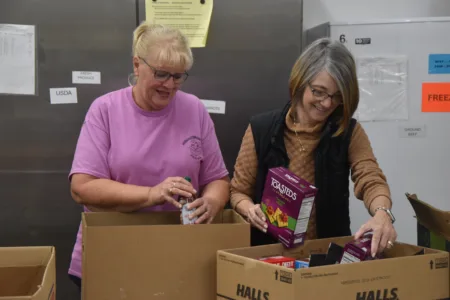
In 2023, the Emergency Food Box (EFB) was serving roughly 400 families per month. Now they are up to 500 families, or 1,900 people, according to Co-chairs Conny Schutte and Regina West.
Schutte said that in the early winter months, the number of people served was slightly less than normal. When the spring hit, the number continued to increase, particularly the numbers of families served and residents aged 60 and older.
"People on fixed incomes are really struggling," West said.
"People who used to qualify for SNAP and don't qualify any longer are in greater need," Schutte said. "What I hear from clients – what they had budgeted for years for groceries and gas . . . it doesn't work anymore. They don't have pay increases on salaries or hourly wages, so they are short."
Retired residents thought they had their retirements wisely budgeted, based on what they thought they would need.
"This last year has been transitional for people," she said.
Going through monthly numbers of clients, Schutte said they are telling her something.
"It's telling me that people who are retired or continuing to work past retirement age, they can't make money stretch like they used to," she said. "If you are retired, with the increased price of food, gas, insurance and some with grandchildren or family members moving in they hadn't planned for – there's a lot of variables that have changed for the senior population which had not happened in the past. They are being caught off guard a little bit. That's why I think our numbers are going up. They thought they had prepared. They thought they had saved and planned, and it's not stretching."
West said they have seen an increase in households with five or six adults who cannot afford to live on their own.
"They bunk up and come in and get food for that number of people," she said. "It's hard."
Schutte said a factor for younger people is finding full-time employment with reasonable health insurance. They are paying more each month and facing higher deductibles every year, even though they are on an employer's plan.
"They are paying a lot more for health insurance than we ever did," she said. "Insurance is going to rise, the cost of medication is going to rise. We're at a turning point, and I'm afraid of where it's turning."
Stretching
According to Schutte, they are not sure how many people will need help with the new TEFAP [The Emergency Food Assistance Program] guidelines brought about by federal funding cuts. For that reason, she said donations are extremely important.
"We could have happen to us what happened last November when suddenly we had people lined up outside, 20-deep," she said. "We think it's going to, so our board and our finance committee is extremely diligent in how we spend our money. Every penny that comes to the food box is put into the food or keeping the lights on or HVAC system. If we want to purchase something, it goes through a stringent discussion, but they are generous on food. They want people fed."
Anticipating the budget getting tighter, she said they are being very frugal. The goal is to help as many families as possible, which is why they try to stretch the money as far as possible. To meet the increasing demand, EFB volunteers take note of what is in stock and take advantage of discount prices – 19 cents per pound – through the Food Bank of Iowa. If they cannot get certain items from the Food Bank, Schutte said they will use local grocers, but will pay higher costs.
Community members ask her if it is better to give food or money to the EFB, and she said money is better.
"We can make your money go further than you can," Schutte said. "But both are great. If we put a call out that we are low on cereal, I blink three times and someone is ringing the back doorbell, bringing us cereal. We have magical things happen for us."
West agreed the community is phenomenal when it comes to helping the EFB. When there was a huge influx of clients in November 2025 when SNAP benefits were not being issued by the federal government, people panicked. But Marshalltown provided "amazing" donations with many food drives and some agencies donating 700 to 1,000 pounds of food.
West added they still operate the "Rescue Food" program. Rather than food getting thrown into the garbage, businesses, such as Kwik Star, Fareway, Dollar General and HyVee, will give the food to the EFB. Schutte said they have program agreements either directly with the company or through the state.
"A lot of the stuff that comes in as rescue are wonderful things like frozen sandwiches we can give out," she said. "Treats, candy, cookies, chips – random stuff we wouldn't go buy, but people like to have as an extra.
Fortunately, West said they have not had to decrease the amount of food clients receive from the EFB yet. She believes the Food Bank of Iowa had to decrease to some degree because of food and gas prices.
"We have not had to do that because we have a really generous community that keeps us going," West said.
Contact Lana Bradstream at 641-753-6611 ext. 210 or lbradstream@timesrepublican.com.