
‘Hard work’ helps decrease MCSD special education deficit
Trending
The deficit in the Marshalltown Community School District (MCSD) special education department has decreased from the previous year to a $1.9 million deficit. However, to cover that negative balance, the School Board approved a spending authority request from the School Budget Review Committee.
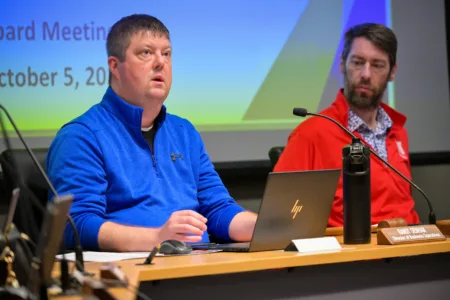
At the regular meeting on Monday, Director of Special Education Benjamin LaConner said the district receives state funding for students based on services in their IEPs (Individualized Education Programs). The services are weighted by the AEA and the district then receives supplemental weighting depending on how intense those services are.
"The increases in funding from the state, however, have not kept up with inflation," he said. "So, even with the supplemental weighting, it's not able to cover all the special education expenses, which is why districts run a deficit, and we need to request the spending authority to cover that deficit."
In the 2026 fiscal year, LaConner said the deficit was more than $1.9 million. Encouraging news is that the deficit has reduced by roughly $140,000 from 2025, he told them.
One action contributing to the decreased deficit is placing more focus on aligning spending with the goals.
"It's a big system with a lot of student needs and a lot of spending requests," LaConner said. "We're trying really hard to make sure every request goes through. [Such as] is it helping us get to some big goals we have such as helping our schools be identified as commendable?"
The department has also seen some success in transitioning away from specialized supports and making sure the ones still utilized are absolutely essential. He said one support which is in the transition process is the district had behavioral analysis specialists coming to the schools to help kids with significant needs. LaConner said if it is possible, they would like to move the support services to a salaried MCSD staff member.
The district has had an increase in Medicaid reimbursement. He said services provided to students by paraprofessionals and nurses can be billed to Medicaid.
"Part of that was due to changing Medicaid vendors," LaConner said. "There's a company we work with that collects that paperwork for us. We identified there were some inefficiencies with the previous vendor, so we made a switch, and I think that has had a positive impact."
A big factor in getting the Medicaid reimbursement is the staff members who submit for services rendered the same day. If the submission is not given that day, LaConner said they do not get reimbursed. The staff members are working very hard to ensure a good system and accounting is in place.
The department has also utilized outside grants for special projects, which helps the "big things" get done while continuing forward momentum and not taking on the costs of the projects.
Next year, LaConner said they will continue strong alignment and is sure they will continue to make progress.
"We just want to make sure we remain laser-focused so everything we're spending is moving us toward some of the big goals," he said. "If it's something that would be nice to have or something we have always done, but doesn't move us toward the goals, we're going to make a change, because we want to be responsible with the money we have."
LaConner shared special education deficits from similar-in-size school districts within the state. He presented the districts so the board could compare the deficits with MCSDs. Districts such as Council Bluffs have a deficit of more than $5 million, and Ames' deficit is more than $4.5 million.
Superintendent Theron Schutte thanked LaConner for the comparisons.
"That really tells the story, that even though it's a lot of money, it is definitely not out of line in comparison to like-sized districts across the state," he said. "In fact, you could probably make the argument (that) it is less than what would be anticipated. A lot of that comes down to the federal government not fully funding their 40 percent."
Executive Director of Finance & Operations Randy Denham agreed and added the weightings have not changed on the state level for more than 20 years.
"I know it's been a topic of discussion off and on with legislatures," he said.
President Sean Heitmann asked LaConner if he knew how MCSD compared to the other districts when it comes to the number of students served. LaConner told him the exact numbers were not available, but it is comparable as MCSD has 13 percent of students identified for special ed.
"Across the state, it's about 15 percent," he said. " . . . Compared to those other districts, I think we're just a little bit under where they are."
Schutte said during his career, the state average has hovered between 12 to 15 percent. LaConner told him it is on the high end of the range due to a post-COVID-19 pandemic jump.
"Our schools have done a really good job at trying to keep that number reasonable," he said. "There's a lot of needs our students bring, and it's tempting to say it must be a disability, but we have a lot of committed staff members who look deeply into whether it is really a disability or a language learning need or trauma experienced outside of school."
Contact Lana Bradstream at 641-753-6611 ext. 210 or lbradstream@timesrepublican.com.