
Marshall County has higher cancer incidence rate than national average
Findings presented at Restore Church Thursday night
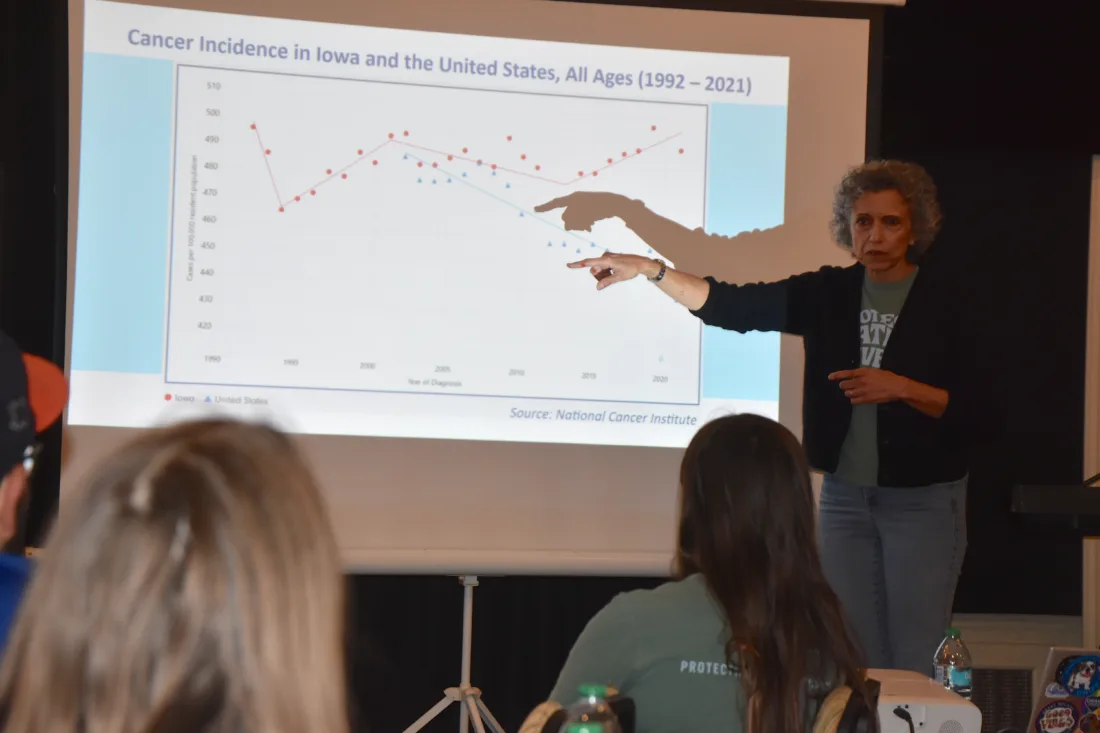
Sue Mattison with The Harkin Institute points out where on the timeline the rate of cancer incidents within Iowa started to increase. She said around that time, the manufacturing of Roundup Ready seeds began, which allowed higher usage of pesticides.
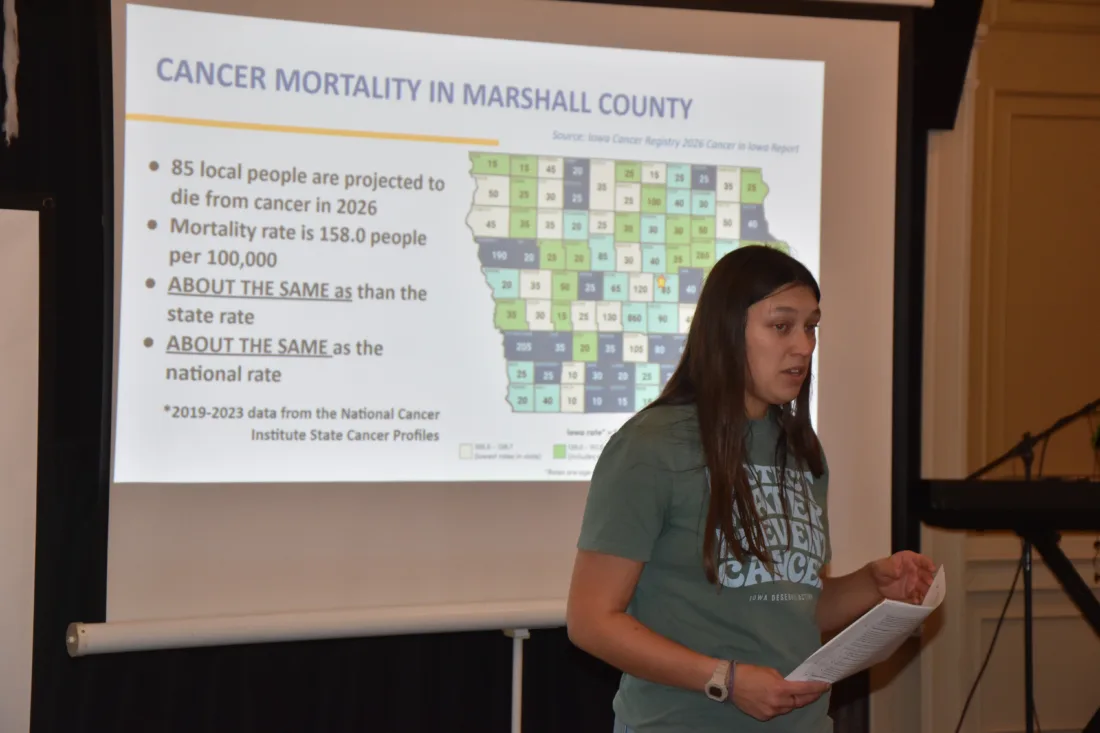
T-R PHOTOS BY LANA BRADSTREAM Kaitlyn Sorenson, the community outreach coordinator with the Iowa Environmental Council, speaks about the cancer mortality rate in Marshall County, which is about the same as the state and national average. However, the rate of cancer incidents within the county is greater than the national average.
Sue Mattison with The Harkin Institute points out where on the timeline the rate of cancer incidents within Iowa started to increase. She said around that time, the manufacturing of Roundup Ready seeds began, which allowed higher usage of pesticides.
T-R PHOTOS BY LANA BRADSTREAM Kaitlyn Sorenson, the community outreach coordinator with the Iowa Environmental Council, speaks about the cancer mortality rate in Marshall County, which is about the same as the state and national average. However, the rate of cancer incidents within the county is greater than the national average.
Trending
The science of environmental cancer risk factors were broken down for Marshall County residents.
On Thursday evening at Restore Church, a presentation on the Environmental Risk Factors and Iowa’s Cancer Crisis report was given to roughly 10 residents. Kaitlyn Sorenson, the community outreach coordinator with the Iowa Environmental Council, said they were sharing the research released this spring which details how the environment may be playing a role in the Iowa cancer crisis.
"As an organization, we felt there needed to be more productive conversation about the environmental risk factors of cancer," she said. ". . . Today we're going to focus on the evidence of association between environmental risk factors and cancer rates in Iowa, and not focus as much on policy discussions. We want to share the science with you, because we want people in Iowa to understand there is a problem, and there is a need for action."
Since 2023, the state has ranked the second highest in the nation for the rate of new cancers.
"Iowa is one of only three states where rates are increasing," she said.
Some cancer-risk factors are well known, Sorenson said, such as smoking, binge-drinking and a sedentary lifestyle, others need more discussion.
"An analogy to consider is a skyscraper. Each risk factor, like alcohol consumption, genetics, smoking add a floor to the building. The taller the building, the more liekly you are to develop cancer," she said.
Around 2012 to 2014, Sorenson said something started to change, but state cancer rates began climbing as rates in other states were decreasing.
Sorenson displayed a slide showing cancer incidence within Iowa counties. Marshall ranks 62 out of 99 counties with an incidence rate for all ages of 496 per 100,000 people, higher than the national rate of 453 but about the same as the state rate.
"It's good you're in the lower half, but that’s still drastically above the U.S.'s average," she said.
Of particular concern is a rising rate of cancer amongst Iowans younger than 50, for which the state also holds the second highest in the nation.
"The fact this is happening in younger folks is of deep concern," Sorenson said. "This shouldn't be a normal occurrence, and points to the urgent need for action."
The incidence rate of cancer in younger Marshall County residents is 91 per 100,000, higher than the state rate and roughly the same as the national rate. The county rate holds onto the 62 out of 99 counties ranking in this category.
The National Center for Health Statistics tracks the mortality rates of cancer in states. Sorenson said Marshall County has a rate which is roughly the same as the state and nation – 158 per 100,000.
"While numbers for cancer incidences are alarming, I guess if you can have good news out of that, it's that Iowa is good at treating cancer," she said. "So, we're not leading the country for cancer deaths."
The science
One of the report authors, Sue Mattison with The Harkin Institute, delved into the science behind the report and wanted to make it clear the report was not against family farms.
"Family farmers are caught in the same system," she said.
The four environmental contaminants which were the focus of the report were pesticides, PFAS, nitrates and radon.
Mattison said pesticides are widespread and it is easy for people to get exposed to them – through food, water, clothing and breathing. Since pesticides are so common, she said they focused on the top three used in Iowa, which are all herbicides – glyphosate – also known as Roundup, acetochlor and atrazine.
"The most recent data shows Iowa uses more glyphosate than any other state using any pesticide, which is a problem," she said.
Glyphosate is linked to non-Hodgkin lymphoma and acute myeloid leukemia, both common cancers in Iowa. Acetochlor – linked to colorectal, lung, melanoma and pancreatic cancers, all four common in Iowa and the first three amongst the highest rising cancers in people younger than 50 – also has the highest rate of usage in Iowa. Mattison said the use is 80 percent higher than the second highest in Nebraska. Atrazine is linked to colorectal, pharyngeal, kidney, lung, non-Hodgkin lymphoma, prostate and breast cancers – all common in Iowa.
A person's exposure to PFAS depends on where they live. They are commonly found in water supplies within Iowa, the highest concentrations in shallow ground water near large rivers, and downstream from waste water treatment plants. However, Mattison said they are also in consumer products such as non-stick deodorant, fast food packaging, firefighting foam and shampoo.
PFAS are also called "forever chemicals" because they do not break down, she said, and have been detected in human hair, blood and urine which indicates widespread exposure. They have been linked to kidney and testicular cancers.
Mattison displayed a cancer incidence slide comparing Iowa to the nation. She pointed where it started to increase.
"In 1997, Roundup Ready seeds were manufactured," she said. "Glyphosate was used before that, but was used more sparingly."
The genetically-modified seeds allowed farmers to apply an increased amount of glyphosate. Mattison said farmers need to make a living like everyone else.
"This is the system that supports them to do that," she said.
Farmers are encouraged to produce as much as possible by engaging in practices such as full season applications, growing crops right up to the creeks and installing more drain tiles to make farmland more tillable.
Nitrates are naturally occurring in soil, human and animal waste and manufactured in synthetic fertilizers, she said. They are found in water and the Environmental Protection Agency set a limit of 10 milligrams of nitrates per liter. Nitrates are linked to colorectal, bladder, kidney and renal pelvis, thyroid, prostate and childhood brain cancers.
"It has been very well established that the main source of nitrate pollution in Iowa's water is agricultural activity," Mattison said. " . . . Ninety-three percent of nitrate pollution in our water does not come from factories. It comes from non-point sources – agriculture."
The final risk factor she discussed was radon, which is the second leading cause of lung cancer and is potentially linked to stomach cancers. It is a colorless, odorless, tasteless naturally-occurring gas which enters buildings through cracks in building foundations and walls. She said Iowa is a "hot spot" for radon.
"Older homes have basements which are more drafty," Mattison said. "That's how radon seeps in. . . . Newer homes, I believe, have to be tested for radon."
Radon test kits can be purchased at hardware stores or obtained at no cost from the Marshall County Public Health Department.
The key takeaways from the report, she said, is Iowa is an outlier for exposure to environmental risk factors, all of the common cancers within the state have associations with risk factors and rates are rising with 80 percent of cancer types associated with the risk factors.
ACTION STEPS
Following Mattirson's portion of the discussion, action steps were listed so Marshall County residents can help reduce risk:
They can engage in safe individual pesticide use
Transition to non-PFAS products
Test for and mitigate nitrate in drinking water and
Test for and mitigate radon inside homes.
Contact Lana Bradstream at 641-753-6611 ext. 210 or lbradstream@timesrepublican.com.