
P&Z Commission sends some data center regulation recommendations on to council
Remaining unresolved issues to be considered next Wednesday
Trending
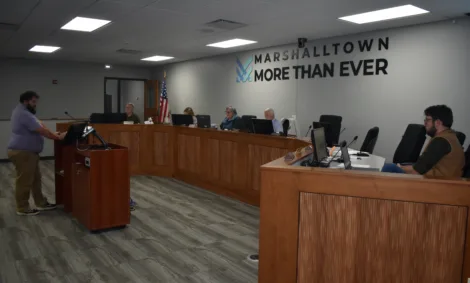
The city of Marshalltown's Planning and Zoning Commission met for about two hours Thursday night and spent most of it considering a new set of regulations specific to data centers -- with some recommended to be sent on to the city council for final approval and others delayed until another special meeting set for next Wednesday.
As the conversation began, Commissioner Patrick Streit indicated that he would be abstaining due to a potential conflict of interest, and Chairman Jon Boston, in a prepared statement, noted that the topic had received more feedback than any other in recent P&Z history and expressed optimism that a modern data center would address many of the concerns previously raised.
"Some people are dwelling on 'What's the worst that could happen?' We should also be thinking about what's the best that could happen to help out our community," he said.
Assistant Housing and Community Development Director Clayton Ender added that the proposed regulations did not grant automatic approval to any specific project but sought to guide the process. He clarified that onsite server facilities for companies are not considered data centers, and Ender explained the newly created Data Center (DC) overlay zoning district identifies areas eligible for development. A data center would need to be located within the overlay district or an underlying district (general industrial) where its use is allowed -- in the overlay district, it would be granted administrative approval, but it would still require a special use permit otherwise.
The commissioners agreed to remove General Commercial and Public Institutional zoning from the permitted uses for data centers. As the focus shifted to setback and buffering requirements, Commissioner Steve Valbracht asked Ender how many industrial properties currently in the city would fail to comply with the new rules, and he answered that while he didn't know for sure, they would be grandfathered in and considered legal non-conforming land uses.
Commissioner Deirdre Gruendler said she had "heartache" about the idea of annexing land on Shady Oaks Road before land already within the city has been developed first, and Commissioner Ben Harris-Medina commented that he didn't believe the 30 foot setback from a residential property line was not enough and would like to see it increased along with the 300 foot setback from noise generating equipment. Other communities, he said, are using anywhere from 150 to 300 feet as guidelines.
"It's a policy choice of what you guys can tolerate. We're not gonna find a scientific analysis with a perfect number for you," Ender said.
Conversely, Valbracht contended that every foot required for setback is a loss of value for the commercial property owner, and Gruendler endorsed the idea of a 100-foot setback for residential. Harris-Medina also called for increasing the setback from noisemaking equipment from 300 to 600 feet, which is still "relatively conservative" compared to rules in other communities. However, Boston suggested that if a noise study can prove they can stay within the ordinance, an exception could be granted. Even at a 600 feet setback, however, the noise ordinance would still apply.
Well over an hour into the meeting, the public hearing was finally opened, and Ender started by reading a written comment from Maggie Valentine calling for a total ban on evaporative cooling as opposed to allowing it in certain situations and capping data centers at 25,000 gallons per day.
Les Davis told the commission he opposed "hyperscale, large and medium-sized" data centers because he felt they produce unnecessary data processing that local business and industries don't need. He called for any data center built in town not to exceed 25 megawatts of continuous electrical use and only allowing closed loop cooling systems.
Mark Eaton, who cited his own background in information technology, software development and artificial intelligence, didn't feel the ordinance was ready for a public hearing and questioned the definition of data centers presented. He also noted that Meta's large data center in Altoona produces almost no noise.
Mike Schlesinger commended the commission for its work on the ordinance and felt that overall, it was sufficient and comprehensive, with a closed loop system's water use similar to a restaurant.
Once the hearing was closed, Gruendler and Harris-Medina both felt they needed more time before sending the Ordinance 15129 to the city council. From there, it was agreed to hold another meeting next Wednesday, Oct. 21, which would still allow the item to go to the city council for its Oct. 26 meeting. After tabling that item, they moved through the next few ordinances fairly quickly, recommending approval of an ordinance requiring new data centers to connect to the city's water system by a 6-0 vote with Streit abstaining.
The commission then recommended approval of the next section restricting the drilling of private wells by the same tally with an allowance to apply for an exception under "extraordinary circumstances." They also recommended approval of the noise ordinance governing data centers by a 6-0 vote. The commission delayed action on the overlay district proposal until the next meeting because notice still needs to be mailed to all property owners within 250 feet of the proposed districts, which would be located on the eastern edge of town with discussions about reducing the overall area.
During the public comment period, Amber Lawthers called for allowing public input and hearings to ensure that the community has a say in the process, and a written comment from Maggie Valentine called for removing the overlay districts entirely. The commission did not take any action on recommending an extension of the current data center moratorium.
Contact Robert Maharry at (641) 753-6611 ext. 255 or rmaharry@timesrepublican.com.