
School bus stop violations occurring daily in Marshalltown
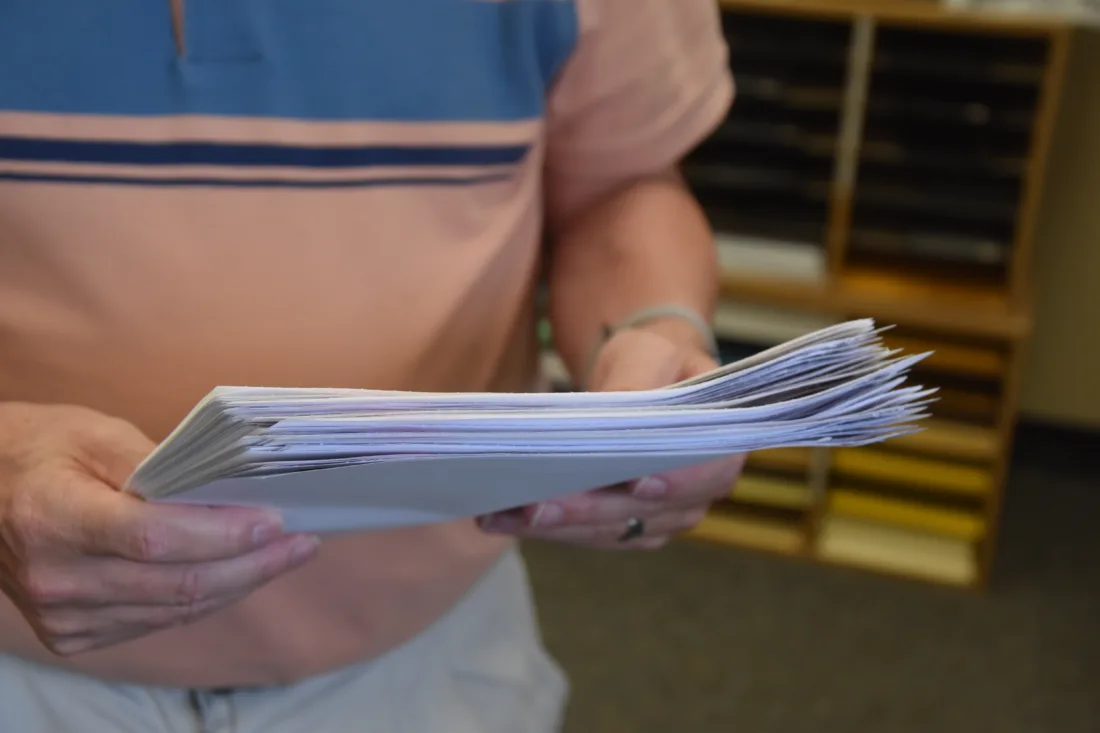
The growing stack of papers are for 38 incidents of drivers disregarding school bus stop signs since the beginning of the school year in Marshalltown. These do not include violations in which clear images of license plates were not captured, or were just reported to him.
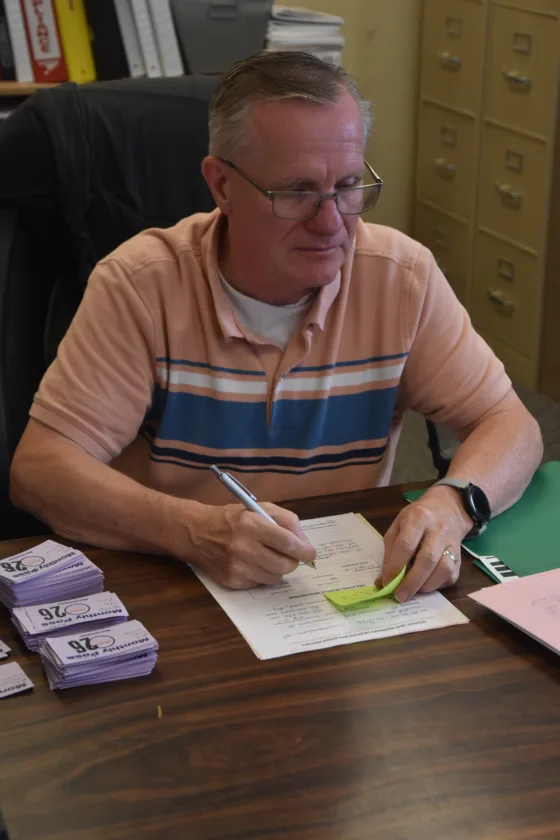
T-R PHOTOS BY LANA BRADSTREAM Rex Kozak, director of transportation for the Marshalltown Community School District, works on school bus stop violations which drivers have submitted to him that week. He said there is at least one incident each day of someone driving through school bus stop signs.
The growing stack of papers are for 38 incidents of drivers disregarding school bus stop signs since the beginning of the school year in Marshalltown. These do not include violations in which clear images of license plates were not captured, or were just reported to him.
T-R PHOTOS BY LANA BRADSTREAM Rex Kozak, director of transportation for the Marshalltown Community School District, works on school bus stop violations which drivers have submitted to him that week. He said there is at least one incident each day of someone driving through school bus stop signs.
Trending
There is a call Rex Kozak, the transportation director for the Marshalltown Community School District (MCSD), hopes to never receive -- one informing him that a child has been hit during drop off or pick up because a driver did not adhere to stop sign laws.
"I don't ever want a tragedy to get people to think," he said. "And I don't even know if that would stop this."
So far during the 2026-27 school year, Kozak has recorded 54 violations -- more than the 42 days MCSD students have attended school. On average, he said there are 1.5 violations each day.
"Have we had some close ones? Yes," Kozak said.
District and law enforcement officials have been trying to make people aware of the laws, but the rate of bus stop violations has not decreased. During the 2024-25 school year, the Marshalltown Police Department (MPD) responded to 45 violations; in the 2023-24 school year, 36 violations.
Kozak said the rate of violations has been about the same as the last two years, but what makes this year different is that he has received more camera footage.
The MCSD school buses are equipped with cameras, and when drivers notify Kozak of a violator, he reviews the incident. There have been times when the camera does not capture a clear view of the license plate, but if there is enough evidence, he turns it over to law enforcement. He speculated if some of the repeat offenders – of which there are five – keep breaking the law because they have not gotten caught.
MPD Chief Chris Jones said Kozak has turned over 26 complaints since the beginning of the school year. Out of the 26 complaints, there was enough evidence in 11 for an officer to issue citations.
"It's a little bit higher than last year when there were 22 complaints," he said.
It is a difficult type of violation for law enforcement to prove, as there needs to be probable cause.
"We need the evidence from the school district, the pictures or video, and the officer verifies the person did not stop," Jones said. "Then, the officer speaks to the owner of the vehicle because they have to prove who was driving."
Considering the severity of the situation, school bus stop violations are taken seriously by law enforcement.
"This is one of the more significant traffic violations to have for a non-habitual offender," Jones said. "There are fines. You can lose your license for 30 days and you have to go to court."
What will it take?
During an interview with the T-R, Kozak showed the stack of 38 violations he had completed during this school year. There were two he was in the process of working on, and another 14 in which clear views were not captured.
"It's frustrating," Kozak said. "Everybody has somebody they know who rides a bus. It's really dumbfounding to me what is so important in their lives to disregard this safety measure."
Violating drivers are usually notified about the incidents. Thankfully, he said they have been understanding. Some wanted to see the video. Kozak cannot give copies of videos, but the drivers are free to go to the Bus Barn, watch it with Kozak and then have a discussion.
"Several called me and asked if they really did that," Kozak said. "I tell them they did, and they say they didn't even see that. Well, I don't know why you didn't see a big yellow bus."
The MCSD bus drivers have been trained to look out for potential threats while on their routes. Some have let violators go through the stop before opening the door, because they can see the driver is not going to stop.
"They just sit there and wait," Kozak said. "What everybody needs to understand is that when the yellow lights come on – the bus is coming to a stop. So, be prepared to stop, not keep going. Then when the red lights come on – stop."
There are some "hot spots" Kozak has identified for bus stop violations within Marshalltown's boundaries -- Sixth Street close to Wayward Social and South 12th Avenue by the Central Iowa Fairgrounds, to name two. That does not mean the other in-town bus stops are free of violations. Kozak said the locations and times of day vary.
While the in-town hot spots have been identified, MPD officers cannot always be there when school is starting or getting out. Jones said they have a lot of responsibilities during those times of the day, such as school parking enforcement when drivers are dropping off or picking up their kids, becoming impatient, double parking and causing traffic congestion.
"We will go through areas where there are multiple concerns," he said. "If we see the violations, we will stop the individuals. Unfortunately, most of the calls for service happen when we're not around. School bus stop violations are hard to catch."
Outside of the city limits, the hot spot is Highway 14, which has seen an increase in the rate of violations, and Kozak said people are just disregarding the stop signs.
Even though traffic drives faster on the highway, the in-town hot spots are more concerning.
"The simple fact is you may have a kid crossing the street," he said. "Out in the country, we only pick up on the side the student is getting on, and country drivers are usually hugging driveways pretty tight. In town, we get on streets where people are parked so drivers can't get to the kids, and [the kids] have to go between cars or around cars. Some of the little ones – you can't see them. Now that it's getting darker, my concern level rises."
Kozak would like to know what it will take for the general public to adhere to the bus stop law. Jones is not confident adding more teeth to the state law, called Kadyn's Law, would help.
"I am not sure a stiffer penalty would see a drastic reduction in violations," he said.
Reducing the rate of violations might prove to be difficult. A school bus stop violation carries a mandatory ticket citation and court appearance, as required by Kadyn's Law. The law, passed in the state in 2012, is named in honor of Kadyn Halverson, a 7-year-old who was killed after being struck by a vehicle that did not stop. Kozak said they do not want to take away people's livelihoods. He suggested that community service could be included in the penalty.
"Maybe they have to be on a bus, do some type of program where they can see what happens and be around those little ones so they can recognize they could have taken a life," Kozak said. "When you think about it, I'm not sure what will get through to people. I understand people have livelihoods, but someone's life is far more important than someone's job. The state may have to go back and look at Kadyn's Law. . . . I just don't know what we can do."
Contact Lana Bradstream at 641-753-6611 ext. 210 or lbradstream@timesrepublican.com.