
State revenues projected to increase as Iowa’s billion-dollar budget deficit remains
Trending
Iowa is expected to spend over $1 billion more than it raises in revenues in the current fiscal year, the Revenue Estimating Conference found Friday -- but Iowa Department of Management Director Kraig Paulsen said this prediction remains in line with Republicans' expectations about the initial impacts of income tax cuts.
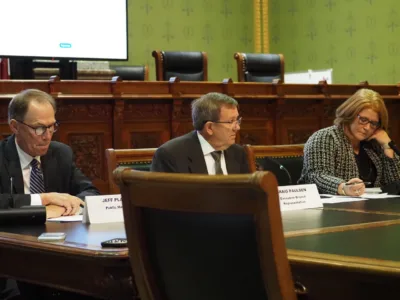
The Revenue Estimating Conference, a three-member panel, met Friday to discuss the state's expected economic outlook. When the conference last met in March, the members projected state revenues would decline by 9.3% in the fiscal year that ended June 30, 2026, but that the state would see a 4.4% increase in revenue growth in fiscal year 2027.
With the books closed for FY 2026, Iowa saw a 7.1% decrease in revenue compared to the previous year -- a drop of just under $635 million. Jennifer Acton, the director of the Fiscal Services division of the nonpartisan Legislative Services Agency, said this figure means revenues for the year were $205 million higher than the REC projected. But, she said, the year was still significant for being "the third year in a row with a net revenue decrease after 90 straight years of net revenue increases."
These decreases are primarily driven by the changes to Iowa's income tax structure in recent years. In 2025, Iowa's law lowered individual income tax rates to a single 3.8% rate, making FY 2026 the first full fiscal year of implementation, Acton said.
Looking ahead to the rest of FY 2027, Acton said though "general fund revenues have been positive to start the year," factors such as the Federal Reserve's move to raise the interest rate, the effects of tariffs on agricultural exports and input prices, as well as tax changes made through the 2025 federal "One, Big, Beautiful Bill" Act, could have a negative impact on the state's economy.
"While revenue growth and the overall economy are positive, concerns remain over persistent inflation, increased borrowing costs due to higher interest rates, and heightened geopolitical uncertainty with respect to gas and diesel prices," Acton said. "These considerations are factored into LSA's general fund revenue projections, which forecast modest growth for FY 27 and FY 2028."
Jeff Plagge, director of Northwest Bank in Spencer, said the Community Bank Sentiment Index shows issues like higher interest rates, deficit questions and "stubborn inflation" all have an impact on economic outlooks.
"Uncertainty remains the common theme," Plagge said. "Interestingly, though, bankers that I've talked to seem to be more concerned about the national economic issues and international unrest than conditions in Iowa or in their local communities."
The panel predicts Iowa's revenue will grow by 2.8% in FY 2027 in comparison to the previous fiscal year, taking in an estimated $8.54 billion. Though it represents roughly $60 million more in state revenue than previously projected, it remains below the $9.65 billion state budget approved by lawmakers earlier this year for the fiscal year that ends June 30, 2028.
This means the state will continue to draw from reserves and the Taxpayer Relief Fund to fill the more than $1 billion gap between state income and spending. Republican leaders have argued this disparity was expected when the Legislature approved income tax cuts, but Democrats and other critics have expressed concerns that the state will be left in a budget crisis.
Paulsen said he does not see the REC projections as a pessimistic outlook for the state, and said he believes "the Taxpayer Relief Fund will last long enough that the revenues will catch up."
"I would say the state doesn't have a revenue problem," Paulsen said. "And we're clearly in an extremely strong cash position, so assuming we continue to see the growth, which, that's what we agreed to today in this meeting. Again, I think the state's in a great spot."
Gov. Kim Reynolds, who is not seeking reelection in 2026, said in a statement the latest projections "reflect a strong and stable financial outlook" for the state.
"For nearly ten years, my administration and the Republican-led legislature have prioritized the type of fiscal responsibility and conservative, pro-growth policies that generate measurable results," Reynolds said. "Today, Iowa's economy is well positioned to sustain growth, maintain stability, and continue to invest in the priorities Iowans value most."
Common Good Iowa Executive Director Anne Discher said in a statement the REC estimate for FY 2027 -- as well as the $8.83 billion revenue estimate for FY 2028 -- show the need for Iowa to change course on its tax and budgeting practices.
"For the current fiscal year, FY 2027, revenue projections are more than $1.1 billion below the budget lawmakers approved in May," Discher said. "For FY 2028, even if lawmakers were to approve what would be a deeply unpopular flat budget -- further disadvantaging our schools and health care and all the other services Iowans depend on -- we'd face a deficit of more than $800 million. This is not sustainable."
Democrats said the latest REC projections show the need for a change in leadership ahead of the 2026 general election.
"With Iowa facing another billion-dollar budget deficit, today's revenue estimate raises serious questions about the state's fiscal priorities after 10 years of Republican lawmaker control," Rep. Megan Srinivas, D-Des Moines, said in a statement. "While Iowa families are paying more for groceries, housing, and health care, wages aren't keeping up with everyday costs. Today's revenue estimates once again show that after a decade of the Iowa Republican trifecta, the economy is leaving middle-class Iowans behind while large corporations and the wealthy keep getting richer."