
A cattle farmer, U.S. Army veteran, and Iowa Senate staffer on serving close to home
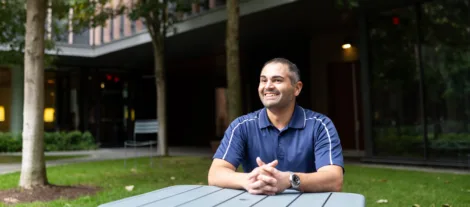
Introducing the inaugural cohort of American Service Fellows: Gannon Hendrick MC/MPA 2027
Trending
(Editor's note: This story, originally published by the Harvard Kennedy School, is reprinted with permission. Gannon Hendrick was a Republican State Senate candidate in District 26, which includes all of Marshall County, in the 2024 election.)
Gannon Hendrick arrived at Harvard Kennedy School with experience raising cattle on his family farm, serving in Iraq, working 16 years in the Iowa Legislature--and a tax return unlike most of his classmates.
"I'm probably the only one to have a Schedule F on my taxes, which is used for farming," says Hendrick. "It is a unique situation."
The tax designation is only part of his story.
Hendrick grew up on a small farm outside McCallsburg, Iowa, population 320. He served in Iraq as a U.S. Army intelligence analyst, returned home to earn a commission, and rose through the Army Reserve ranks to lieutenant colonel. He worked for the Iowa Senate Republicans, eventually becoming chief of staff to Iowa Senate President Amy Sinclair. Along the way, he served on a school board, as a township clerk and trustee, and as commander of his local American Legion Post 334.
Now, as a member of the inaugural American Service Fellowship (ASF) cohort, Hendrick is bringing those experiences to HKS as he prepares for his next chapter in public service.
"I've had many opportunities to go elsewhere and make more money," he says. "Instead, my experiences have reinforced the idea that we need good people in public service."
A childhood in politics
Hendrick's education in public service began before he could vote. His parents farmed for Bob and Micki Lounsberry -- Bob Lounsberry served as Iowa's secretary of agriculture from 1972 to 1986, and the Lounsberrys were active in Republican politics. They often invited the Hendricks to political events.
"If my parents couldn't make it, they would ask: 'Would Gannon like to go?'" he recalls.
By the time he was five, Hendrick was attending rallies and meeting candidates.
"As a child, I met Lamar Alexander and Bob Dole," he says. "If you don't meet presidential candidates in Iowa, it's your own fault -- they show up everywhere."
His involvement became more serious at 17, when a candidate running in an Iowa House primary asked for Hendrick's endorsement. Hendrick explained he was too young to vote.
"He said, 'I understand, but I know if I have your name in your community, people will vote for me.'"
Hendrick's parents saw his early political engagement as civic education. After his father served nine years on the local Colo-NESCO school board, Hendrick followed him in 2007. He ran after watching the district lose 20 percent of its enrollment and seeing old divisions reemerge.
"I ran for two reasons: first, to try to address the problems, and second, to put those issues to rest for good."
The experience taught Hendrick that local government is rarely about soaring speeches. It's about solving problems practically, in communities where people know one another--and remember what happens next.
Understanding the consequences of policy
A friend from Hendrick's high school baseball team joined the Army and suggested he speak with a recruiter. Two weeks later, in June 2002, Hendrick enlisted.
He deployed to Iraq in 2004-2005, to Camp Taqaddum, about 45 miles west of Baghdad. His primary assignment was as an intelligence analyst, but he also drove for the battalion commander, operated heavy equipment, served as a radio operator, and worked as a forward air controller.
He spent 360 days in Iraq. "Not that I was counting," he says.
The deployment changed how he understood the connection between government and policy. From the ground, he saw how decisions made at the highest levels affected those responsible for carrying them out.
"I saw how much could be lost between a presidential directive and its execution on the ground," he says.
After returning home, Hendrick enrolled at Iowa State University and received a commission as a second lieutenant. Over the next 16 years, he served as company commander, battalion executive officer, brigade executive officer, and battalion commander. He retired from the Army Reserve as a lieutenant colonel after 24 years of service.
His military leadership shaped the way he evaluates public policy.
"Whenever I question a decision, I think about its impact on the people below me," he says. "I ask whether the pain they will experience is worth what needs to be done, or whether I can mitigate it."
He also applies the same test to legislation.
"I ask, 'What problem are we trying to solve with this piece of legislation?' Sometimes a proposal creates more problems than it solves, and I suggest doing it differently."
That habit of working backward from a desired outcome has served him well in the military and politics. He describes his work with Iowa Senate President Amy Sinclair in similar terms: she identifies where she wants to go, and he determines how to get there.
"You can tell me what to do--where you want to go--or you can tell me how you want to get there, but you can't tell me both," he says.
Public service close to home
Hendrick joined the Iowa Legislature in 2011, first working on the Education Committee before becoming staff director in 2017. He became chief of staff to Sinclair in 2023.
He has also run for office twice. In 2024, he narrowly lost a Republican primary for the Iowa Senate. In 2026, he ran for Story County supervisor and finished second in a three-way primary. The campaigns reinforced his belief that politics works best when it begins with listening.
"People often say the two things they hate most about campaigning are door-knocking and raising money," he says.
Hendrick enjoys both. Fundraising, he says, reflects a community's confidence in a candidate. Door-knocking creates opportunities to hear from people whose concerns do not always fit neatly into campaign talking points.
"In Nevada [Iowa, pronounced 'Nav-AY-dah'], I spoke with residents who were concerned about emergency management services and how those services worked across the county and the state," he explains. "I sat with them for an hour, listened to their concerns, and learned a lot from our conversation."
Hendrick won Marshall County by 13 points in his 2024 state Senate campaign, despite not having been well known there. The relationships he formed continue.
"Those people still call me because they know what I do for a living," he says. "When they have a state-level issue, they contact me because they know I will respond and try to help."
An unexpected invitation
Hendrick learned about the American Service Fellowship through a Department of Veterans Affairs newsletter in August 2025. He'd never visited Boston and wasn't planning to leave his position in Iowa.
He applied anyway. In his application, he identified himself as "very conservative." Some friends assumed that would prevent him from getting admitted, but Hendrick saw it differently: Harvard had an opportunity to complicate its public image as an elite, liberal institution.
"I thought I might be part of that change," he says.
When an acceptance email arrived in March, he was surprised--and immediately faced a practical question.
"I was 'the dog that caught the car,'" he says. "I thought, 'Now what do I do with this?'"
A second email arrived two hours later: he was selected as an American Service Fellow. He showed the message to Sinclair, expecting a conversation about whether he could realistically leave his job.
"Instead, she asked, 'When do you leave?'" he recalls.
Hendrick told her he wanted to visit Boston before deciding. He attended New Admit Day in April 2026 and accepted the following Monday.
Apart from military assignments and vacations, it was the first time he had left home by choice.
"I love it here," he says about HKS. "I disagree with many things I hear and see, but I love it because people are open to conversation."
He hopes other students--especially those from rural communities or unconventional professional backgrounds--will see themselves as qualified to apply.
"A lot of people in the Midwest simply do not consider applying because Harvard seems like an impossibly high hurdle," he says. "Reach for it. The worst that can happen is that someone says no, and you can still earn your degree somewhere else. But what if they say yes?"
Bringing rural Iowa to Harvard
At HKS, Hendrick quickly learned his background wasn't just unusual. It was useful.
For his DPI-820M: Policy Memo Writing for Decision Makers class with Lauren Brodsky, he wrote about water quality in Iowa and the relationship between agriculture and environmental challenges. Concepts familiar in his home state required explanation for classmates who had never encountered them.
"I had to explain every part of my memo because there was no shared context," he says.
That experience is part of what he values most about HKS. Its classrooms bring together not only different countries and professions, but different regions, political traditions, and lived experiences.
"Not every issue is about national defense or national education," Hendrick says. "State and local issues matter, too. I would argue that they often matter more than national issues because the closer politics are to home, the more directly they affect daily life."
He has found unexpected common ground in DEV-356: Economic Policy in Africa: Challenges and Opportunities with Celestin Monga. The course explores questions that also confront rural Iowa: how to attract investment, build infrastructure, develop a skilled workforce, and sustain communities.
"There must be lessons that can be applied at home," he says.
His presence has also challenged assumptions. During the Mid-Career MPA Summer Program, Hendrick was assigned to a small group with several international students. When one student described himself as conservative, he identified himself the same way.
Another student looked at them "as though she had seen a ghost," Hendrick says. She had expected to be surrounded by people who shared her views.
Hendrick says she asked him, "Why are you here?"
He told her that the HKS community needs diverse perspectives. He wanted to learn from her and to show her that disagreement did not make someone "evil or mean."
The two stay in touch.
"That was a major learning experience for me," he says. "I had assumed that everyone would arrive expecting to encounter people with different views."
"I love it here … I disagree with many things I hear and see, but I love it because people are open to conversation."
Missing home
The fellowship is helping Hendrick imagine what comes next. When he returns to Iowa, he expects to return to his work in public service, though his exact role may change.
But for now, when asked what he misses most about home, he answers without a beat: the cattle.
He and his father have raised them all their lives. Over time, Hendrick learned that managing cattle requires understanding their behavior, not forcing them to behave differently.
"When I was younger, I would sometimes yell at them," he says. "Eventually, I realized they were simply being cattle. You cannot change what they are going to do, so you have to change the situation around them."
The lesson stayed with him.
He misses Iowa's open space, the ability to see for miles, and having a freezer full of steaks ready for the grill. He does not miss the bugs, dust, gravel roads, or snakes.
But mostly, he misses the place that shaped his understanding of community.
From a rural farm to an Army deployment to a career in state government, Hendrick has built a life around service close to the ground. At HKS, he is learning how to carry those lessons into a wider conversation--and creating the conditions so more can join in.