
Council narrowly votes to eliminate data center overlay zoning district
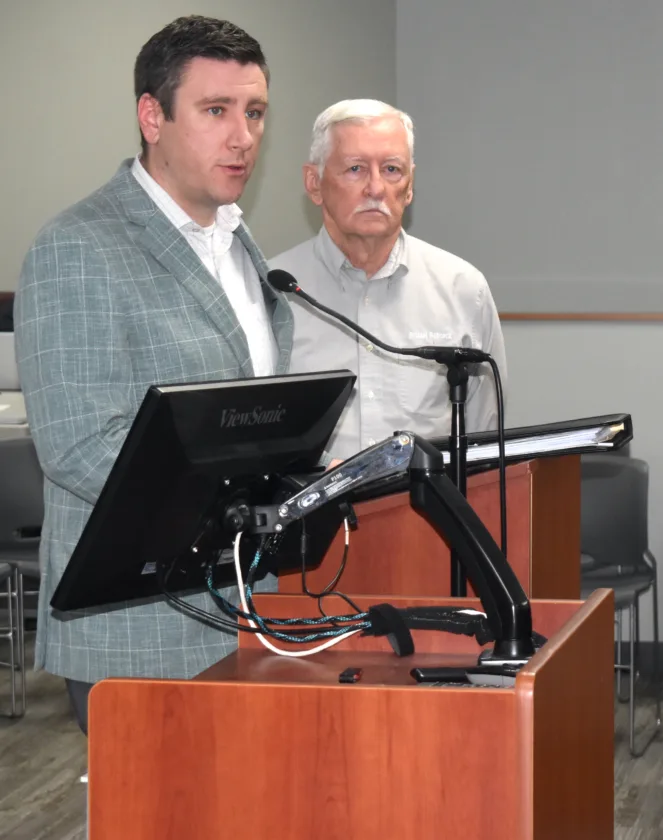
Marshalltown Area Chamber of Commerce President/CEO John Hall and Marshalltown Planning and Zoning Commission Chairman Jon Boston address the city council during Monday night's meeting.
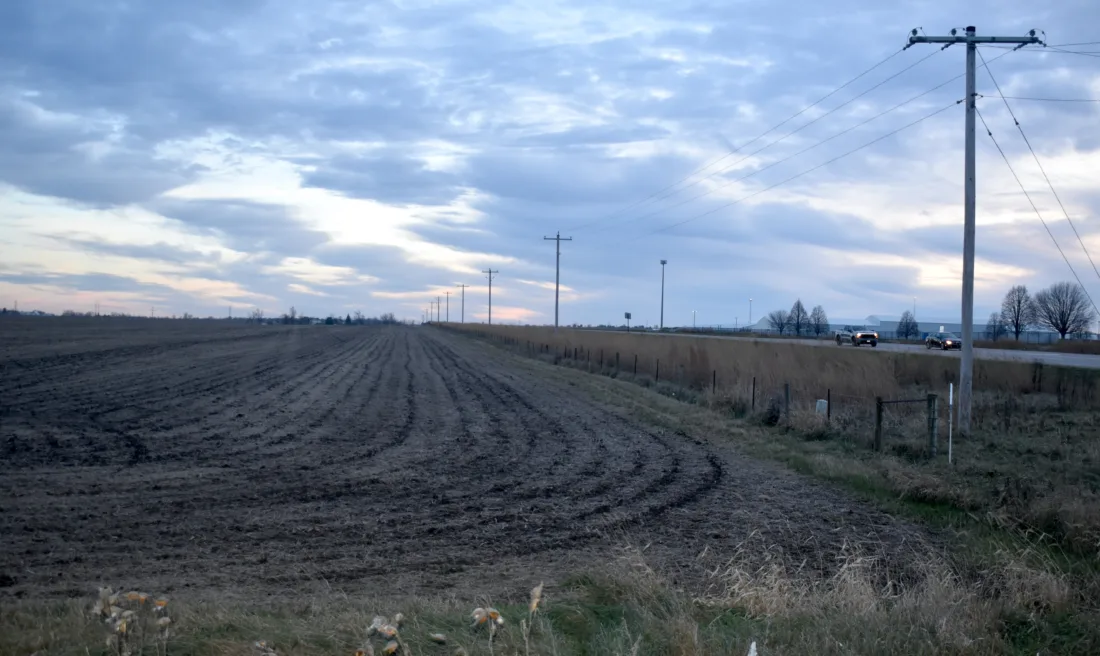
T-R PHOTOS BY ROBERT MAHARRY The third and final reading of an ordinance amendment that would have established a data center overlay zoning district both in the Edgewood Industrial Park and an area off of South 18th Avenue (pictured) between the east water tower and Iowa Avenue failed by a 4-3 vote at Monday night's city council meeting.
Marshalltown Area Chamber of Commerce President/CEO John Hall and Marshalltown Planning and Zoning Commission Chairman Jon Boston address the city council during Monday night's meeting.
T-R PHOTOS BY ROBERT MAHARRY The third and final reading of an ordinance amendment that would have established a data center overlay zoning district both in the Edgewood Industrial Park and an area off of South 18th Avenue (pictured) between the east water tower and Iowa Avenue failed by a 4-3 vote at Monday night's city council meeting.
Trending
(Editor's note: This is the third story in a series about Monday night's Marshalltown city council meeting and the ongoing controversy surrounding data centers in the community.)
After passing the third reading of several of the ancillary amendments pertaining to the larger new zoning code governing data centers in Marshalltown, the city council ultimately voted down the third reading of an ordinance establishing a data center overlay zoning district by a narrow 4-3 vote during Monday night's meeting.
With recent amendments factored in, the overlay district would have allowed data center projects in two primary areas -- the Edgewood Industrial Park near JBS and a stretch of 18th Avenue between the water tower and Iowa Avenue East -- to be approved "by right" if they are under 40 acres in size and on one story. Anything larger would still be subject to a special use permit, which is approved by the Board of Adjustment.
Councilor Gary Thompson said he disagreed with the idea of an overlay district and the "two standards" that would exist within the general industrial zoning district and would be voting no. City Attorney Steve Leidinger also noted that the larger zoning ordinance "contemplates" an overlay district, and if the council rejected the overlay, they would have an amendment that provides uses for a non-existent overlay district.
Public commenters then spoke up against the overlay, with Leigh Bauder feeling that it constituted a lack of "equity" across the city as the districts are only located in Wards 1 and 4 and the possibility of a data center being across the street from the soccer fields on the east side of town. Councilor Marco Yepez-Gomez recounted the process and questioned why public hearings should be taken away for any projects.
Layne Pieri compared the situation to the debate over chickens and the desire to avoid spot zoning, contending that the overlay district was a prime example of such a practice.
"Chickens were, I was gonna say small potatoes, but I guess small chickens compared to what we're talking about now, so if spot zoning is important to you guys in one thing, then I feel like it should be in this as well," he said.
Councilor Jeff Schneider asked if Thompson would be more inclined to support the overlay district rules if they were applied to the entire general industrial zoning district, but his amendment was shot down because it had already been voted on and failed at a previous meeting and would be subject to a reconsideration vote.
Marshalltown Area Chamber of Commerce President/CEO John Hall explained that the overlay guidelines had arisen from a compromise due to a previous zoning administrator viewing data centers fell under industrial code rather than major utilities and would not require any public hearings.
The owners of Diamond Roots LLC, who farm near the proposed 18th Avenue overlay district, sent written comments opposing its creation, and Hall and Planning and Zoning Commission Chairman Jon Boston provided further clarification on which industrial projects would require special use permits. Councilor Marco Yepez-Gomez took issue with Boston's comments and contended that any heavy industrial project would require a special use permit.
Councilor Sue Cahill felt the overlay was being proposed to drive developers toward less populated areas, and she noted that the soccer fields are already up against an Emerson facility as it is. Yepez-Gomez then said he felt like he was the only one who had actually read the proposed ordinance.
"The only thing that the overlay does is take away the special use permit, which is giving you a public hearing for 40 or more acres, and other than that, if it's 39, 20 in the Edgewood Industrial Park, you won't have a public hearing. It'll be by right," he said. "It can go anywhere in general industrial when this ordinance passes. It's getting a little bit frustrating hearing comments that are not accurate, and they're spreading somewhat misinformation. So I encourage my fellow councilors to really read the ordinance if you haven't already because this is pretty critical."
Leidinger told the council that "by right" did not mean developers could simply do whatever they want as they would still be subject to all of the city's established regulations on setbacks, water use and other codes governing data centers.
"If you want to bring a data center into town in Marshalltown and this is passed, you have to meet all of these requirements that the ordinance puts into effect to try to mitigate potential impacts and whatnot. It's not because it's as of right that you get to do whatever you want. I just want to make that clear," he said.
Hall added that the current discussion essentially served as the public hearing on data centers under 40 acres and two stories within the overlay. Cody Brink felt that while the overlay was a good idea in theory, the lack of public hearings was a major issue given the sensitivity of the data center topic. Schneider argued that because the city already owns all of the lots in the Edgewood Industrial Park, any sales would be subject to council approval and thus, public comments and scrutiny as well as any annexation in the southeast part of town.
"There's gonna be public hearings no matter what we do. I think we should establish the hatch. Just have one public hearing. People will get their chance when the property transfers or the annexation happens," he said.
Pieri asked for clarification because the purchaser of the land may not be required to publicly disclose its intended use and use a Limited Liability Corporation (LLC) to make the transaction. Ladehoff deferred to Leidinger, who said the hearing would be on the sale rather than the land use itself, and it could still be sold to a third party from there.
"That being said, then, I would also say that we should also have the special use permit for all of these data center proposals instead of having any by right," Pieri said.
A motion to pass the third reading of the ordinance establishing the overlay district boundaries failed by a 4-3 vote with Thompson, Yepez-Gomez, Melisa Fonseca and Mark Mitchell opposed and Schneider, Cahill and Nichols in favor.
The council then took a brief reprieve from data centers for about a half hour to discuss space utilization at city hall with architect Cory Sharp of FEH Design and all of the councilors agreeing that they would like to keep staff in the old city hall and, at the bare minimum, spend an estimated $385,000 to improve the windows, bathroom and breakroom.
But they were not finished discussing the topic of the night as the final discussion item of the night pertained to an outright ban or long-term moratorium on data center construction proposed by Thompson.
Contact Robert Maharry at (641) 753-6611 ext. 255 or rmaharry@timesrepublican.com.