
Council passes second reading of data center zoning ordinance, votes down proposed amendment
Trending
(Editor's note: This is the second in a series of stories about Monday night's Marshalltown city council meeting and the ongoing debate over data centers in the community.)
After the first long discussion of the night and an eventual unanimous vote to extend the current data center moratorium by 60 days until Jan. 22, 2027, the Marshalltown city council moved on to approving the latest readings of several ordinances related to data centers and eventually voted 4-3 to remove the proposed overlay districts entirely.
First, the council considered the second reading of the main zoning ordinance governing data centers and a proposed amendment from Councilor Melisa Fonseca that would cap floor space used for data center operations at 75,000 square feet per building and cap floor space across all buildings at 10 percent of the development's total land area. In explaining her rationale for the proposal, she cited the square footage of other large buildings in Marshalltown -- Hy-Vee is 71,822, Theisen's is 87,500 and Walmart is 214,000. Within the proposed data center overlay district, she added, 275.42 acres are in Ward 1, and 404.95 are in Ward 4. There are none in Wards 2 or 3.
"My amendment is to limit the size and keep the land more land than building," she said.
Councilor Sue Cahill asked for a potential compromise to raise the threshold to 100,000 square feet limit, but Fonseca indicated that she would prefer to keep her amendment as it was written while exploring an increase at a later date. Fellow Councilor Greg Nichols cited the size of large industrial buildings like JBS and Lennox, arguing that limiting the size of a data center would constitute unfair treatment of one industry, and Councilor Jeff Schneider indicated his opposition due to what he felt would be an inefficient use of land.
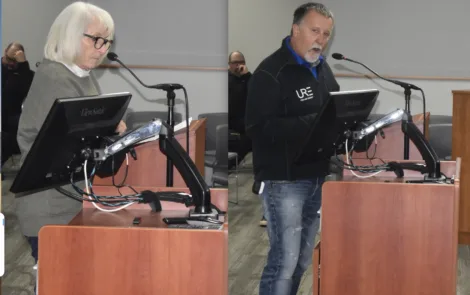
During the public comment period, Layne Pieri, speaking of the ordinance in general, pressed City Attorney Steve Leidinger for answers on why a second reading was being considered when he had indicated during the previous meeting that there were enough substantial changes to revert back to a first reading.
With the conversation shifting back to the amendment, Planning and Zoning Commission Chairman Jon Boston said the zoning code has never limited building size and felt it "sends a bad message." He also didn't feel that a 90 percent open space requirement would be "reasonably debatable."
Jim Palmer cited a past example of a park being turned into a business, and Vada Exline said the restrictions should be in place because residents didn't want another JBS, describing it as "a giant polluter." MARSHALLTOWN Company President/CEO Joe Carter noted that they are currently in the process of adding another 185,000 square feet and expressed gratitude that his building size wasn't being limited. The amendment failed by a 4-3 vote with Fonseca, Mark Mitchell and Marco Yepez-Gomez in favor.
With the conversation shifting back to the original ordinance, Leidinger responded to Pieri's question and explained that he made a quick judgment call on whether it should revert back to first reading after the acreage change for a special use permit requirement within the overlay district.
"Sometimes I get asked hard questions up here. I do my best to answer them. If I don't think it's right and I have time to correct it, I'm not too big to admit I'm wrong," he said. "I chatted with some colleagues on the drive home and contacted the city. We still had time to correct my error, so we did."
City Clerk Alicia Hunter then read a written comment opposing the ordinance as written, calling for the removal of the overlay district and supporting an extension of the moratorium, which had already been passed. Councilor Mark Mitchell then opined that businesses like Lennox, Emerson and MARSHALLTOWN had "good track records" and didn't feel they should be compared to the unknowns of a prospective data center. He also called the decision to allow JBS to expand 45 years ago a "mistake" and said the council should learn from it.
Boston defended P&Z's work toward crafting the ordinance, noting that they had more public meetings and did more research than anything he'd ever worked on in his 46 years with the commission. He also pointed out that the ordinance limits data centers to the general industrial zoned areas anyway and warned that many of the "horror stories" people have read pertain to data centers built before strong code was established.
During his comment, Palmer highlighted the fact that the Marshalltown Community School District (MCSD) may not see the tax benefits of a data center along 18th Avenue because a small portion of the southeast corner of Marshalltown is actually part of the East Marshall district along with the rumored Shady Oaks development. Leigh Bauder proclaimed her Christian faith and expressed sympathy for the city councilors in Fairfax who can no longer see the stars because of the data center development in Cedar Rapids, and the next commenter warned that artificial intelligence (AI) could wipe out humanity as a whole.
Other commenters highlighted Iowa's rich soil in arguing against allowing data centers, warning against chasing short-term financial gains over long-term quality of life.
"Come on Marshalltown. I'm proud of this place. I want to live here, but I'm not going to if we don't think about the future generations," Kristin Stuchis said.
Jarrod Ulery of U R Energy, who introduced Amir Atefi with Swarm Systems to the area several months ago, spoke of his longtime roots in Marshalltown and Le Grand and contended that he would never do anything to hurt the community.
"I'm not a billionaire. I'm not from out of town. I chose Amir with Swarm Systems for a reason because I live here," Ulery said.
He added that in his view, data centers are not an issue but an opportunity. Carter reiterated that he felt confused by the conversations on restricting the size of buildings or not allowing data centers due to a perceived lack of permanent jobs, and he hoped the ordinance would pass.
April Long asked for the matter to be tabled, arguing that councilors would be less eager to pass it if data centers were proposed on the west side of town and making the case for the council to create "the gold standard" for ordinances in Iowa.
"Make it tough to build here. If our location is so wonderful, which we've been told it is because of water and electricity and central location to highways and all of that, if it's so wonderful, then the builders will rise to that standard," she said. "Right now, our ordinance is the bare minimum."
Subsequent commenters continued to raise concerns about whether the revenue and jobs data center developers promise ever actually come to fruition. Francisco Zambrano told the council he had collected signatures for an anti-data center petition, and Jimmy Landt felt Boston should have used a more apt comparison than a car when he described water usage at a data center.
A motion to pass the second reading of the zoning ordinance passed 5-2 with Mitchell and Gary Thompson opposed. From there, the council, in a relatively short span of time, quickly passed third readings of ordinances requiring mandatory connection to the public water system, restrictions on the drilling of private wells and noise control by unanimous votes.
The next item of lengthy discussion and debate pertained to the third reading of an ordinance establishing the initial boundaries of the data center overlay zoning district.
Contact Robert Maharry at (641) 753-6611 ext. 255 or rmaharry@timesrepublican.com.