
Marshalltown city council votes down decommissioning requirement for data center projects
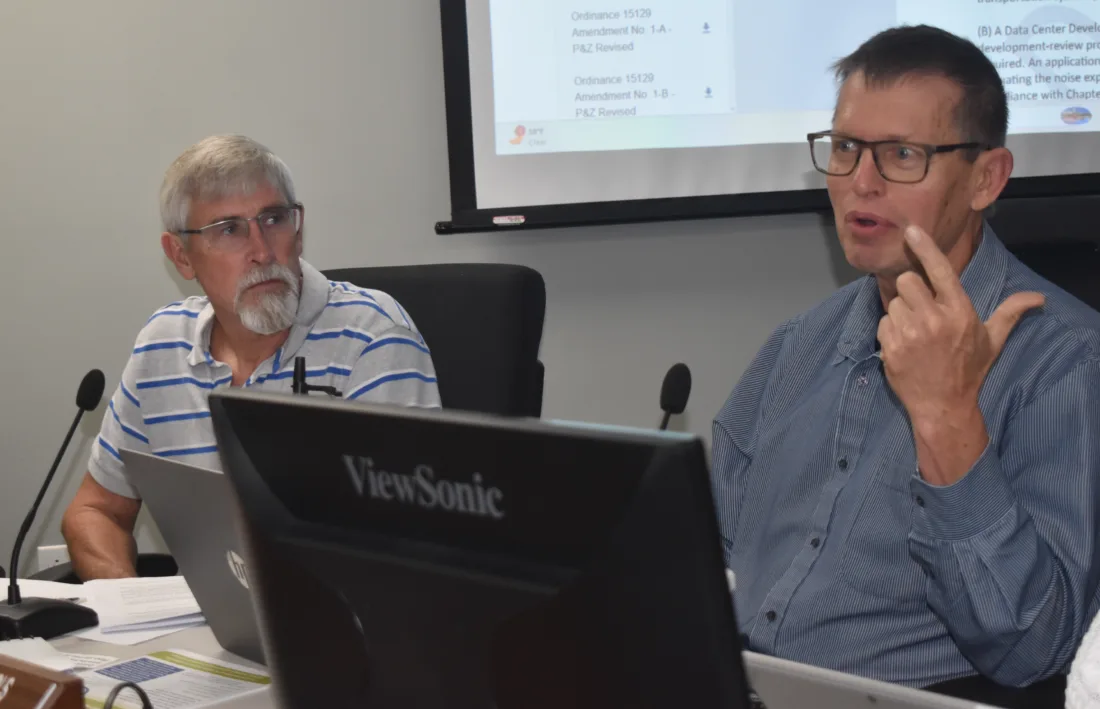
T-R PHOTOS BY ROBERT MAHARRY Marshalltown City Councilor Greg Nichols, right, speaks about the widespread for data centers during Monday night's city council meeting as fellow Councilor Mark Mitchell, left, listens.
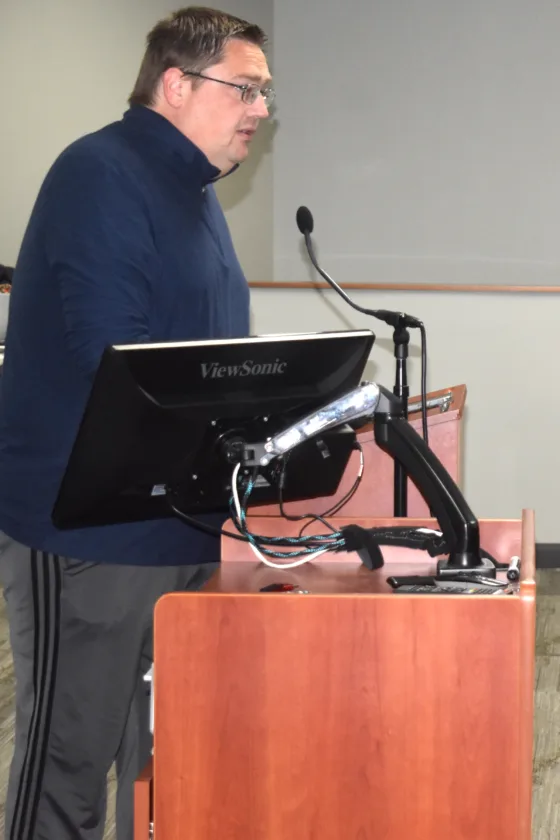
Fairfax City Councilman Dan Wozniak, who attended Monday night's city council meeting along with fellow Fairfax Councilor Cindy Anderson, spoke out against data centers and Alliant Energy during Monday night's meeting. The city of Fairfax has enacted an indefinite moratorium on the projects.
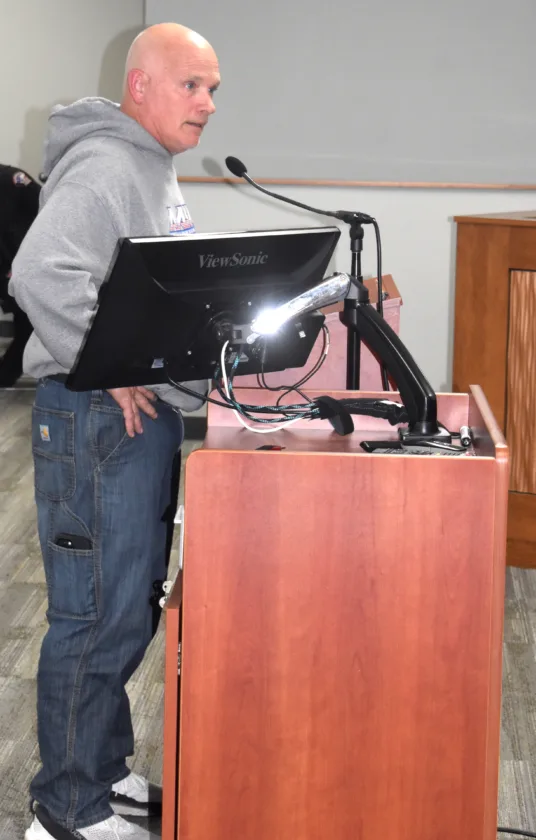
American Aluminum Seating Inc. Owner Jim Palmer speaks about proposed amendments to the city of Marshalltown's data center ordinance during Monday night's city council meeting.
T-R PHOTOS BY ROBERT MAHARRY Marshalltown City Councilor Greg Nichols, right, speaks about the widespread for data centers during Monday night's city council meeting as fellow Councilor Mark Mitchell, left, listens.
Fairfax City Councilman Dan Wozniak, who attended Monday night's city council meeting along with fellow Fairfax Councilor Cindy Anderson, spoke out against data centers and Alliant Energy during Monday night's meeting. The city of Fairfax has enacted an indefinite moratorium on the projects.
American Aluminum Seating Inc. Owner Jim Palmer speaks about proposed amendments to the city of Marshalltown's data center ordinance during Monday night's city council meeting.
Trending
(Editor's note: This is the second in a series of stories regarding Monday night's Marshalltown city council meeting and the ongoing debate around data centers and the proposed regulations to govern them.)
After a lengthy public hearing with an overwhelming majority of speakers either calling for stricter regulations or an outright ban on data centers within the Marshalltown city limits, the council considered a number of amendments to the proposed zoning ordinance, narrowly approving some and narrowly rejecting others with several 4-3 votes.
Councilor Marco Yepez-Gomez moved to remove "by right" administrative approval within the data center overlay district completely from the ordinance and require special use permits, which are authorized by the Board of Adjustment, for all proposals. First, however, the council voted on the Planning and Zoning Commission's recommendation to lower the threshold triggering a special use permit requirement to less than 40 acres and a one-story building.
Councilor Gary Thompson, citing the intense controversy around data centers, said he had a problem with shifting the decision for approval to the volunteer Board of Adjustment as he felt the council itself should be accountable to the public.
Yepez-Gomez pointed out that special use permits are common for expansions at other major local businesses like JBS and Lennox in arguing his case against allowing administrative approval for data center projects.
"We're doing something unique here where we're taking away the public hearing that the public is entitled to right now," he said. "We're trying to do this by right, which is really, really strange for a development of this size."
He also cited the example of a potential annexation of land into the city for a large data center project, but Mayor Mike Ladehoff noted that any annexation is subject to council action.
"I've never heard anyone say 'Hey, take my public hearing away from me.' I haven't heard that from anyone, so I'm not sure why we're doing this," Yepez-Gomez said. "It should be, at minimum, a special use permit."
Once the amendments and the annexation process were further clarified, Councilor Greg Nichols weighed in on how much everyone in the room utilizes data centers, holding up his cell phone as a prime example.
"Anybody have one of these things?" he asked. "Almost every app you open on this, I've found, has a data center backing it... I swipe my credit card, open an app on my cell phone, anytime I check my email, use (Microsoft) Word, I don't know who's a gamer, (if I) post anything on the cloud, any social media, they're all using data centers."
"But it's not in your backyard," a member of the audience replied.
"Oh, it's in somebody else's backyard, and that doesn't matter," he retorted.
With the crowd getting louder and one attendee even asking Nichols how much he'd been paid, Ladehoff banged the gavel in an attempt to get the situation under control. The councilor reiterated his argument that many of the people opposed to data centers used them regularly when they post to social media or use other smartphone apps. Yepez-Gomez's amendment to remove the overlay district failed with himself and Councilors Melisa Fonseca voting in favor, and another amendment to reduce the special use permit threshold from the P&Z's 40-acre recommendation down to 20 acres failed by the same tally.
After Fonseca asked Ender for a breakdown of the proposed data center overlay district, which is all along the eastern edge of town (Wards 1 and 4), she asked her fellow councilors if they would consider the preferences of the councilors in those specific wards -- herself and Yepez-Gomez.
"If we are saying that this data center overlay is not necessary right now, would you guys consider that? Because it doesn't seem like a positive thing right now for the community. I can't get away from it, and we have seen it here and heard about it. And it's not feeling well. It's not feeling good for the community, so if we could please consider that as I have considered many things in specified wards of fellow council members," Fonseca said.
Thompson added that he didn't understand the overlay district and why some locations were permitted by right as opposed to special use permits. His suggestion was to either remove it entirely or expand the overlay into the entire general industrial district, and he responded to Fonseca's comment by noting that as at-large councilors, he, Jeff Schneider and Sue Cahill take calls from all wards.
The original amendment to set the special use threshold at 40 acres and two or more stories passed 4-3 with Schneider, Thompson and Cahill opposed. The next amendment dealt with setbacks and proposed setting the figure at 600 feet from "sensitive uses" for developments under 40 acres on a single story, and raised the setback to 1,500 feet for anything 40 acres and above and/or two or more stories in height.
P&Z Commission Chairman Jon Boston said the proposed amendment didn't make sense to him, and Schneider called it a "poison pill" that he would oppose. Conversely, Yepez-Gomez argued that building setbacks are not changed from general industrial zoned areas already in place and said there had been "a lot of misinformation." The amendment failed by a 4-3 vote with Fonseca, Mitchell and Yepez-Gomez in favor, and the next proposed amendment failed by the same margin.
The council then moved on to a trio of amendments proposed by Mitchell, all of which ultimately failed. The first pertained to requiring a decommissioning plan, which he said was even recommended by Google AI, and he called out P&Z Commissioner Steve Valbracht for removing the language from the ordinance the council was now considering in opposition to the will of the people.
City Attorney Steve Leidinger advised the council of comments in his memo with respect to the amendment, which he later said were protected by attorney-client privilege and could not be made public unless a councilor chose to do so. Leigh Bauder, who has repeatedly advocated for the amendment Mitchell proposed, expressed a desire to avoid another old hospital situation if a data center shuts down.
She also said that some wealthy investors are backing away from data centers due to the midterm election results, and Layne Pieri asked for more information on the legal opinion Leidinger provided, which the attorney said was privileged and confidential. Cahill asked if the decommissioning plan would apply to all businesses in Marshalltown, and Ender said it would only apply to data centers.
"I guess, then why do we bring up the hospital? It wasn't a data center, so we had no view of that happening and us being in the position that we were," Cahil said. "Who would've thought, 50 years ago, when the hospitals were in town, that there would be an issue? And again, it wasn't the hospital. It was a further developer."
Mitchell countered that the council should learn from past mistakes and implement the decommissioning plan.
"It's time we start listening. We don't have the money coming out of our back pockets," he said.
Marshalltown Area Chamber of Commerce President/CEO John Hall contended that even if a data center does close down, it didn't necessarily make sense to require that it be torn down, citing the city's limited existing assets in terms of land and buildings. He added that the owners of a standing building would still be required to pay property taxes as opposed to going back to a vacant site.
Fairfax City Councilwoman Cindy Anderson shared support for the decommissioning clause, noting the rapidly evolving technology and the prospect that a company could declare bankruptcy and simply stop paying taxes.
"You are dealing with trillion dollar companies. Put that onus on them. Don't assume that you have to pay their bills because they decided to leave your town. This is the time to think outside the box. This is the time to put new rules in place, and you guys have that power," she said. "You guys need that language. You need that choice, and the other thing that I will say -- you need to listen to your people because... ultimately, your people have to live with this. I have to live with data centers that I didn't even know were coming because I don't live in that town."
Boston spoke next and said that unlike a wind turbine, a defunct data center building could have many potential uses, and Jim Palmer didn't feel that requiring the whole building to be torn down made sense.
Mitchell and Ender clarified that the amendment wouldn't necessarily require a full demolition if an adaptive reuse was presented. Yepez-Gomez told the council he would like to incorporate Leidinger's recommendations, which prompted another legal issue as he began to read his proposed amendment.
"I can't force any of you not to break privilege. However, if he makes this comment, it will break the council's privilege," Leidinger said.
From there, Yepez-Gomez proposed an amendment to revise the financial assurance "equal to 100 percent of the reasonable estimated third party cost of decommissioning and site restoration and to permit a reversible letter of edit, surety, bond or other form of security approved by the city attorney in lieu of cash." He explained that it was basically a bond covering 100 percent of the cost with a third-party estimate. The amendment failed by the same 4-3 tally with Fonseca, Mitchell and Yepez-Gomez in favor.
The original unamended decommissioning requirement failed by a 5-2 margin with only Fonseca and Mitchell in favor, and Ladehoff then called a 10-minute recess over 2 ½ hours into the meeting.
Contact Robert Maharry at (641) 753-6611 ext. 255 or rmaharry@timesrepublican.com.