
Marshalltown city council extends data center moratorium, narrowly votes to advance full ban

Longtime Marshalltown firefighter Marc Grant, left, was honored for 25 years of service during Monday night’s city council meeting. He is pictured alongside Marshalltown Fire Chief Christopher Cross, right.
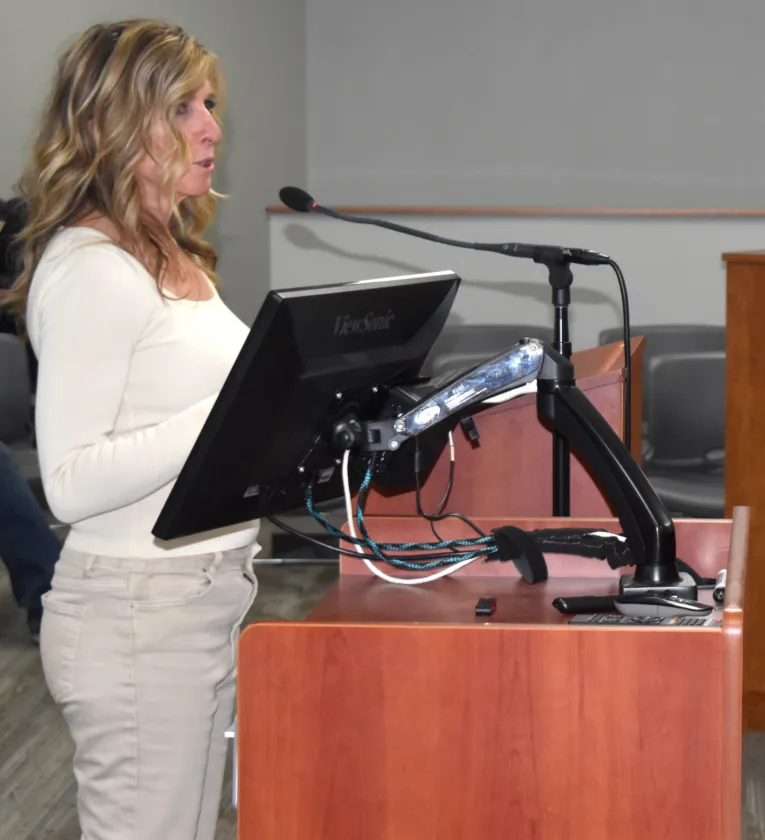
Laura Fricke was one of many Marshalltown residents who spoke in favor of extending the data center moratorium by 60 days during Monday night’s city council meeting. The council voted unanimously to do so and later voted 4-3 to proceed with a new ordinance that would ban data centers outright within the city limits.
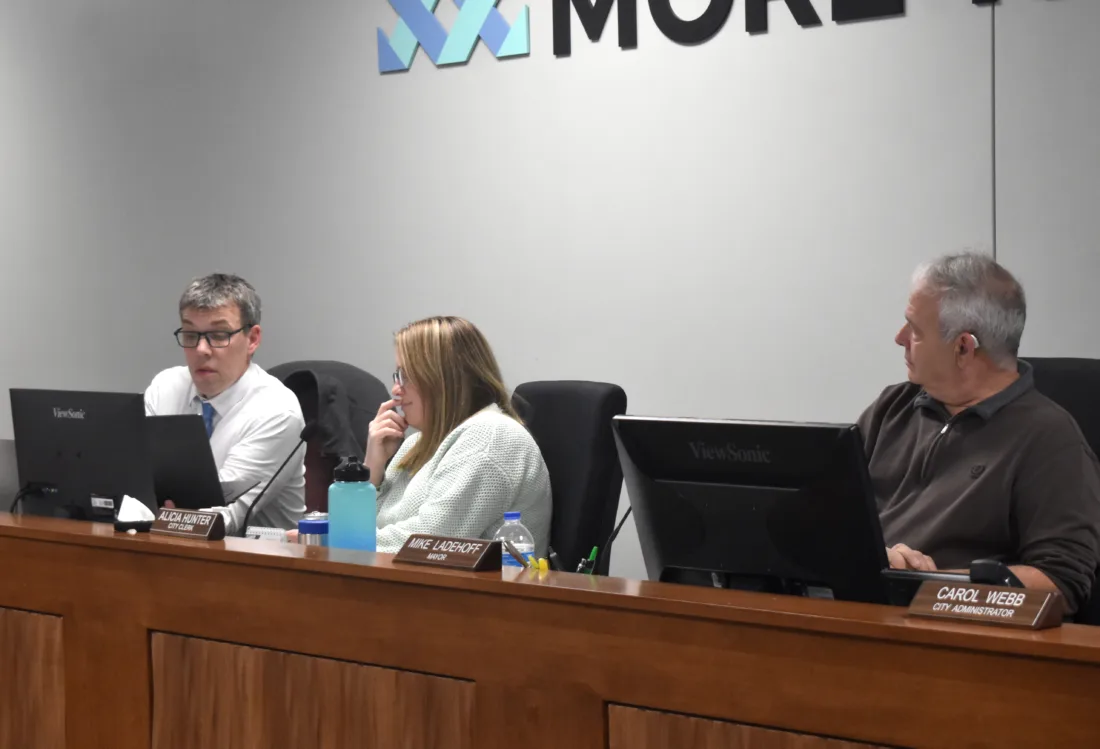
T-R PHOTOS BY ROBERT MAHARRY Marshalltown City Attorney Steve Leidinger, left, reviews the temporary moratorium ordinance while City Clerk Alicia Hunter, center, and Mayor Mike Ladehoff, right, look on during Monday night’s city council meeting.
Longtime Marshalltown firefighter Marc Grant, left, was honored for 25 years of service during Monday night’s city council meeting. He is pictured alongside Marshalltown Fire Chief Christopher Cross, right.
Laura Fricke was one of many Marshalltown residents who spoke in favor of extending the data center moratorium by 60 days during Monday night’s city council meeting. The council voted unanimously to do so and later voted 4-3 to proceed with a new ordinance that would ban data centers outright within the city limits.
T-R PHOTOS BY ROBERT MAHARRY Marshalltown City Attorney Steve Leidinger, left, reviews the temporary moratorium ordinance while City Clerk Alicia Hunter, center, and Mayor Mike Ladehoff, right, look on during Monday night’s city council meeting.
Trending
(Editor's note: This is the first in a series of stories about Monday night's city council meeting and the ongoing debate over data centers in Marshalltown.)
The ever-controversial discussion over data centers in Marshalltown took another new turn during Monday night's lengthy city council meeting, which clocked in at nearly 4 ½ hours, as the council voted unanimously to extend its current moratorium by up to 60 days and, later in the night, voted 4-3 to take the first steps toward a permanent ban on the facilities after Councilor Gary Thompson reversed his previous position, citing public feedback on the matter.
With a packed house including many attendees holding anti-data center signs in their seats, the tone for the night was set early as Marshalltown Area Chamber of Commerce President/CEO John Hall, during the initial public comment period, decried what he had witnessed during the last city council meeting as going "beyond disagreement" into accusations about motives and allegations about character.
"Nobody here is getting rich off of this. Nobody is here for an easy night. In almost every case, people are giving something up to be here because they want Marshalltown to be a healthier, better, stronger place to live," he said. "We may have very different ideas about how to get there, but we are pointed at the same destination. When we forget that, we stop debating ideas and start questioning each other's hearts. That's when good people stop running for office. That is when talented staff leave. That is when residents decide it isn't worth showing up, and that is a loss for all of us no matter which side of an issue we're on. So my ask is simple. Keep disagreeing, keep asking hard questions. Hold each other accountable, but do it assuming the person across from you loves this community as much as you do because in my experience, they almost always do."
Conversely, Layne Pieri, who launched the Marshall County Data Center Moratorium Facebook page (now known as the Civic Analysis Bureau), contended that the council shouldn't be afraid to say no to data center development.
"People who never thought they'd spend their evenings at city council meetings are showing up. They're reading ordinances and asking questions. They're talking to their neighbors and they're getting involved because they care about what happens to their home. And that gives me hope," he said. "So as we're making decisions about Marshalltown's future, I don't want us making them out of fear. Not fear that we'll lose an opportunity or businesses won't come, not fear that we won't have enough money, not fear that saying no today means nobody will ever ask Marshalltown again. Marshalltown has faced harder things than a missed opportunity, and through all of those trials, what carried this community forward wasn't one building, one business, one industry or one investment. It was us. So whatever decisions we make here tonight, make them because they're right for Marshalltown and the people who call it home. Don't make them because you're afraid of what happens if we say no. Have enough faith in Marshalltown to believe that we'll be OK if we do."
After honoring longtime firefighter Marc Grant for 25 years of service and moving through several routine business items, the council considered the first major data center-related item of the night -- extending the current moratorium, which was set to expire on Monday night without council action.
Under the wording of the moratorium in place, it can be extended once by 60 days -- until Jan. 22, 2027 -- or until the new ordinance is passed and takes effect after publication. Councilor Marco Yepez-Gomez motioned to remove the second trigger and extend the moratorium 60 days regardless, and the council then heard from a slew of public commenters, almost all of whom favored the extension either temporarily or permanently.
April Long said prospective developer Swarm Systems had not actually completed any projects and that Marshalltown would be the "guinea pig," arguing that the current proposed regulations were not strong enough to protect the community. She also accused Mayor Mike Ladehoff and "at least two council members" of abdicating their duties to the citizens and acting as agents of Alliant Energy and Swarm Systems based on emails obtained through Freedom of Information Act (FOIA) requests revealing correspondence between Ladehoff and representatives of Alliant.
Other commenters raised concerns about the proliferation of artificial intelligence (AI) and water pollution, and Councilor Sue Cahill then asked for a point of order on whether attendees should be allowed to hold signs in the audience. City Administrator Carol Webb did not believe there was a formal policy, but Ladehoff discouraged the use of signs, contending that council meetings were not "town forums" or "soccer games."
"Respect is a two-way street, but this is a business meeting for the Marshalltown city council," he said. "I don't think displays are appropriate, and I hope that you follow that advice."
The public comments continued with citations of general opposition to data center construction, needing more time to develop regulations, uncertainty over the property tax revenue projections, potential for the AI bubble to burst, long-term detrimental effects akin to radium and microplastics and concerns that the technology could become outdated and leave Marshalltown with large vacant buildings.
Hall noted that, in contrast to the commenters who claimed the process had been "rushed," the issue had been discussed repeatedly since his birthday on June 22 and compared the situation to the film "Groundhog Day."
"Perhaps what's most frustrating is, again, it's the same rehashing of the conversation that we've had over and over and over," he said.
He ultimately asked the council to extend the moratorium regardless because the third reading of the new ordinance was not set to pass until the next meeting. Larry Ginter of rural Rhodes called out the city for looking at the issue as a matter of pure dollars and cents and added that the U.S. already has nearly 10 times as many data centers as China, invalidating the claim of needing to win the "AI War." Vicki Weaver warned of the negative effects data centers can have on autistic people like her great-grandson, and City Clerk Alicia Hunter read several written comments afterwards.
One, from Planning and Zoning Commission Member Patrick Streit, who abstained from voting on any of the data center related items due to a stated potential conflict of interest, contended that many of the regulations P&Z was asked to weigh in on were outside of the commission's scope, which is focused on land use. He took the city council to task for its handling of the matter and called for more public meetings and open houses.
"My main concern is simply that you have not sold the public on these regulations. If you think these regulations are a good idea, you should have put the extra work in to sell it to the people. If you have a room of angry people in front of you, some of them will never agree on whether data centers should be built, but please empathize with them and address their concerns. They should at least feel like they have been heard," Streit wrote.
The remaining written comments favored extending the moratorium, and finally, Amber Lawthers came to the speaking podium and expressed the same position.
"It is better to take our time and do something right rather than to jump into the deep end before we even learn how to swim," she said.
Despite City Attorney Steve Leidinger advising against it based on his own legal interpretation, Yepez-Gomez's amendment to remove the passage of the ordinance as a trigger for ending the moratorium passed by a 4-3 vote with Councilors Cahill, Jeff Schneider and Greg Nichols. The amended motion to extend the moratorium passed by a unanimous 7-0 vote.
In other business, the council:
Approved the consent agenda as listed.
Approved the appointments of Robert Proffitt and Matthew Vogeler to the Stormwater Advisory Committee.
Appointed William Scott McLain to the Board of Adjustment.
Appointed Jim Johnson to the Building Board of Appeals by a 6-1 vote with Mitchell opposed.
Adopted the 2027 City Council Goal Setting Report.
Contact Robert Maharry at (641) 753-6611 or rmaharry@timesrepublican.com.