
Possible financial challenges ahead for county conservation
Trending
Marshall County Conservation could have some financial problems in the future if issues with funding sources are not worked out. Changes made by the Iowa Legislature to property taxes are impacting county departments.
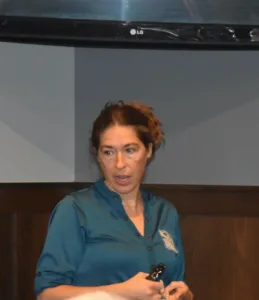
Director Emily Herring was the speaker at the monthly Marshall County Democrats Tuesday Talks at Legends and addressed the funding challenges that lay ahead.
"Many counties over the last couple of years have seen significant cuts," she said. "Hamilton County had to cut two positions this last fiscal year and they were told to expect to cut two more. They are losing their naturalist and natural resource manager."
The smaller and the bigger counties are the ones primarily struggling with the tax changes.
"We currently are OK," Herring said. "I think it might just be because we are happy-medium in size. All of the other directors are freaking out. On the good side, we're not seeing gigantic cuts, but we've been underfunded since square one."
If Marshall County Conservation has to face major cuts in the future, she said it will have to be taken from staff, since it takes up the vast majority of the budget.
With seven people, the department manages more than 3,400 acres across 38 parks, including ones within unincorporated towns, and maintains trails, prairies, river accesses, recreational and educational opportunities and outdoor training facilities.
"We have the highest number per acre to staff ratio in the state," she said.
Herring said the department relies on state and federal funding. At the federal level, DOGE [Department of Government Efficiency] hit certain agencies, such as the Environmental Protection Agency and the U.S. Forest Service, very hard.
"If you think that's the federal level and doesn't affect you, well it does affect us because a lot of our grants are federal grants," she said. That money from DOGE was cut and [when] those organizations were cut, it trickled down to us."
So, they are not sure if federal grants the Marshall County Conservation usually receive will even be available. When DOGE began, Herring recalled it as a scary time because they had been approved for grants and had already started the pertaining projects. Fortunately, "so far, so good," she added.
At the state level, there is the Iowa Department of Natural Resources (DNR) whose budget is determined by the legislature and relies on state and federal taxes. The DNR has seen several cuts during roughly 10 years, she said.
At the county level, Herring can create a budget, present it to the Marshall County Conservation Board and get it approved, but Marshall County Board of Supervisors might make cuts.
"Most of our general operation funds comes from the county taxpayers," she said. "Salaries are 90 percent of my budget from the board of supervisors. Technically, they say we usually get a 2 percent increase. For the rest of my budget, a 2 percent increase last year was $9,000. It makes it hard to be able to buy a new vehicle if it's broken down."
Funding programs
Herring focused on two funding programs – REAP (Resource Enhancement and Protection) and the Iowa's Water & Land Legacy (IWIILL) fund.
Herring said that upon REAP's creation in 1989, it was determined the maximum amount of annual funding the program could get would be $20 million, and it has never been fully funded. She said it is usually around $13 million to $15 million, and continues to shrink. This year, it was $12 million.
"There is a sunset date, a date when this program is supposed to end," Herring said. "We have for multiple years voted to keep REAP going, even though it's not been fully funded. In June of 2028, it will expire again. The county conservations and Iowa Natural Heritage Foundation has brought this to legislation to try to get it renewed and it has not been. We're getting to the point of concern that it might not get renewed."
The other program – IWILL – has not even been enacted yet. Created in 2006 by the legislature, it takes three-eighths of a penny from the next sales tax increase for an estimated $187 million fund annually to give to public health, water quality, trails, REAP, lake restorations, rural revitalization, economic development and more. Herring said it was approved twice by the legislature and as a constitutional amendment, it was approved by 63 percent of Iowa voters in 2010. However, the legislature has not raised the sales tax in more than 20 years.
"Now we sit here, 20 years later and it still hasn't happened," she said. "It has sat empty ever since. . . . We haven't had that tax increase. . . . We've been pushing the last 20 years for it to go through."
One argument against enacting IWILL has been that voters approved it two decades ago. An ongoing survey has found, so far, 67 percent of Iowa voters support IWILL and want to see it enacted.
Herring said there is also speculation that the reason IWILL has not been enacted are some "major players" believe the money will be used for land acquisition, even though conservation departments cannot afford Iowa farmland.
"I think what we're going to see here is with the current tax restrictions, the only way to increase tax is the sales tax," she said. "It will be interesting to see how it moves forward."
When IWILL was created, Herring said an equation was made to determine how much of the money each category would receive each year. However, there is a catch.
"It was a constitutional amendment for three-eighths of a penny, and the equation was not part of the constitutional amendment," she said. "Whoever is in the legislature will set the equation"
Two years ago, some legislators tried introducing a constitutional amendment to remove IWILL. Herring said it would have to go through the same process as the implementation – approval twice by the legislature and voter approval.
"We're hoping someday this funding will come to fruition, and if it does, we're going to have a facility master plan which allows us projects we can put funding toward," she said. "We ask people to talk to their legislators. . . . Honestly, I think it is something that will happen sooner rather than later, not necessarily because they support the project, but because they won't have an option with the tax situation."
Contact Lana Bradstream at 641-753-6611 ext. 210 or lbradstream@timesrepublican.com.