
Trending
By NANCY ADAMS
This is the 13th and final installment in a series of ARTicles featuring the artists and restored artworks currently on display in the Fisher Art Museum at the freshly renovated Marshalltown Arts & Civic Center (MACC).
Approximately half of the Fisher Art Collection is now on view while the others rest in climate-controlled storage. In 2025 the exhibit will be changed out, with the remainder of the collection then exhibited. A similar series of ARTicles will accompany that show.
In 1958, Bill and Dorothy Fisher gifted Marshalltown an extraordinary legacy; a stunning mid-century modern community center and a world class art collection highlighting the late 19th and early 20th centuries.
After 55 years, the community center and collection were both in need of restoration. In 2017, with the full support of the Fisher Family and the Fisher Governor Foundation, committees were formed to write grants, digitize records, reach out to organizations and individuals for funding, and hire technical experts and consultants.
An on-site evaluation of the collection was completed the day before the EF3 tornado devastated the north side of Marshalltown and the appraisal of the collection was completed in 2018. A total of 44 artworks, (paintings and sculptures) were chosen for restoration.
In July 2020, the Chicago Conservation Center retrieved the identified works. The very next month, the community center, and much of Marshalltown, was decimated by a derecho.
Restoration of the art was completed in 2021, and the Fisher Art Museum opened in September 2022.
Today's featured artist is the Danish/American sculptor and teacher, Christian Petersen.
Petersen was born in Dybbol, Denmark on Feb. 25, 1885 and emigrated with his family to the United States in 1894. Initially settling near Paxton, Illinois, they eventually moved to Newark, New Jersey, where he completed his compulsory education. He continued his education at the Newark Technical School where he learned the basics of die-cutting and sculpting, and then apprenticed with sculptor Henry Hudson Kitson.
At the start of the Great Depression, at the urging of artist Grant Wood, Petersen moved to the Midwest to participate in the federal Public Works of Art Project (WPA) and worked for a time with Wood at the WPA headquarters in Iowa City. Through a WPA commission for the Dairy Industry Building at Iowa State College, (now Iowa State University-ISU), in Ames, Petersen became acquainted with the college president, who ultimately appointed him Sculptor in Residence in 1935.
This was the first known permanent artist residency at any U.S. college or university. Petersen's sculptures were completed in the Neoclassical Style (symmetrical, proportioned) and Beaux-Arts Style (architectural and decorative), both of which were commonly used to depict national figures and convey national morals. There are some gestures towards modernism in his reliefs, though in general he preferred traditional renderings.
Petersen eventually became an associate professor at ISU, and retained his residency at ISU until retiring at age 70, in 1955. His artistic legacy is visible throughout the grounds of ISU and many of his sketches, drawings and sculptures are housed in the Christian Petersen Art Collection in the Morrill Building on campus.
In his personal life, Petersen was twice married and had 4 children, the youngest of which passed away in Feb. 2024. In 1949, he converted to Catholicism, and for the next decade or so, created a number of religious works of art, many of which were commissioned by churches and schools in Iowa.
Here in Marshalltown, we are fortunate to have four Christian Petersen sculptures. At the MACC.
Upon entering the beautiful grounds, the first piece you will encounter is actually his final work, a monumental bronze sculpture commissioned by Bill Fisher in 1959, titled 'Dedication to the Future'. The centerpiece of the beautiful pond, Petersen never saw the work installed, as he'd authorized a final casting of it just 4 days before he died on April 4th, 1961. Of this scultpure, Petersen said: 'We lift up our youth to see beyond that which we cannot see'. Around the base of 'Dedication', you will also note the 'Four Seasons', bronze sculptures by French artist Georges Oudot. Bill Fisher commissioned these in 1963 and they were installed in 1965.
Once inside the building, in the Fisher Art Lounge, you will see a Petersen bronze bust of Bill Fisher. Completed in 1959, it was gifted to the center by Mrs. F. Edna ('Gramma') Fisher, Bill's mother.
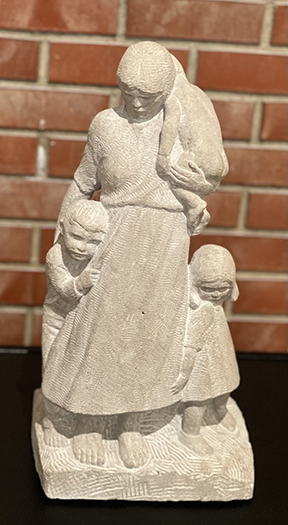
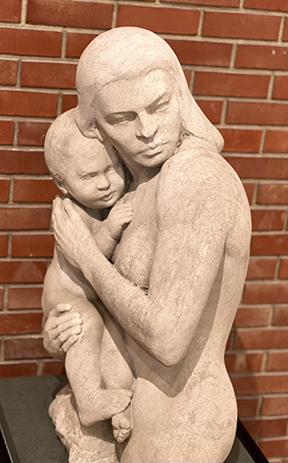
And lastly, tho certainly not least, are 2 sculptures by Petersen currently exhibited in the Fisher Art Museum. Both depict mothers protecting their children as best they can, from natural and man-made disasters.
Mountain Mother, c. 1939, was sculpted after he saw Kentuckians flooded out of their homes, and War, c. 1940, depicts a mother shielding her child from Hitler's blitzkrieg through Europe. Each of these powerful works were carved from Bedford limestone, and are reflective of Petersen's preferred genre. The latter originally belonged to Martha-Ellen Tye, Bill Fisher's sister.
In addition to being a sculptor and a teacher, Petersen was the illustrator for a children's book about the Mesquakie (the spelling they used then). Written by Halla Rhode and Bessie Coon, CHA-KI-SHI was published in 1936 by Charles Scribner's Sons. To learn more about the book and Petersen's experience with the process, check out the following link: https://universitymuseums.pubpub.org/pub/y1bzei30/release/1.
Christian Petersen was captivated by middle America. Celebrating that which we might take for granted. As he stated:
"Here in the midwest, I felt folks would be more natural, and I have found it to be so in the main…So judge for yourself. Create an American art, here in the rich soil of the middle west, where America has its roots. Here shall be the soil and the seed and the strength of art."
To experience several his sculptures, visit the MACC, and bring a friend! Call 641.758.3005 or visit www.maccia.org for more information.
Nancy Jeanne Adams is a member of the Fisher Art Museum Committee.