
Burt Walters retires as conservation officer
Iowa Conservation Officers (game wardens) are part of a long line of specialized law enforcement folks who are professionally trained regarding all aspects of the laws and regulations pertaining to hunting, fishing, trapping, and natural resource protection. In addition, the job can be very satisfying most of the time, or not easy at other times when having to deal with realities of human behaviors (good and bad) that go along with our society.
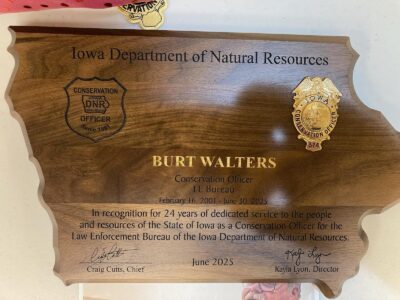
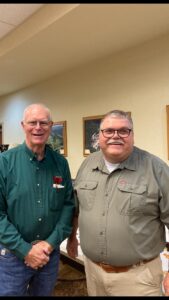
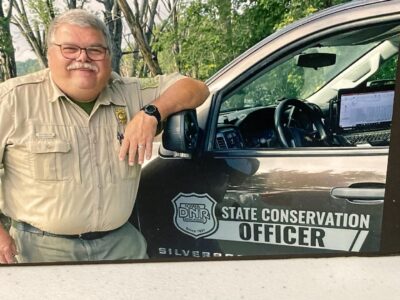
Burt Walters fit the job very well and conducted his tasks professionally and firmly. He garnered great respect from all of his contacts.
Every conservation officer that the state of Iowa’s Department of Natural Resources assigned to the Marshall-Grundy territory came into contact with our local County Conservation Board. That list of conservation officers is a long list of great people, many who have since retired after their service.
As a former Director of the Marshall CCB, my office would get calls about things pertaining to state regulations. Notes were taken and then passed on quickly to the game warden. It was always a cooperative venture with game wardens. Why?
Primarily because the local Marshall CCB would inevitably receive calls plus information and tips about potential bad things going on in the fishing, hunting and trapping related activities happening in the outdoors. From the public’s point of view, they needed to call someone, without regard to the specific separation of county or state jurisdiction.
Burt Walters came to the Marshall/Grundy County area in 2001. One task that I enjoyed in our cooperative ventures was helping to orient new conservation officers to the land areas they would be patrolling. Every wetland, pond, river access point both public and private, public hunting lands and specific private lands of interest were duly noted so as to become familiar with the places Walters may have to patrol.
A special treat was to take any game warden on an airplane ride to provide them with a big picture view. It helped them learn the landscape quickly before they would interact with people on the ground.
Walters graduated from MarMac High School in 1981. From 1981-82, he served as reserve deputy with Clayton County Sheriff’s Department. His next move was from 1982-84 as Police Chief for the City of Marquette.
From 1985-1996, he moved on to the Monticello Police Department, where he served as an investigator, was promoted to Sergeant and, from 1989 to 1996, he was that city’s police chief. He had part time-work with Dubuque County and, when he attended the National Park Ranger Academy at Hocking, Ohio in 1996, graduated and was named Valedictorian. What followed was a stint at Effigy Mounds National Monument (Park Service).
From 1996-1999, Walters obtained a Bachelor of Science degree at Upper Iowa University, a four-year task he completed in three years. His degree was in conservation management and criminal justice.
Next in line for a job was at Dyersville Police Department from 1997-2001. He also worked in state DNR Waters Aid duties from 1998-2000.
Then in 2001, as the newly minded game warden, he came to the Marshall/Grundy county area. Special tasks he accomplished included swift water rescue, and ice water rescue as an instructor.
He also held Field Training Officer functions and a special detail as Iowa DNR Honor Guard. He also served as an instructor for the Iowa DNR Academy for reptiles, game warden history, and native plant protection/enforcement.
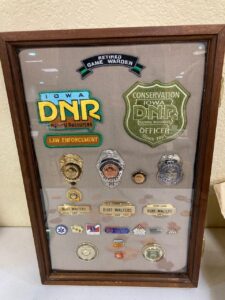
If one adds all these experiences up, a total of 44 years in law enforcement was achieved with the last 24 years in conservation officer functions. His retirement was well earned. Congratulations Burt Walters for being a great friend and a great role model for professional conservation law enforcement duties.
———-
Here are some general things the public may not know about conservation officers (game wardens). It is a special segment of law enforcement in which one’s education, training and interests in natural resources are combined.
They play a critical role in preserving our natural heritage. Obtaining compliance with conservation laws and regulations is co-mingled with wildlife management and recreational pursuits. Having the correct mind-set to be good in the game warden career field requires a host of hurdles to cross successfully.
Educational background minimums typically require a BS degree in natural resources, wildlife ecology, biology and perhaps even working to obtain a double degree in criminal justice. With those credentials in hand, the next steps entail more education as time and funding allow to broaden the scope of a candidate’s resume.
Understanding the legal framework governing wildlife protection through criminal justice and law courses is essential. Add to this the physical aptitude and psychological aspects of law enforcement need to be accounted for. All this is to ensure the candidate is going to be a correct fit for the job.
One more detail to take note of: The number of persons who may aspire to become game wardens is way larger than the actual openings that may become available. So this quote from an unknown source says it well.
“Long-range goals keep you from being frustrated by short-term failures.”
Obtaining interviews with state conservation officer supervisors or other hiring authorities becomes an important part of learning how and when openings become available. It takes time, but if the candidate has the right stuff, the goal is worth the effort. Since time marches on, and everyone has another birthday, older and well experienced conservation officers retire.
They take a lifetime of experiences and knowledge with them. New hires have a big job to “catch up” on training and all the insights from older officers about what works and what does not.
Training after being hired requires attending the state law enforcement academy. Game wardens are peace officers. They take the same basic training to become certified.
Then a new game warden goes through an additional training regime with other conservation officers who assist with learning the ropes of what it takes to conduct a wide range of duties. At any time during this long process, the candidate must pass the test, test after test, in an almost endless list of things to know.
Even then, there will be continuing education workshops or courses, even advanced law enforcement courses of investigation techniques and methodologies, and repeat certifications. In a more simple summary of conservation officer careers, training never stops. Education never stops especially after those initial college degrees have been earned.
And lastly, these types of careers come with this exciting and sometimes not so pleasant reality — you will be on call 24 hours a day, seven days a week, and every holiday for the public means you are likely to be working. Now try to work that career into a family with children and
their school activities and you soon see how ‘time off’ is a rare thing. All of this is just so that you know before you go what the tasks of a conservation officer/game warden entail.
Across the nation, there are conservation officers in every state who are dedicated to the tough jobs they need to do. The fact that they are dedicated is amazing in itself.
I personally salute all of them for their tireless efforts to hold the line, reward good deeds where appropriate and arrest the bad guys anytime and anywhere. Conservation of natural resources is not a hands off thing.
An informed and educated public are extra eyes and ears to assist conservation officers in their work. Sportsmen and women who legally conduct themselves by following the law and using ethical standards that go above and beyond legal are a great tribute to North American conservation efforts.
————–
Garry Brandenburg is the retired director of the Marshall County Conservation Board. He is a graduate of Iowa State University with a BS degree in Fish & Wildlife Biology.