Faux history has its eyes on you
History is making headlines for all the wrong reasons
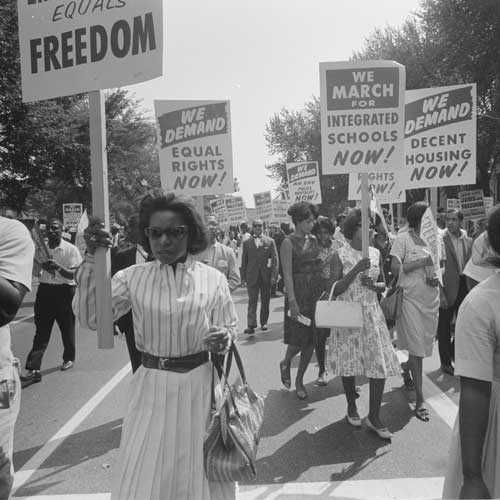
CONTRIBUTED PHOTO — The civil rights March on Washington in 1963.
Years ago, I chose a defining fork in the road and applied to graduate school. As I anxiously awaited acceptance in the University of Missouri-Columbia’s School of Journalism, it was my good fortune to snag a summer job at the State Historical Society of Iowa in Iowa City.
As a northwestern Iowa native, living and working in clear view of the beautiful Old Capitol landmark broadened my sense of state history. Just think, in 1857 our fledging Legislature had the foresight to prioritize the creation of the State Historical Society of Iowa! As someone who loved both history and genealogy, the library at 402 Iowa Ave. was a treasure trove.
Today I live much closer to the State Historical Society of Iowa built in 1987 in Des Moines, and I was dismayed to learn in June of staffing cuts at both locations and the abrupt decision to shutter the Iowa City branch by 2026.
I should have seen it coming. Remember in 2023 when Gov. Kim Reynolds rammed through a reorganization of state government, reducing 37 cabinet level-agencies to 16? The State Historical Society of Iowa lost its autonomy, and was placed beneath the Department of Administrative Services, which received one-half of its requested funding this year. The Research Library requires only a miniscule portion of the budget, yet it was deemed a financial drain and “duplicative.”
Plans are underway to move 40% of the research library’s collection to Des Moines this month, but due to space constraints, a new home is being sought for the remainder.
The “Annals of Iowa,” an academic journal edited and published by the state for 163 years, also now is looking for a new home. Although it basically was self-supporting, the decision was justified as a staffing issue.
A Change.org Petition to Save Iowa History 2025 has garnered 7,008+ signatures to date.
Required whitewashing?
This history-making-headlines moment in Iowa is a bellwether for the current upheaval of our national history. In observance of our country’s 250th anniversary this year, the Trump administration wants the Smithsonian to “celebrate American exceptionalism” by “removing divisive or partisan narratives and restoring confidence in our shared cultural institutions.”
The Smithsonian Institute’s Board of Regents is being required to conduct an internal, comprehensive review of its exhibits and materials and “implement content corrections where necessary.”
The initiative takes aim at eight of the Smithsonian’s 21 museums. Additional museums will be included in a second phase.
Most troublesome is the Trump directive to remove “improper ideology.” Who will be the arbiter of “proper” ideology? Does this mean our history will be whitewashed?
In April, the Department of Government Efficiency (DOGE) terminated National Endowment for the Humanities grants to thousands of groups across the country including humanities councils, museums, historic sites, archives, libraries, educators, and media outlets.
Fortunately, a federal judge has ruled that this abrupt elimination of grants previously approved by Congress was “unlawful” and that a lawsuit by humanities groups can move forward.
However, humanities councils still are operating without their congressionally appropriated funds, and many have already laid off staff and canceled vital programs.
In April, the beloved National History Day competition for high school students was jeopardized by these DOGE cuts. A social media funding campaign allowed the national competition in May to go forward. But the future of National History Day remains uncertain. Its 2026 theme is very timely: “Revolution, Reaction, Reform in History.”
Gaining a foothold in classrooms
Yet against this backdrop of iconic historical resources under siege, a new history exhibit, The Founders Museum, opened inside the Eisenhower Executive Building next door to the White House. It’s a partnership between the White House Task Force 250, the U.S. Dept. of Education, and PragerU.
Ever heard of PragerU? Me, neither. It’s not a university, any more than the University of Okoboji is. It’s a conservative nonprofit founded by conservative radio host Dennis Prager and an associate in 2009, and funded by very wealthy donors. Its business model is 5-minute edutainment videos covering an array of topics. It also has its own PragerU YouTube Channel.
You may recall the “America First” test adopted by Oklahoma to screen New York and California teacher applicants on their wokeness quotient? PragerU created the test.
The Founders Museum features 56 portraits of the signers of the Declaration of Independence, along with 40 AI-generated, animated short videos of these historical individuals telling stories — produced by PragerU. The intent is for these individuals, places, and events to come to life, making history engaging to Americans. No doubt it’s a worthy goal.
However, did President John Adams ever say, “Facts don’t care about your feelings?” Probably not, but his AI character does. Ben Shapiro, a prominent conservative commentator, has used it often, and it’s even become a meme.
Most of us aren’t experts in multiple fields, and therefore we don’t know all the facts. The facts we’re using as our filters and how we source them are critical components.
PragerU maintains that the Signers’ narratives are based on letters, speeches, and original writing. However, the issue goes beyond whether the animated stories are based on historical archives; PragerU’s carefully curated narratives raise the issue of which individuals integral to our history are being left out: People of color? Working class Americans? Alexander Hamilton, an immigrant to the U.S., didn’t sign the Declaration of Independence because he was with the Continental Army in New York at the time.
Another section, titled Ladies of the Revolution, raises my hackles; why not call it: Women of the Revolution? All ladies are women, but does this imply not all women are ladies? Mercy Otis Warren, a woman well ahead of her time, stridently criticized leaders at the Philadelphia Constitutional Convention through her writings. She spoke truth to power. But her words seem watered down in her AI story.
Another section will feature 20 “Major Events,” but it appears incomplete.
The Founders Museum isn’t only available to tourists in Washington D.C. There are plans to take it on the road with mobile museum trucks during this Sesquicentennial year. Schools and state capitols will be encouraged to incorporate The Founders Museum in some way. (Oklahoma and Florida already have approved PragerU’s separate history initiative in their classrooms.)
History: What is it good for?
Why do we need history? Why do the archival resources that form the foundation of history matter?
Plainspoken former President Harry S. Truman once said, “The only thing new in the world is the history you don’t know.”
In fact, history offers lessons with uncanny applications to current events. For instance:
(1) At a Sept. 4 with Health and Human Services Secretary RFK, Jr. ,Sen. Maria Cantwell, D-Washington, presented a chart showing the positive impact of vaccine use in reducing and eliminating infectious diseases in the past century. She pointed out, “You’re basically trying to refute over 100 years of history on vaccines.”
(2) Why was the Insurrection Act passed in 1807 and why are we hearing about it today? How about the Posse Comitatus Act of 1878? The Insurrection Act allows the president to deploy military or federalize the National Guard against Americans in certain cases of emergency or rebellion. The primary exception to it is the Posse Comitatus Act, which generally bars the military from civilian law enforcement.
(3) Why did fluoridization of drinking water became widespread in the U.S. by 1960? It’s been hailed as one of the top 10 public health achievements of the 20th century for its success in preventing tooth decay in children and tooth loss in adults, especially those in low-income families with limited access to dental care. Why is RFK, Jr. targeting it, with Utah and Florida following his lead to ban it, and other states proposing legislation?
(4) Why is the Civil Rights struggle such an integral part of our history? Florida’s revised K-12 curriculum teaches that some Black people benefited from slavery because it helped them develop useful skills. Could this partially illustrate why considerations of Diversity, Equity, and Inclusion still are relevant after 250 years of U.S. history?
(5) Why should the Federal Reserve Board and the Bureau of Labor Statistics remain independent? As Sen. Elizabeth Warren, D-Massachusetts, pointed out at confirmation hearing of Stephen Miran, this isn’t a theoretical argument. “We’ve actually seen this happen before when other countries with authoritarians take control of the central bank, working people suffer from higher inflation,” she said.
Is history history — will it become a victim of identity politics? History is not only the stuff between the covers of dry, dusty books. And history certainly isn’t the faux history bought and paid for by ideologues living in the lap of luxury. History is a living and breathing entity that humanizes us, binds us together as a nation, and impacts our daily lives. That’s something to celebrate in our 250th year!
If our leaders respect our history, and we the people scrutinize it, we can save ourselves from our worst human instincts. History doesn’t belong to one group of Americans, or one political party, or presidential administration. It belongs to us all. Indeed, history has its eyes on us.
——-
Cheryl Tevis’ column, Unfinished Business, is on Substack and she is a member of the Iowa Writers’ Collaborative.
Columnists

The return of Socialism and the GOP’s golden opportunity

The future of gorillas depends on zoos working together
Editorial Roundup: The New York Times on the next 50 years of the United States
On this Fourth of July, the United States turns 250. A quarter of a millennium is long enough to make a nation feel ...
FUTURES FILES
Mixed Cattle News Herd Live cattle futures faced downward pressure this week. A trend toward market liquidation ...
ASK AUGUSTINE
Does biblical narrative supersede biblical law? According to Deuteronomy 21:17 firstborn sons are given a double ...