Leading change through collaboration
Jones
In early November of this year, I received a request from the Honorable Judge Sharon Soorholtz Greer of the Iowa Court of Appeals to participate in a collaborative workshop to explore the overall needs and available resources for Marshall County citizens. Having worked with the community for nearly 30 years as a police officer, I felt I could contribute to this discussion group based on my experience leading and personally working through the difficulties many within our community face on a day-to-day basis. The workshop was sponsored and directed by staff from the National Center for State Courts (NCSC) through the Sequential Intercept Model Mapping (SIM Mapping) program. This event would be the first of many throughout the State of Iowa, and Judge Sharon Soorholtz Greer did an excellent job recruiting NCSC to allow Marshall County to host the 1st session in Iowa. The event would consist of approximately 12 hours of group discussion over two days to help better define areas of community concern and develop strategies to put in motion to improve the lives of those who live in Marshall County. Our event was held on Dec. 10 and 11.
Not knowing exactly what to expect when I arrived, I quickly realized how extensive our discussion was about to be. Members from many area disciplines began to fill the room. There were representatives of city and county leadership, Marshall County court representatives, Department of Corrections leaders and staff, Marshall County and Marshalltown school officials, a variety of mental health and substance abuse professionals, medical and social work representatives, support and non-profit organization leadership and staff, grant administrators, and a variety of advocacy group representatives. This was by far the most extensive group of public support members I have had the chance to engage with at any one time. It was an outstanding networking opportunity.
We all began by learning about the SIM Mapping model and how the event would be managed. With help from NCSC representatives, we were able to map the group’s collective concerns and dig deep into the events, circumstances, and challenges many of our community members face. We explored the actual statistics that make up our community, from the wide range of Marshalltown diversity challenges to how Marshalltown compares to the State of Iowa overall in demographics, housing and income, education, and reported cases of behavior and substance abuse. We examined challenges arising from six significant “intercepts”. First, being our overall community concerns. What challenges are those working within Marshall County seeing most often, and which concerns seem most prevalent? Second were law enforcement concerns. What do our local law enforcement leaders see as current and future societal challenges? We moved to court leadership. What issues are most impacting members within the Marshall County court system? Then we moved to jail and correctional observations. We explored systems and organizations currently in place or available to help individuals better prepare themselves for community re-entry from the criminal justice system. Lastly, systems that are in place locally to help individuals more effectively reintegrate into our community.
Dozens of observations were discussed and logged as participants spoke about their specialties and how they may address the concerns. By the end of our 1st 8-hour session, members were able to review all areas presented and helped build priorities based on their own personal observations. At the beginning of our second session, we were presented with three local issues that stood out most to our group. One, to examine behavioral services within the jail, including peer support services, medication stabilization, entry and exit from the criminal justice system, and “warm hand-offs” to potential community support services. Two, coordinate and plan education for the community, court users, stakeholders, and cross-system training opportunities to ensure information is available to all resources and individuals in need. Third, explore the role of a behavioral health liaison who works directly with the courts. This would better provide a resource to individuals who find themselves in the criminal justice system, so they may focus on their challenges as early as possible and obtain the help they need to begin their journey toward a more seamless community integration. Each of the three focus areas centered on lowering criminal recidivism (re-offense) rates and helping our community members become more resilient.
To close our session, we divided into groups based on our individual specializations and interests and developed action steps that group members will take to address our community concerns. We were all honest that the problems presented would not be solved overnight, but could be addressed effectively if we worked together. Each of us took away steps that we can work toward to help address our priorities. At the conclusion of our workshop, I not only made positive connections with new organizational leaders in our area but also developed a new appreciation for all the hard work so many put into the well-being of our community. I am confident in our community’s ability to overcome any challenge set before us and achieve great success. I want to thank the NCSC team for guiding our community discussion, all the participating members, and especially the Honorable Judge Sharon Soorholtz Greer for helping bring this event to our community.
——-
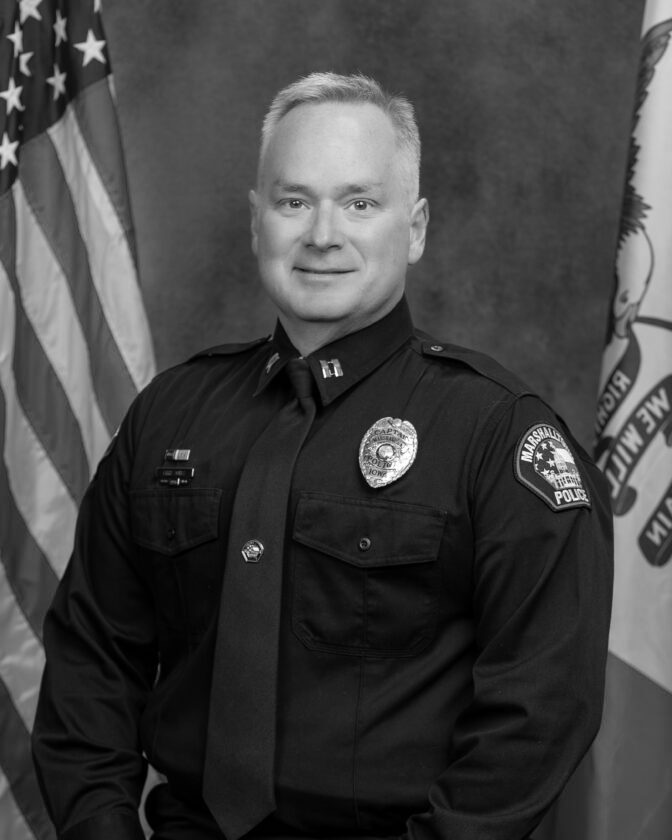
Christopher Jones is the chief of the Marshalltown Police Department.
Columnists
A new year’s resolution for our representatives: Vote for Iowans, not billionaires

Merry Christmas 2025
Aging firsts
I was so light headed and unstable on my feet, I had to use one of those electric carts at the supermarket. A ...
Leading change through collaboration
The mental health crisis calls I dread — and why I keep answering them
Since my husband and I went public with our family’s story about our son’s severe mental illness, my phone, ...