Liberty for one drug lord, but a death sentence for some
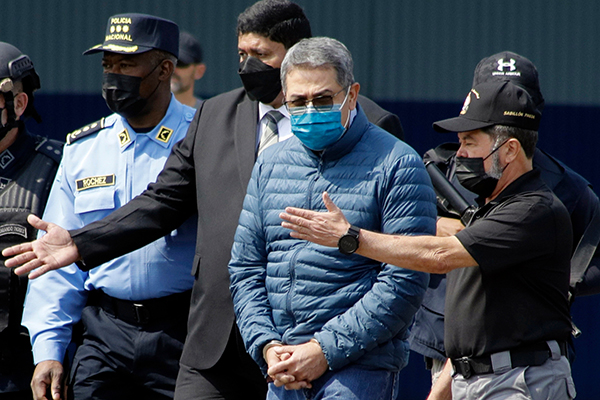
AP photo Former Honduran President Juan Orlando Hernandez, second from right, is taken in handcuffs to a waiting aircraft as he is extradited to the United States, at an Air Force base in Tegucigalpa, Honduras on April 21, 2022.
There seems to be a lack of consistency — if not outright contradictions — in the president’s messaging on drug trafficking into the United States.
Recent news headlines bear out the disconnect between what the president says and what he does.
One thing is certain: Donald Trump’s mixed messaging is leading many Americans to conclude that our nation continues to lack a coherent federal strategy for dealing with the scourge of illicit drugs.
See what you think about these questions of death and liberty.
Inconsistency #1
President Trump ordered the use of U.S. military drones to attack more than 20 small boats since early September, killing about 80 suspected drug couriers on the Caribbean Sea. The administration said the boats were hauling illegal drugs to the United States from Venezuela.
“We’re going to take care of that situation,” the president told U.S. military members in a Thanksgiving day video call. “We warn them: Stop sending poison to our country.”
Trump accused Venezuelan President Nicolas Maduro of direct involvement with what the White House described as drug cartel “narco-terrorism” that kills thousands of Americans annually.
Inconsistency #2
On Friday, while Iowans watched football games or shopped for holiday bargains, President Trump announced an early Christmas gift to the former president of the Central America nation of Honduras, a “full and complete pardon.”
Upon receipt, Juan Orlando Hernandez, 55, will walk away a free man no longer subject to a 45-year prison term that followed his conviction in the United States last year on charges of drug trafficking to the U.S.
The conviction did not arise from a few grams of cocaine hidden in Hernandez’s suitcases. Instead, U.S. officials said he was running another “narco-state” that protected traffickers as they moved at least 400 tons of cocaine from South America through Central America and into the United States.
The street value of those drugs exceeded $10 billion, federal officials said at the time.
Prosecutors accused Hernandez, who was Honduras’ president from 2014 to 2022, of accepting millions of dollars in bribes from drug traffickers and in return provided them with protection from arrest and prosecution.
Among those accused of paying bribes was the notorious Mexican drug cartel leader Joaquin Guzman, known as “El Chapo.”
U.S. prosecutors said Hernandez “paved a cocaine superhighway to the United States” by using Honduras police and military to guard drug shipments.
Hernandez was found guilty in 2024 following a trial in New York City. The investigation of him began during the first Trump administration. The charges and trial occurred during Joe Biden’s presidency.
Prosecutor Jacob Gutwillig described Hernandez at the sentencing hearing as a man “polluting this country with incomprehensible amounts of poison.” He said Hernandez “abused his power as the president of Honduras to send incomprehensible amounts of cocaine to the United States.”
In recent days, Trump explained his rationale for the pardon. He said Hernandez’s conviction was a “setup.” Hernandez was “treated very harshly and unfairly” by the U.S. government.
“They gave him 45 years because he was the president of the country. You could do this to any president of any country,” Trump said.
U.S. District Judge P. Kevin Castel, who handed down the lengthy prison sentence, called Hernandez “a two-faced politician hungry for power” who masqueraded as an anti-drug crusader while partnering with and protecting drug traffickers.
The judge, a President George W. Bush appointee, said the prison sentence should serve as a warning to “well educated, well dressed” people who gain power and think their status insulates them from justice.
Given his prominence, the Hernandez pardon would attract attention whenever it occurred. But considering its timing, the contradiction the pardon creates is unmistakable.
It comes as President Trump dials up his rhetoric about Venezuelan drug-runners and warns that the U.S. is prepared to take the drug fight “onto the land,” a thinly veiled threat of war against Venezuela and the Maduro government. Simultaneously, the U.S. Navy moved an aircraft carrier strike force into the Caribbean as a show of force toward Venezuela.
The drone assaults on small vessels in the Caribbean also represent a dramatic change in the United States’ longstanding strategy for combatting drug trafficking. In the past, the U.S. Coast Guard intercepted and boarded boats suspected of carrying drugs.
The Coast Guard typically confiscated the drugs, detained the boat occupants and handed them over for questioning in the hope of building criminal cases against the drug ringleaders.
The White House strategy presents another remarkable inconsistency:
Consider that Juan Orlando Hernandez was sentenced to 45 years in prison after a federal court jury rendered its unanimous verdict after listening to the evidence both sides presented during the public trial.
We call that due process.
But, for the 80-some men killed on those small boats in the Caribbean, our government did not accord them similar treatment.
No charges and arraignments began court proceedings against the suspected criminals. The accused did not receive public trials or face judgments rendered by juries of ordinary Americans. No unanimous verdicts of guilt or innocence were returned, and no judges handed down punishment upon conviction.
Instead, the Trump administration bypassed all due process and went directly to punishment. In at least 80 cases, the U.S. government imposed the death penalty. This contradiction perverts Patrick Henry’s Revolutionary War cry: “Give me liberty or give me death.”
For in this modern drug war, Juan Orlando Hernandez receives liberty after his conviction, while 80 sailors get death without a trial.
——-
Randy Evans is the executive director of the
Iowa Freedom of Information Council. He can be reached
at DMRevans2810@gmail.com.
Columnists
Liberty for one drug lord, but a death sentence for some
Trump’s War on Drugs could be lunacy
Since President Richard Nixon declared a “War on Drugs” in 1971, federal, state and local governments have ...
Welcome back, inflation!
In 2024, Donald Trump repeatedly promised that “a vote for Trump means your groceries will be cheaper.” He ...
Europe has made itself an afterthought
In the contention over the U.S. peace plan for Ukraine, the Europeans are in their accustomed role — carping from ...

Grateful to be an Iowan